

When you think about it, building a home gym is the ideal end game for nearly all fitness enthusiasts. We dream of a gym with only the equipment we want, no commutes, no waits, no membership fees, great music and 24 hour access– an iron paradise. And many have made it their mission to bring that heaven to earth by investing in their own space. Maybe you’re one of them– if so I commend you. But whether you’ve just begun your journey or have years under your belt, you have or will run into one inevitable conclusion: designing a home gym is not as straight-forward as it seems.
Sure, anyone can buy and furnish fitness equipment for their homes, but there’s a level of nuance that (without awareness and preparation) can cost you time, a lot of money, and even your health. Many people rush into the setup process and run into a pit of avoidable errors that create frustrating and unsafe setbacks within weeks. I’m not saying this to deter you, but the reality is that home gym design mistakes are much more common than people expect.
Poor planning at the design stage can lead to wasted money, wasted space, and even serious injury. Whether you’re converting a garage, finishing a basement, or carving out a corner of a spare room, the decisions you make before a single weight plate hits the floor will define the quality of your training environment for years to come.
This guide covers ten of the most damaging home gym design mistakes — what they look like, why they happen, and exactly how to avoid them.
1. Poor Lighting Choices: Too Dim or Too Harsh
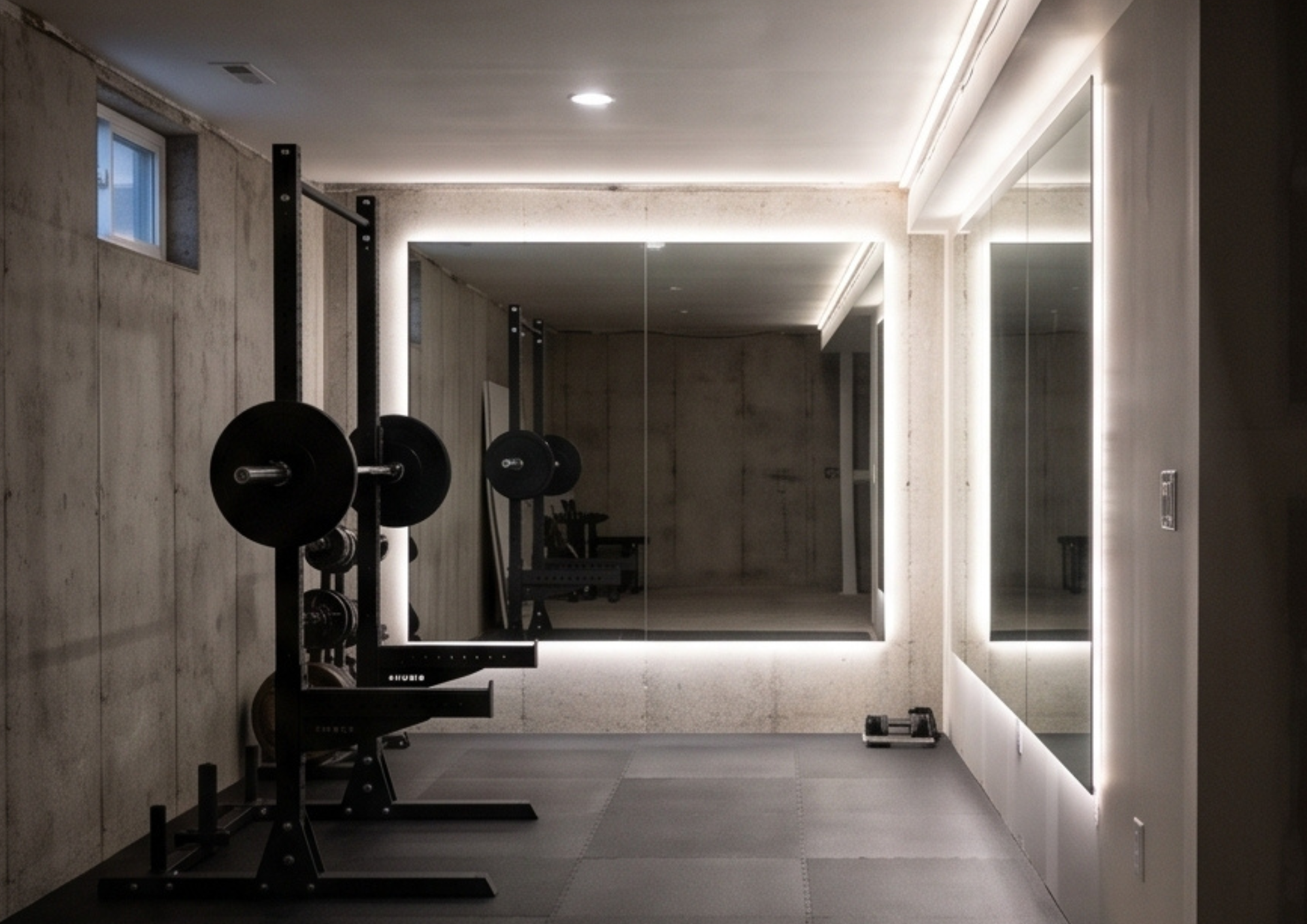
There’s a reason we’re starting this list with lighting; it’s a factor that has the least tangible effect on your space but some of the greatest influence on your workouts. It’s also one of the first places people go wrong. Many gym builders either repurpose existing lighting — a single overhead bulb in a garage or a couple of recessed cans in a basement — or swing to the opposite extreme and install blinding industrial LEDs that create harsh shadows and eye strain.
Neither extreme works. Dim lighting creates real safety hazards. When you can’t see clearly where your feet are relative to a barbell, or you can’t spot the weight stack labels at a glance, you’re setting yourself up for errors. It turns out dim lighting is also great for killing motivation. Numerous studies on environmental psychology have shown that low-light spaces reduce energy levels and mental arousal, exactly the opposite of what you want when you’re trying to push through a heavy set.
On the flip side, overly harsh lighting — particularly bare LED strips or high-kelvin fixtures mounted directly overhead — creates uncomfortable glare, deepens shadows in ways that distort depth perception, and makes it harder to check your form in mirrors.
Practical Tip
The ideal home gym lighting strategy uses layered illumination: bright, cool-white overhead lighting (4000K–5000K color temperature) to cover the general space, supplemented by directional lighting aimed at specific zones like the squat rack or lifting platform. LED panel lights or high-bay LED fixtures work exceptionally well in garages and basements. If your space has any natural light potential — windows, skylights, glass block — take full advantage of it.
Aim for a minimum of 50 foot-candles of illumination across the entire workout floor. Install dimmer switches if you want flexibility for stretching, yoga, or lower-intensity sessions. And never position a fixture directly above a bench or rack where the glare will hit your eyes at the top of a lift.
Related Article: Best Home Gym Lighting Ideas (And Why They Matter)
2. Wrong Flooring for the Space and Activity Type

It’s fitting that, in regards to home gym design mistakes, the first concerns what’s above you (light) and the second focuses on what’s beneath you– flooring. Flooring is of great importance on so many levels because it is your literal and metaphorical foundation– yet it’s one of the most overlooked aspects of the entire setup. In an effort to focus on expensive fitness equipment, many are guilty of laying down the cheapest tiles they can find– installing flooring that’s completely wrong for their primary activity, or ignoring flooring entirely and working out on bare concrete.
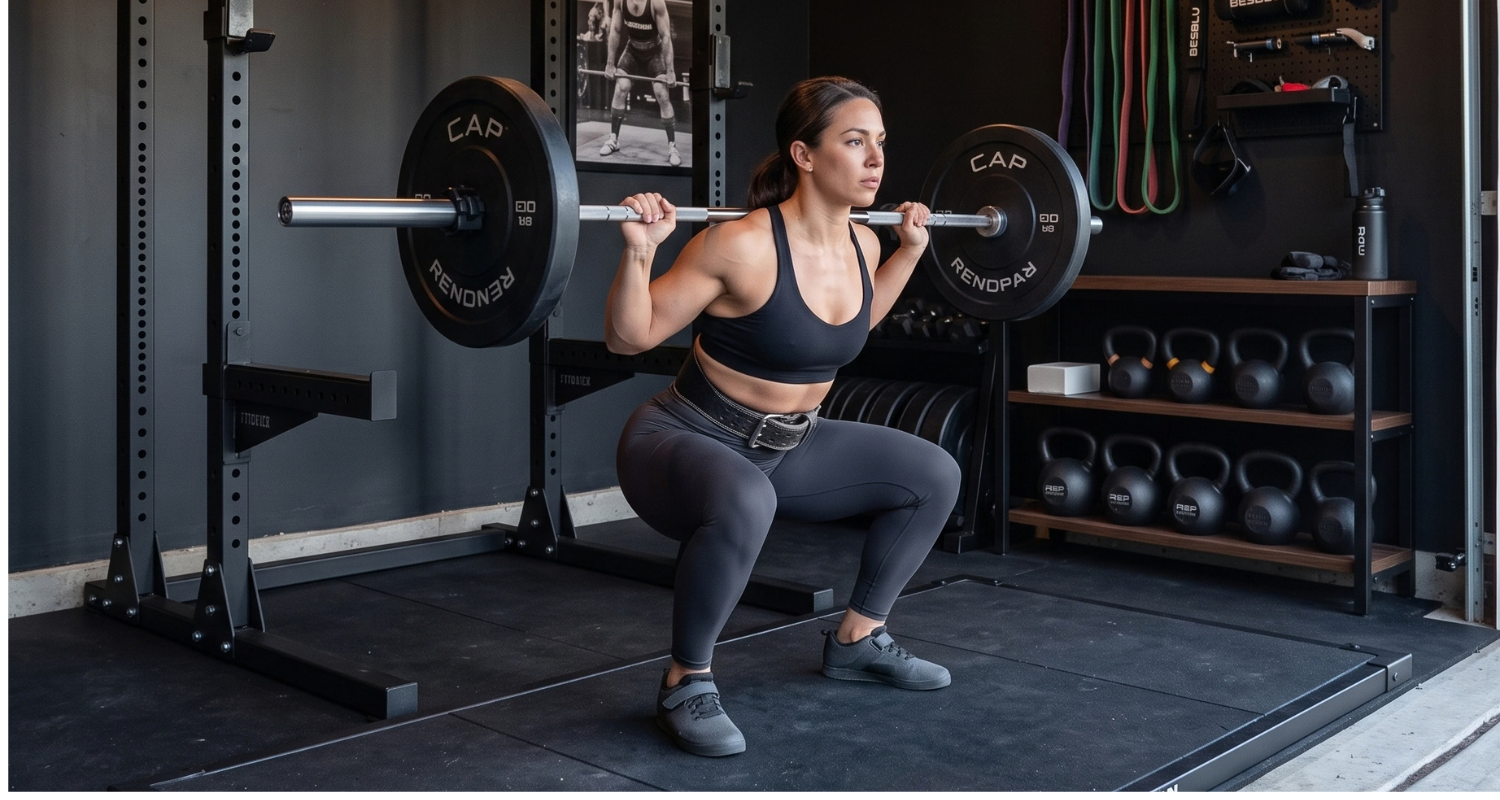
To do right by your home gym, you have to choose your flooring based on what you’re using the space for. This approach requires thought and an understanding that rubber tiles are not the answer to every home gym setting. Powerlifters and Olympic weightlifters who are dropping heavy loads need thick, dense rubber flooring — at minimum 3/4 inch, ideally a full inch or more in the lifting zone — that can absorb repeated high-impact drops without breaking down. Budget foam puzzle tiles won’t cut it here; they compress, shift, and deteriorate quickly under serious loads.
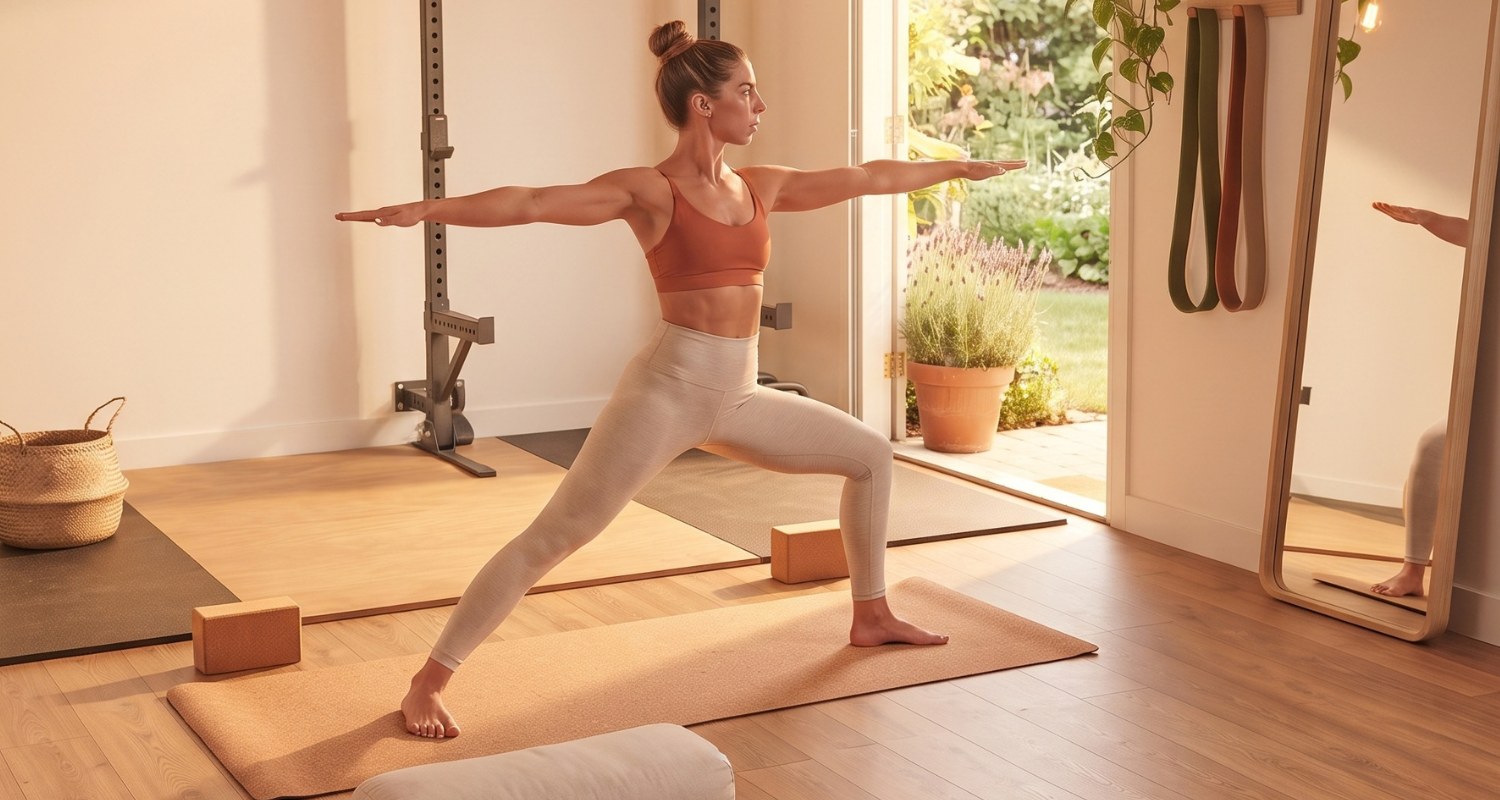
On the other hand, if your space is primarily for cardio equipment, yoga, or bodyweight training, hard rubber can actually be counterproductive. For yoga and mobility work, a smooth, grippy surface with some give is preferable. For treadmills and ellipticals, vibration dampening matters more than drop resistance.
Another major mistake is ignoring the subfloor condition before installation. Bare concrete is cold, unforgiving on the joints, and becomes dangerously slippery when sweat hits it. But if your concrete has moisture issues — common in garages and basements — laying rubber or foam flooring directly over it can trap moisture, leading to mold, mildew, and flooring that eventually buckles or smells.
Practical Tip
Always check for moisture issues before you install anything. Use a vapor barrier where needed, and select flooring products rated for below-grade applications if you’re in a basement. For the lifting area, invest in commercial-grade rubber flooring. For the rest of the space, interlocking rubber tiles in the 3/8-inch range provide a solid balance of comfort and durability.
Related Article: The Best Flooring for Home Gyms: Rubber, Foam, or Carpet?
3. No Designated Zones: The Chaos vs. Organization Problem
Walk into a well-designed commercial gym and you’ll immediately notice how the space is divided. Free weights over here, cardio over there, stretching zone in the corner, machines along the perimeter. That layout isn’t arbitrary — it’s the result of deliberate planning around how people move, what they need near them, and how to minimize conflicts between different types of training.
Many people throw this step out the window completely and repeat this home gym design mistake religiously. They see equipment placement through the lens of a “where-ever it fits” policy. The space evolves (or should I say devolves) into an incohesive mess that lacks any semblance of rhythm or flow.
The result is a space that feels chaotic and frustrating to use, which directly impacts how often you actually train in it. Research into behavioral design consistently shows that friction in our environment reduces follow-through on intended behaviors. A disorganized gym creates friction. Less friction means more training.
Practical Tip
Before a single piece of equipment enters your space, do yourself a favor and sketch out designated zones on paper (or use a free room planner tool). Common zones in a well-designed home gym include:
- A lifting zone with the rack, barbell, and weight storage immediately adjacent
- A cardio zone for treadmill, bike, rower, or jump rope — with enough clearance around each machine
- A functional training area with open floor space for kettlebells, bands, and bodyweight movements
- A stretching and recovery corner with a mat, foam rollers, and mobility tools
Keep the floor plan logical: things you use together should be near each other, and high-energy zones (like heavy lifting) should be separated from recovery or low-intensity areas. Dedicated zones also make storage intuitive — everything has a home, and the space stays clean between sessions.
Related Article: How to Organize a Home Gym (Solutions that Work)
4. Ignoring Traffic Flow and Safety Clearances
Every piece of gym equipment has a minimum safety clearance requirement — the amount of open space needed around it to use it safely and to exit quickly if something goes wrong. Most home gym builders ignore these requirements entirely, packing equipment in as tightly as possible to maximize the number of machines in the space.
This is a costly mistake, and for more than just the reason of comfort or aesthetics. As you can imagine, a crowded, congested gym floor is an injury waiting to happen. A treadmill positioned too close to a wall means that if you slip, you’re thrown directly into it. A power rack without enough clearance around it to drop weights safely means someday it may fall on you instead. A barbell loaded on a rack needs clear space on both ends for loading and unloading — a minimum of 18 to 24 inches beyond the end of the bar on each side. A cable machine with inadequate front clearance limits the range of exercises you can perform and makes the machine functionally useless for anything but the most basic movements.
Floor Plan Guidance
General safety clearance guidelines to follow:
- Power racks and squat stands: 24 inches on each side and at least 36 inches in front and behind
- Treadmills and rowing machines: 6 feet of clear space behind the machine for emergency dismounts
- Free weight areas: minimum 3 feet of usable floor space per person during a session
- Overhead movements (presses, pull-ups): verify ceiling height clears your full reach by at least 12 inches
Traffic flow is equally important. Think about how you move between zones during a workout. If getting from your rack to your dumbbell rack requires squeezing between machines, you’re going to knock something over eventually — or skip the supplementary work entirely because it’s too much hassle. Main pathways through the space should be wide enough to walk comfortably without turning sideways.
5. Bad Mirror Placement: Behind a Rack Is Dangerous

I bet you weren’t thinking about mirror placement when reading this list! Or maybe you were, but for most home gym owners it’s often (and understandably) overlooked. The vast majority of us don’t see mirrors for what they actually are– legitimate functional tools in home gyms. And as a result they become a chronic home gym design mistake. We forget that checking our form during squats, deadlifts, rows, or pressing movements allows for real-time self-correction that can prevent injury and accelerate progress. This is why serious lifters use mirrors, and it’s why commercial gyms cover their walls with them.
The critical mistake in home gyms is mirror placement, and the most dangerous version of this error is placing a mirror directly behind a power rack or squat stand.
Here’s why this is so dangerous: if a mirror is directly behind a rack and a bar slips, a safety catch fails, or a lifter loses control of a loaded bar, the barbell can travel back and make contact with the mirror. Shattering a full-length mirror behind a heavy barbell doesn’t just create a mess — it creates an immediate and severe laceration risk during one of the most physically vulnerable moments of a lift. In a worst-case scenario, the lifter is already on the floor or off-balance when the glass breaks.
Practical Tips
Mirrors should be positioned on the side walls relative to a rack, never directly behind it. If your layout requires mirrors on the wall behind the rack due to space constraints, opt for acrylic mirror panels instead of glass — they’re shatter-resistant, lighter, and just as functional. Acrylic mirrors are also a better choice for any wall within striking range of free weights or heavy equipment.
Additional mirror placement guidelines: position mirrors so they’re usable while standing at the correct distance from the equipment, not just visible from directly in front. Angled or split mirror configurations often provide better sightlines across multiple zones than a single solid wall of mirrors.
6. No Climate Control Planning
I’m sure you can imagine the terrible scenarios that await any home gym without proper climate control. And as you can also imagine, a home gym that’s 95 degrees in July and 35 degrees in January is a home gym you won’t use. Climate control is one of the most frequently skipped considerations in home gym planning, especially for garage conversions — and it’s one of the most expensive mistakes to correct after the fact.
Temperature and humidity affect not just comfort, but performance and safety. Exercising in excessive heat accelerates fatigue, raises heart rate artificially, and dramatically increases the risk of heat exhaustion. Cold temperatures reduce muscle pliability and increase injury risk, particularly for lifts that require a long warm-up period to perform safely. Excessive humidity — common in basements — damages equipment through corrosion and rust, degrades rubber flooring, and creates an environment where mold and mildew can take hold.
Before you commit to a gym location, check or plan for the climate realities of that space across all four seasons. Garages in northern climates can drop well below freezing in winter without insulation and heating. Basements in humid regions can run 70–80% relative humidity in summer without dehumidification. Both scenarios make a space unusable without intervention.
Four Seasons Solutions
Here are a few tips that will help to keep your gym comfortable year round:
- Insulate walls, ceilings, and garage doors before installing any equipment — it’s a lot cheaper to insulate during the build phase than to add it later
- Install a dedicated mini-split system for both heating and cooling — these are efficient, quiet, and relatively affordable for a single-room application
- Add a commercial-grade dehumidifier if your space runs humid — aim to keep relative humidity between 40–60% for both comfort and equipment longevity
- Install a ceiling fan or box fans for air circulation even in climate-controlled spaces — moving air dramatically improves perceived comfort during intense training
Don’t forget ventilation. A sealed space where you’re generating high heat and carbon dioxide through intense exertion needs fresh air exchange. If your gym is in a converted interior room without windows, plan for mechanical ventilation.
Related Article: How to Ventilate Your Garage in the Summer
7. Choosing Aesthetics Over Function

Social media has created a generation of home gym builders more focused on how the space looks in a photo than how it performs as a training environment. This shows up in a dozen ways: choosing expensive equipment that photographs beautifully but has poor ergonomics, prioritizing a color scheme over practical flooring choices, buying matching equipment sets instead of selecting each piece on merit, or dedicating wall space to decorative elements instead of functional storage.
None of this is to say that aesthetics don’t matter. A space you enjoy spending time in is a space you’ll actually use, and there’s real psychological value in having a gym that energizes and motivates you. The problem is when aesthetic priorities override functional ones.
The most common version of this mistake is buying equipment that looks great but trains poorly. A sleek, European-designed rack that photographs beautifully but has non-standard J-hook sizing, limited attachment compatibility, or inadequate weight storage becomes a daily frustration. A gorgeous hardwood-look flooring option that’s completely unsuitable for dropped weights prioritizes looks over every practical consideration.
Function Over Aesthetics
The right approach is function-first, aesthetics second. Choose equipment based on its engineering, adjustability, durability, and suitability for your specific training style. Then apply aesthetic preferences to the choices that don’t compromise function: wall color, lighting warmth, motivational signage, equipment finish options when the underlying specs are equivalent.
It’s also worth noting that a clean, organized, well-lit gym with well-chosen equipment looks excellent regardless of whether it was designed with Instagram in mind. Function produces its own kind of aesthetic when executed well.
8. Forgetting About Storage From the Start
If you’re planning a home gym without a second thought to storage units, then you’ve already committed a home gym design mistake. Storage is the element most home gym builders treat as an afterthought — something to figure out once everything is set up — and it’s consistently one of the biggest sources of long-term dissatisfaction with a space.
The problem compounds quickly. Resistance bands end up hanging off whatever is nearby. Foam rollers and mobility tools pile in a corner. Small plates get stacked on the floor next to the rack instead of on proper storage pegs. Jump ropes get tangled with pull-up straps. Chalk spills across everything. Within six months, a well-intentioned gym looks like a sporting goods store after a tornado.
The trick is to plan storage infrastructure at the design stage, before equipment is purchased. Ask yourself: where will every single item live when it’s not in use? Then build or install the storage solutions to support those answers before the equipment arrives.
Storage by Design
Key storage elements to incorporate:
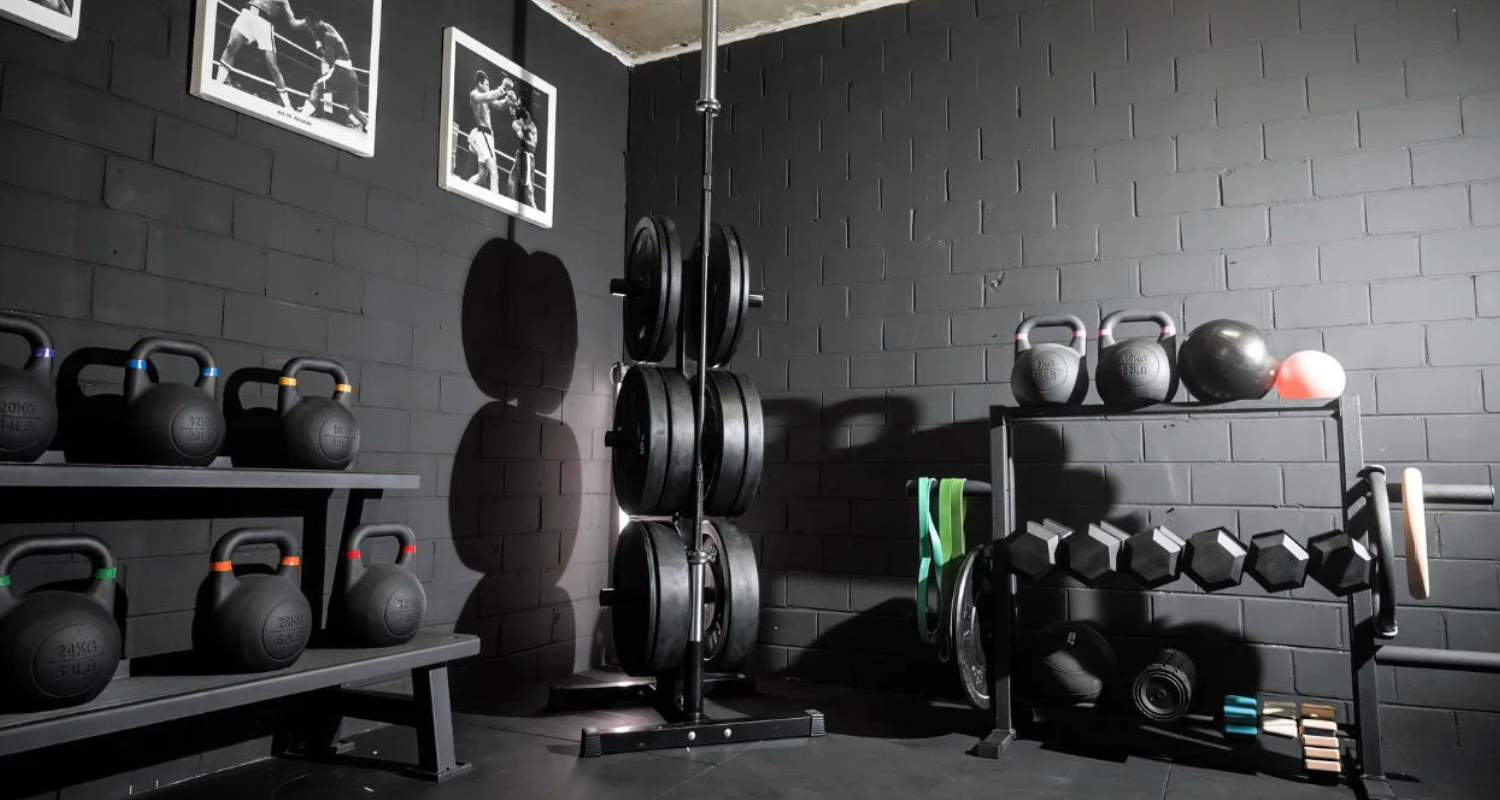
- Weight plate storage pegs or trees positioned adjacent to the rack and loading area — not across the room
- Dumbbell racks sized for your current set with room to expand
- Wall-mounted pegboard or vertical wall organizers for accessories, bands, and straps
- Designated hooks or hangers for jump ropes, TRX straps, and mobility tools
- A chalk station with a lidded container if you use chalk — keeps the mess contained
- Shelving for water bottles, towels, a small first aid kit, and training accessories
The best storage solutions put everything within arm’s reach of where it’s used. Plates should be near the rack. Kettlebells should be in or near the functional training area. Stretching equipment goes in the recovery zone. Distance between equipment and its storage is the enemy of a clean, functional gym.
9. Wrong Equipment for the Space Size
This is perhaps the most expensive home gym design mistake to correct, and it comes in two distinct flavors: buying equipment that’s too large for the space, and buying equipment that’s too small or limited for the type of training you actually do.
Oversizing is the more common problem. A full commercial-spec power rack might be 54 inches wide, 48 inches deep, and 90 inches tall. In a room with 8-foot ceilings, that rack leaves six inches of clearance above the chin-up bar — completely unusable for most people. In a 10×10 space, that same rack eats up most of the floor plan before you’ve added a single plate tree or bench.
Practical Tips
Before purchasing any major piece of equipment, measure your space in all three dimensions and compare those measurements against the equipment’s footprint plus minimum safety clearances. Be rigorous about this. Many people measure the floor space and forget to check ceiling height against overhead press requirements, or measure the room but forget to account for the depth the door swings into the space.
The opposite error — underbuying — is less common but equally problematic. Purchasing a half-rack when your training style requires full safety systems, buying a single adjustable dumbbell set when you need a full range for varied training, or getting a residential-grade treadmill for someone running 30+ miles per week will result in equipment that fails to meet your needs, breaks prematurely, or limits your programming.
The right equipment selection process:
- Define your training style first: powerlifting, bodybuilding, CrossFit, cardio, mobility — be specific
- List every exercise you intend to perform and the equipment each requires
- Map those equipment pieces against your space dimensions with safety clearances included
- Prioritize the highest-value pieces and plan expansion over time if the budget or space doesn’t support everything at once
Compact alternatives often match or exceed full-size equipment for home use. Folding racks, wall-mounted pull-up systems, and space-efficient cable units have improved dramatically in quality and are worth serious consideration for smaller spaces.
10. No Consideration for Noise and Neighbors
Noise is the home gym issue that causes the most conflict with the people around you — and the one that’s most likely to result in your gym being shut down entirely, either by a landlord, a homeowners association, or simple domestic necessity if other people in your household can’t tolerate the racket.
The sources of noise in a home gym are multiple and interact in complex ways. Impact noise from dropped weights or running on a treadmill transmits through the floor structure as vibration, which neighbors below experience as thumping and banging through their ceiling. Airborne noise from music, grunting, and mechanical equipment hum passes through walls. Equipment vibration — from motors, spinning flywheels, or shaking cable stacks — transmits directly through whatever structure the equipment is bolted to or resting on.
If you’re in an apartment or condo, dropping weights is effectively off the table without serious acoustic intervention — and even with mitigation, the structural transmission of repeated impact is very difficult to control completely. If you’re on an upper floor, deadlifts with bumper plates and a drop-friendly platform may simply not be possible without affecting the floor below in ways your neighbors will not accept.
In a house with a basement gym, impact noise travels up through the floor joists and into living spaces. In a garage gym, noise travels through the garage door, the shared wall with the house, and often directly outdoors — which matters if you train at 5 AM and your neighbors are 20 feet away.
Navigating Noise Control
Noise mitigation strategies that actually work:
- Thick rubber flooring (3/4 inch to 1 inch) as a first layer, with isolation pads under equipment that vibrates — treadmills, bike frames, and cable machines all benefit significantly
- Acoustic underlayment beneath rubber flooring to decouple the floor surface from the subfloor structure
- Deadlift platforms built with rubber-top layers that absorb drop energy before it hits the subfloor
- Equipment selection that minimizes noise: belt-drive bikes and rowers over chain-drive alternatives, quality treadmill motors that run quietly
- Training time awareness: if you’re in a situation where neighbors are legitimately affected, communicate proactively and time heavy sessions accordingly
Don’t forget your own household. If your gym is below a bedroom or adjacent to a home office, the noise your equipment generates at 5 AM or 9 PM will affect people you live with. Acoustic consideration is a form of respect — and it keeps your gym operational long-term.
Related Article: How to Soundproof a Home Gym Without Major Renovations
Final Thoughts: Planning First, Equipment Second
The common thread running through every home gym design mistake on this list is the same: acting before planning. Equipment gets purchased before the space is measured. Flooring gets installed before moisture is checked. Mirrors go up before anyone thinks about where the rack is going. Lighting gets ignored entirely until the space is already full.
The home gyms that work — the ones people use consistently for years and genuinely love — are built in reverse order from the typical impulse purchase approach. They start with the space analysis: dimensions, ceiling height, climate, subfloor condition, noise constraints, and available power. Then they move to zone planning and traffic flow. After that, storage infrastructure. Then flooring. Then major equipment. Lighting and finishing details come last.
This order feels slow when you’re excited to get lifting, but it saves enormous amounts of money, frustration, and wasted space in the long run. The best home gym is not the one with the most equipment — it’s the one designed to match your specific training style, your specific space, and your specific life.
Avoid these ten home gym design mistakes, and you’ll build a space that doesn’t just look great on day one, but continues to serve your training goals for years to come.
Related Article: How to Set Up a Home Gym: The Complete Beginner’s Guide
Leave a Reply