
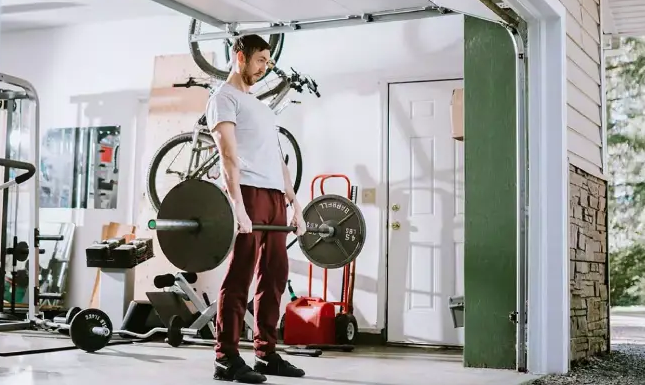
Can you imagine?: After 3 long years you’ve gathered enough coin, space, and equipment in your garage to create your ideal home gym. And it’s perfect; it’s got the power rack/ smith machine you’ve always wanted, turf space where you used to store the motorcycle, and powerful, adjustable LED lighting to flatter the amazing physique you’re developing for summer. Your garage gym is ready, your summer shred program is ready, you’re ready– until the first “hot” day of spring arrives. It came earlier than expected this year, and boy did it not hold anything back. In a matter of hours the sweltering heat managed to turn your perfect iron paradise into a hot box from Hell.
You can’t inhale without tasting every degree of the 110°F humidity, your workout benches burn your skin, your sweat pools at your feet with rapid speed, the unbearable heat causes your brain to pound within your skull– exercise is out of the question. How did this dream turn into a nightmare so quickly you wonder? It’s because in the process of building your sanctum you forgot one very crucial feature: garage gym ventilation.
The Need for Ventilation
It’s not as much fun to think about or purchase as fresh gym equipment, but a proper space for exercise doesn’t function without proper air-flow. Whether you’re serious about garage gym ventilation or even just want to work comfortably on a car or DIY project, understanding how to move air through your garage is essential– especially during those summer months.
This guide covers everything from the fundamentals of airflow to specific equipment recommendations, so you can keep your garage cool, safe, and functional all summer long.
Why Garage Ventilation Matters in the Summer
Garages, while a great addition to any home, do not prioritize comfort. The vast majority of them are designed with very little insulation or few to no windows to allow air to travel. On top of this, the concrete flooring only works to amplify heat even as the sun sets which translates to hot, uncomfortable flooring late into the day.
These factors lead to more than just an environment of discomfort, but can also lead to:
- Heat exhaustion or heat stroke especially while performing intense/ explosive movements or workouts
- Carbon monoxide buildup if a car is left running or if a generator or gas-powered equipment is inside
- Mold and moisture damage to stored items or wood framing after years of wear
- Degraded equipment like cracked rubber mats, warped wood or corroded metal
- Poor air quality from off-gassing chemicals like paint, gasoline or cleaning products
If the goal is to use your garage as a gym, you can see how many factors can hinder your workout experience without proper ventilation. It’s not just about comfort, in many cases it’s a matter of safety.
Understanding How Airflow Works in a Garage
Now that we have an idea of what’s at stake, we have to understand the basic principles of airflow in order to fix the problem. Remember this:
Hot air rises, cool air sinks.
It’s a simple concept but devastating in its consistency and impact. Effective ventilation utilizes this principle by creating pathways for hot air to escape near the top of the space while cooler air is drawn from the bottom.
This process is called cross ventilation or stack-effect ventilation, and will form the basis for every approach in this guide. This cycle creates a circuit of sorts; the cool air enters low to the ground, heats up, rises, and exits high. If this process is hindered at any point, the system falls apart.
The second concept to tackle is air changes per hour (ACH)— which is how many times the total volume of air in your garage is replaced each hour. For garage gyms, you’ll want at least 6-10 ACH to keep a comfortable climate during hot summer months. A typical two-car garage is about 20 feet x 20 feet x 10 feet, or 4,000 cubic feet. That means maintaining 8 ACH requires moving 32,000 cubic feet of air per hour (533 CFM- cubic feet per minute). That math will come in handy when choosing fans and exhaust systems.

Step 1: Assess Your Current Ventilation Setup
In order to grasp the situation, take a walkthrough of your garage at the hottest point of the day and ask yourself:
- If the garage has any windows, can I open them?
- Is there any other doors other than the garage door (side entry door or one that leads into the house)?
- Are there any vents, roof vents, ridge vents or soffit vents above the garage ceiling
- Does the attic above the garage trap additional heat?
In most cases, attached garages only have a main door or side opening, which is not great for garage gym ventilation. Detached garages offer a little more flexibility since they can be modified to a greater extent without affecting the house directly.
Attention to detail will also go a long way in assessing your garage space– for example tracking where the sun hits your garage throughout the day. A west-facing garage door absorbs afternoon sun directly, making the interior hotter than one that faces north or east. This affects how aggressively you’ll need to ventilate.
Step 2: Maximize Natural Ventilation First
Before spending money on fans or HVAC equipment, maximize what you already have.
Open the Garage Door Strategically
The garage door is your biggest asset. Keeping it open during the cooler morning hours allows fresh air to flood in and reduces the baseline temperature before the heat of the day builds. Close the door in the early afternoon to trap that cooler air, then reopen it in the evening once outdoor temperatures drop.
This strategy works especially well for garage gym users who prefer to train in the morning or evening. Timing your workouts around natural temperature cycles reduces the ventilation burden considerably.
Add Windows If You Don’t Have Them
If your garage lacks windows, adding even one or two is a high-impact improvement. Windows near the roofline are particularly effective because they allow hot air to escape from where it accumulates. A window on the wall opposite the garage door creates cross-ventilation when both are open simultaneously.
If cutting into the wall isn’t an option, louvered vents — which are passive, always-open vents with angled slats to prevent rain intrusion — can be installed in the upper portion of the wall for a relatively low cost and without requiring a contractor in most cases.
Use Your Garage Door’s Built-In Gap
Many people don’t realize that propping the garage door open just 6–12 inches at the bottom provides meaningful airflow. You can use purpose-built garage door stops or even a simple piece of 2×4 lumber to hold it at a consistent height. This creates a low intake for cooler outdoor air while venting hot air from other openings higher up.
Step 3: Choose the Right Fans for Your Garage
Natural ventilation alone usually isn’t enough during peak summer heat. Mechanical ventilation — fans — is almost always necessary for a truly usable space.
Box Fans and Window Fans
The most affordable option, box fans and window fans work best when used in pairs: one pushing cool air in on one side, and one pulling hot air out on the other. Position the intake fan low and facing inward; position the exhaust fan high and facing outward. For garage gym ventilation on a tight budget, two 20-inch box fans running simultaneously can move 3,000–4,000 CFM combined — enough to adequately ventilate a one-car garage.
Best for: Budget setups, renters, or those needing a portable solution.
Pedestal and Tower Fans
These are better at circulating air within the space than they are at actual ventilation, but they’re excellent as a supplement. Positioned to blow directly on the person exercising or working, they create a wind-chill effect that dramatically improves comfort even when the ambient temperature is high.
Best for: Personal cooling during workouts; supplement to other ventilation strategies.
Whole-Garage Exhaust Fans (Wall-Mounted)
These are the workhorses of serious garage gym ventilation. A wall-mounted exhaust fan is permanently installed in the upper portion of an exterior wall and wired to a switch (or thermostat). They’re rated by CFM and can be matched precisely to your garage’s volume. Look for fans in the 1,500–3,500 CFM range for most two-car garages. Brands like iLiving, Air King, and Canarm make well-regarded options in the $80–$250 range.
Pair the exhaust fan with an intake opening — either the garage door cracked open, a window, or louvered vents near the floor — to complete the airflow circuit.
Best for: Permanent, hands-free ventilation; garage gyms and workshops that are used regularly.
Ceiling-Mounted Drum Fans
Large drum fans mounted to the ceiling joists are common in commercial garages and are increasingly popular in home gym setups. They circulate air throughout the entire volume of the garage and can be combined with wall vents for a complete ventilation system. They require a bit more installation work but are very effective in tall garages.
Best for: Large garages with high ceilings; spaces where floor and wall space is at a premium.
Step 4: Consider a Mini-Split or Portable AC for Extreme Heat
If you live in a climate where summer temperatures regularly exceed 95°F — think Texas, Arizona, Florida, or the Southeast — fans alone may not be enough, particularly for garage gym ventilation during high-intensity workouts. At a certain point, you’re just moving hot air around.
Portable Air Conditioners
Portable ACs are a decent middle-ground option. They require a vent hose routed to the outside (usually through a window or a hole cut in the wall), and they cool air by exhausting heat outdoors. A 12,000–14,000 BTU unit can cool a one-car garage reasonably well. However, they’re less efficient than permanent solutions, tend to struggle in poorly insulated spaces, and the exhaust hose limits placement options.
Best for: Renters; those who want a removable solution; moderate climates.
Ductless Mini-Split Systems
A mini-split is the gold standard for garage gym climate control. A single-zone 9,000–12,000 BTU mini-split can maintain a set temperature in a two-car garage regardless of outdoor conditions, and many units double as heat pumps for year-round use. Installation typically costs $1,500–$3,500 depending on labor rates in your area, but the unit itself can last 15–20 years.
For serious garage gym athletes, this is often the most worthwhile long-term investment, as it eliminates the need to plan workouts around weather conditions.
Best for: Dedicated home gyms; climates with extreme summer heat; year-round use.

Step 5: Address the Attic and Ceiling Heat Problem
A place most people wouldn’t think contributes to hot garages is the attic space above it. In many attached garages, the ceiling separates the living space from a small attic cavity that bakes in direct sunlight all day. This turns the ceiling itself into a radiant heat source.
Attic Ventilation
If your garage has an attic space above it, make sure it is properly ventilated with soffit vents and a ridge vent or powered attic fan. An unventilated attic above a garage can reach 150°F or more on a summer day, and all of that heat conducts down into the garage.
Insulation
Adding insulation to the garage ceiling — either spray foam or rigid foam board — dramatically reduces heat gain from the attic. R-13 to R-19 in the ceiling is a common recommendation for garages. This is especially worthwhile if you’re investing in a mini-split, as it reduces the cooling load and improves efficiency.
Reflective Insulation and Radiant Barriers
A radiant barrier — a foil-faced insulation product stapled to the rafters — reflects radiant heat before it can conduct into the garage. In hot climates, this can reduce ceiling surface temperatures by 20–30°F and significantly improve comfort even without active cooling.
Related Article: Minimalist Home Gym Setup: Solid Training With Less Equipment
Garage Gym Ventilation: Putting It All Together
For those specifically building or improving a garage gym, here’s a practical summary of the most effective approach:
Budget setup (under $200):
Two large box fans for cross-ventilation, one blowing in low and one exhausting high. Crack the garage door during workouts. Train in the morning or evening. Add a pedestal fan aimed at your workout area.
Mid-range setup ($200-$800):
Install a permanent wall exhaust fan (1,500–2,500 CFM) wired to a wall switch. Add louvered intake vents near the floor on the opposite wall. Install a pedestal fan for personal cooling. Add reflective insulation to the ceiling.
Premium setup ($1,500+):
Ductless mini-split for full climate control. Insulate the walls and ceiling. Add a wall exhaust fan for air changes when you want fresh outdoor air rather than cooled recirculated air. Seal gaps around the garage door with weatherstripping to improve efficiency.
Safety Tips for Garage Ventilation
- Never run a car, generator, or gas-powered equipment in a garage with the door closed, regardless of how good your ventilation is. Carbon monoxide is odorless and can be lethal within minutes.
- Install a CO detector in your garage, especially if it is attached to the house.
- Don’t store flammable chemicals (gasoline, paint thinner, propane tanks) near exhaust fan motors or any source of ignition.
- Check fan wiring periodically, especially in damp climates. Moisture can cause corrosion and create fire hazards in older wiring.
Final Thoughts
Having proper garage gym ventilation is both a necessity and the icing on the cake to any home gym. It will completely transform your space providing comfort during workouts which allows for consistency and ultimately greater value for your gym as a whole. If you don’t feel comfortable spending a lot of money upfront, start with the free or low-cost fixes; open windows and doors thoughtfully, incorporate passive vents, etc. For the serious garage gym owners, consider investing in proper ventilation– it will not only improve your gym experience but also save you money for years to come.
Regardless of your approach, remember that the best garage gym ventilation system is the one you’ll use consistently. Whether that means a pair of box fans or a full mini-split installation, the goal is the same: get hot air out, bring cool air in, and keep the air moving.

Leave a Reply