
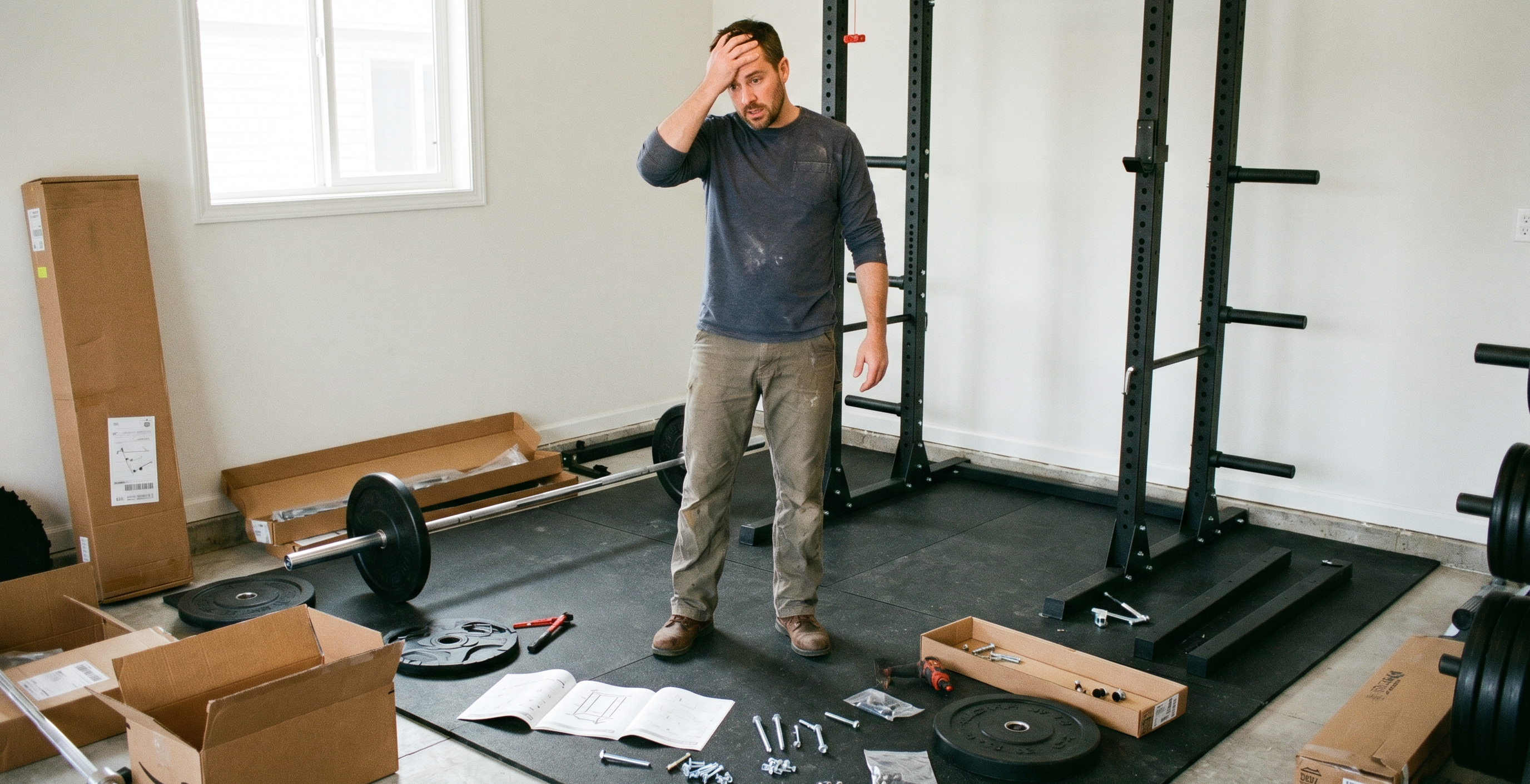
We’ve all heard the expression “learn from others’ mistakes”, and when it comes to building a home gym from scratch, it couldn’t be more relevant. There are few things more annoying (or costly) than jumping head-first into building your “iron paradise” only to find you wasted hundreds or even thousands of dollars on equipment- missteps that could’ve been easily avoided with prior knowledge or planning.
These are the home gym buying mistakes almost every first-timer makes — and the trainers who work with home gym clients see them constantly. The good news: every single one of them is avoidable. What follows isn’t a list of vague cautions. It’s the real, specific, “I wish someone had told me this first” guidance that turns a frustrating setup into the training environment your goals actually deserve.
Mistake #1: Ordering First, Measuring Never
This one accounts for more returns, more headaches, and more wasted delivery fees than almost anything else. A piece of equipment can look perfectly sized in a product photo and be completely impossible to move through your front hallway, down your basement stairs, or through your garage door.
Here’s what you need to measure before you buy anything large:
- Every doorway the equipment will pass through (including any turns in the hallway)
- Stairwells — width and ceiling height at the lowest point
- Your actual floor space, including clearance on all sides for safe use
- Ceiling height, especially for anything with an overhead component (pull-up bars, cable machines, rack uprights)
A standard interior doorway is 32–36 inches wide. Many power racks, treadmills, and cable machines are wider than that — or come in boxes larger than that. Measure the box dimensions, not just the assembled footprint.
✓ Action Step: Before you click “buy” on anything bulky, draw your space to scale on paper. Mark every doorway and obstacle. Then look up the product’s shipping dimensions (not just assembled size) and trace the path it needs to travel to reach its final spot.
Mistake #2: Buying Equipment That Doesn’t Match Your Goals
→ See also: How to Set Up a Home Gym: The Complete Beginner’s Guide
This is the mistake with the longest shelf life. A set of adjustable dumbbells and a bench is a complete training environment for someone focused on hypertrophy and fat loss. But if your goal is powerlifting, you need a barbell and plates. If you’re training for a marathon, you need cardio infrastructure, not a rack.

What I tell clients who are starting out: get clear on your primary training modality first. Not what you think you should be doing — what you’ll actually do consistently. Then build the equipment list around that.
The most common version of this mistake is buying based on what looks impressive rather than what matches the program. A cable machine is aspirational for a lot of people. But if you’re following a beginner barbell program, it’s a very expensive clothes rack.
✓ Action Step: Write down the three movements you’ll do most often in your training. Then build your equipment list backward from those movements. Everything else is secondary — add it later when you know it’ll get used.
Mistake #3: Impulse Buying “Cool” Equipment
You saw it on someone’s reel. It looked like it would transform your workouts. It arrived and you used it twice.
Novelty equipment — ab wheels, vibration platforms, battle ropes without anchor points, certain suspension trainers — has a high impulse purchase rate and a low long-term use rate. Not because it’s all bad, but because it’s bought emotionally rather than strategically.
The equipment that gets used isn’t always the most interesting-looking. It’s the equipment that fits your routine, serves your goals, and is convenient to access. A pull-up bar that’s already mounted and ready is more effective than a set of rings you have to rig up every session.
✓ Action Step: Apply a 72-hour rule to any equipment purchase that wasn’t already on your planning list. If you still want it after 72 hours and you can answer “what movement does this replace or improve?” — then it earns its place.
Mistake #4: Ignoring Weight Capacity Specifications
→ See also: Best Home Gym Flooring: Rubber vs Foam vs Mats
Weight capacity specs exist for a reason, and ignoring them is both a safety issue and a financial one. This comes up in two main scenarios:
Flooring: Rubber flooring has weight-per-square-foot limits. If you’re stacking a loaded rack and a full plate set in one area without distributing the load, you can damage subfloor, crack concrete sealant, or create structural stress over time.
Equipment itself: Benches, racks, and cable systems all have rated load capacities. A bench rated for 600 lbs sounds like plenty — until you account for dynamic loading (the impact force of dropping a weight is significantly higher than its static weight). A bench that technically holds your working weight might not hold up to years of heavy use.
Weight capacity also matters for pull-up bars, especially door-frame-mounted models. These are often rated for 250–300 lbs, which sounds like enough until you factor in kipping movements or the force of a dynamic hang.
✓ Action Step: Always check weight capacity on benches, racks, bars, and flooring. Then add at least 20% to your current working weights as a safety buffer. If you’re planning to progress (and you should be), buy ahead of where you are now.
Mistake #5: Not Reading the Return Policy Before You Buy
Return policies in the fitness equipment industry are genuinely terrible compared to most retail categories — and most people don’t find this out until they’re trying to return a 200-lb treadmill.
Common policy structures to watch for:
- Restocking fees — often 15–25% of purchase price, charged even if the item arrived damaged
- “White glove delivery” as a non-return condition — if you paid for assembly, some retailers consider the item “used” and non-returnable immediately
- Short return windows — some major fitness retailers offer only 30 days, and the clock starts on the shipping date, not the delivery date
- Customer-responsible return shipping — on a 300-lb item, that’s hundreds of dollars
Some brands have excellent policies. Others are designed to make returns prohibitively difficult. This isn’t cynicism — it’s just the reality of the industry.
✓ Action Step: Before purchasing, find the return policy page (not the FAQ — the actual policy), search “[brand name] return policy problems” to see real customer experiences, and confirm exactly what happens if the item arrives damaged.
Mistake #6: Underestimating Assembly Difficulty
A product listing that says “easy assembly” has a very optimistic definition of “easy.” What it often means is: two adults, several hours, a YouTube tutorial, and ideally someone with spatial reasoning.
Assembly difficulty matters for several reasons:
- Time: A complex assembly that takes four hours is four hours you’re not training — and if you hit a frustrating point mid-assembly, motivation takes a real hit
- Tools: Many pieces of equipment require tools not included in the box — specific socket sizes, torque settings, or power tools
- Accuracy: Incorrectly assembled equipment — bolts not fully torqued, cables run wrong — is a safety hazard
- Space during assembly: You need room to lay out every piece before it goes together. A rack that assembles to 4×4 feet might need a 10×10 area to build
✓ Action Step: Search “[product name] assembly” on YouTube before you buy. Watch real customer assembly videos, not brand-produced ones. Note how long it takes, how many people are involved, and what tools they use.
Mistake #7: Buying Too Much Too Soon
→ See also: Painful Budget Home Gym Mistakes That Can Cost You Thousands
This is the mistake that kills home gyms before they have a chance to become habits. Buying everything at once — the rack, the bar, the plates, the bench, the cables, the cardio machine — means that before you’ve ever trained in your space, you’ve already spent thousands of dollars and filled the room.
Then one of two things happens: you feel overwhelmed and the room becomes storage, or you use it and realize half of what you bought doesn’t serve your actual training.

The trainers who see the most successful home gym builds consistently say the same thing: start with the equipment for your first 12 weeks of training. Just that. Let the space earn its expansions.
A minimum viable home gym for most beginner-to-intermediate lifters:
- Adjustable dumbbells (or a small fixed set)
- A quality mat or small rubber flooring area
- A pull-up bar or suspension trainer
- A bench (optional but highly versatile)
✓ Action Step: Build your first equipment list for a 3-month training block, not a forever gym. Ask yourself: what do I need for the next 90 days? Add everything else to a wishlist and revisit it after you’ve trained consistently.
Mistake #8: Cutting Corners on the Equipment That Actually Matters
There’s a meaningful difference between being budget-conscious and being cheap in the wrong places. Some equipment can be bought affordably without meaningful quality loss. Other equipment should never be the place you try to save money.
Worth buying budget:
Resistance bands, ab mats, foam rollers, kettlebells (cast iron is cast iron), fixed dumbbells from a commercial source.
Never cut corners on:
- Barbells — a low-quality barbell bends, has poor whip, has collars that slip, and can fail under load. This is a safety issue, not just a performance one
- Power racks and squat stands — cheap racks flex, have poor weld quality, and have been known to fail under heavy use
- Flooring — inadequate flooring damages your subfloor, creates noise issues, and budget rubber flooring degrades quickly and often off-gasses badly
A good barbell will last 10–15 years of heavy use. A cheap one might last two. The math on cost-per-year almost always favors the quality investment.
✓ Action Step: Identify the one or two pieces of equipment most central to your training. Spend well there. Then find savings on everything less critical to your safety and performance.
Mistake #9: Buying Without Researching the Brand
The fitness equipment industry has a significant problem with brand proliferation — dozens of companies selling near-identical products at a range of price points, with very different build quality hiding behind similar marketing language.
What to look for when researching a brand:
- How long have they been in business? New brands are high risk — if they’ve been selling fitness equipment for less than 3 years, their long-term quality is unproven
- Do they manufacture or just resell? Many “brands” are resellers of generic overseas manufacturing with a logo applied
- What does warranty support actually look like? A 2-year warranty is worthless if the company takes 6 weeks to respond to a claim
- Are replacement parts available? Equipment breaks. If you can’t get replacement cables, pulleys, or upholstery in two years, the warranty is irrelevant

Established brands with strong reputations in the home gym space have earned those reputations over years of customer feedback. That credibility is worth paying for.
✓ Action Step: For any major equipment purchase, spend 30 minutes on Reddit’s r/homegym community searching the brand name. The candid feedback there — good and bad — is more useful than any review site.
Mistake #10: Ignoring Reviews — or Trusting the Wrong Ones
Product reviews are one of the most useful tools available to home gym buyers, and one of the most misused. The mistake isn’t failing to read reviews — most people read reviews. The mistake is reading them wrong.
What to ignore:
- 5-star reviews left immediately after delivery, before meaningful use
- Reviews that praise packaging and delivery speed — this tells you nothing about the product
- Review scores on the brand’s own website — heavily curated
What to look for:
- Reviews left 6–12 months after purchase, discussing long-term durability
- Reviews from users with a similar use case to yours
- Specific negative reviews that describe the same problem repeatedly — a pattern is a data point
- Reviews that mention assembly, customer service response, and wear over time
The best reviews for home gym equipment are found on Reddit, YouTube comment sections for in-depth review videos, and verified purchase reviews on third-party retailers — not the brand’s own page.
✓ Action Step: For your top two or three equipment candidates, search “[product name] long-term review” and “[product name] problems” specifically. You want to know what goes wrong, not just what people like.
Build It Right the First Time
The home gym buying mistakes on this list aren’t just inconveniences — each one has a cost. In money lost to bad returns. In time spent dealing with equipment that doesn’t fit, doesn’t work, or doesn’t match what you actually train for. In motivation drained by a space that feels chaotic instead of intentional.
Your home gym is not a convenience purchase. It’s an infrastructure decision. It’s the environment where you’ll show up — or won’t — on the days when motivation is low and the gym down the road feels very far away. Getting it right from the start means building a space that doesn’t just hold equipment, but actively supports who you’re working to become.
Avoiding these home gym buying mistakes is how you protect that investment before you make it. Research the brands. Read the return policies. Measure everything twice. Start smaller than you think you need to.
And if you want a structured starting point that makes sure nothing gets missed, download the free SOMA Home Gym Planning Checklist — it walks you through every decision, in the right order, so your first purchase is one you won’t regret.

Leave a Reply