

It’s time. You’ve done the research. You’ve watched the YouTube videos, scrolled through the Reddit threads, and you’re left with two names replaying in your mind and one impending choice: Rogue, Rep Fitness, and which one should you choose? You haven’t reached this dilemma from lack of due diligence— you’ve reached it because both seem like great options, but few resources are available to tell you which one is right for your situation.
If that’s what you’re looking for then I’ve got you.
The rogue vs rep fitness power rack debate is one of the most searched, most argued-over questions in the home gym space — for good reason. It says a lot about two brands that have taken center stage with products the industry backs for their quality and reliability. Products you plan to invest real money in. Choose right and you’ll have a unit that will be the cornerstone of your home gym years (maybe even decades) to come. Get it wrong and you’re either overpaying for a rack that’s more than you need, or you’re under-buying and compromising on the equipment that your heaviest, most important lifts depend on.
If this sounds like a decision you’re concerned about, let’s cut through it together.
Rogue and Rep Fitness: Understanding What You’re Actually Choosing Between
Before we get into specs and price comparisons, it’s important to discuss who these two brands actually represent. Understanding where both brands come from will give context to which company and product you choose to invest your money in.
Rogue Fitness
Rogue was built in Columbus, Ohio, in 2006 and became the official equipment supplier for the CrossFit Games. That origin story matters. Rogue’s identity is rooted in competitive performance, American manufacturing, and a reputation built in front of cameras and crowds. Their racks are made in the US, quality-controlled in-house, and backed by a brand that has staked its entire reputation on durability. When someone says “buy once, cry once,” Rogue is what they mean.
Rep Fitness
Rep came up later and took a different path — direct-to-consumer, overseas manufacturing (primarily in China and Taiwan), and pricing that makes the home gym accessible to people who aren’t willing to spend $800–$1,200+ on a rack alone. What Rep figured out is that a well-engineered rack at a fair price doesn’t have to feel like a compromise. And over the last several years, they’ve built a genuinely loyal following by delivering on that promise more often than not.
Both brands are the real deal. However, neither brand is the obvious choice. That being said, keep their brief backstories in the back of your mind.
Action Step: Before you even look at specs, decide what your non-negotiables are — budget ceiling, expected load, and whether made-in-USA matters to you personally. That decision tree will filter out one of these brands faster than any spec sheet.
Mapping the Lineup: Which Models Should We Be Comparing?
While both brands are equally legitimate, there are levels to the models of both inventories. Both brands offer multiple tiers, and comparing a Rep entry-level rack to a Rogue Monster Series rack is like comparing a Corolla to a Tacoma — they’re not in the same category. So let’s be clear about what maps to what.
Rogue’s Lineup:
Monster Lite Series (R-3, R-4):
2×3 inch, 11-gauge steel, the “accessible” Rogue — still premium, but the sweet spot for most serious home gym owners

Monster Series (R-6, R-7, R-8):
3×3 inch uprights, commercial-grade, overkill for most home applications but unmatched in build
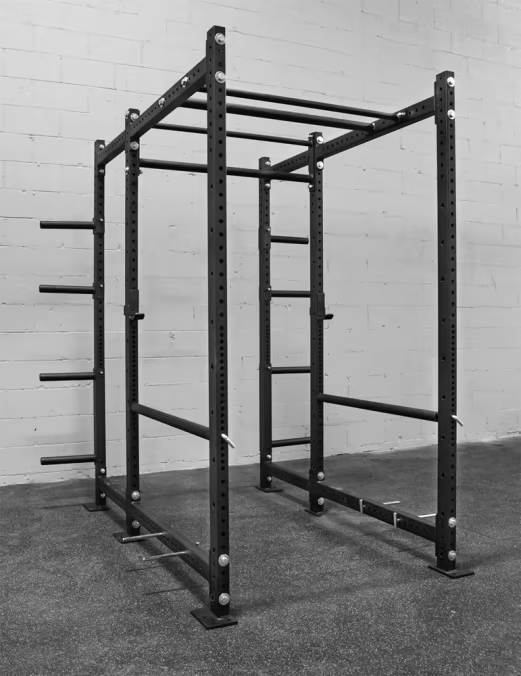
Rep Fitness’s Lineup:
PR-1100:
Entry-level, 2×2 uprights, budget-friendly starting point

PR-3000:
2×3 uprights, 11-gauge steel — this is Rep’s direct competitor to the Rogue R-3/R-4

PR-5000:
3×3 uprights, Rep’s flagship and their answer to the Monster series

The fairest, most relevant comparison for the average home gym builder is Rogue R-3/R-4 vs. Rep PR-3000
And the Rogue R-6 vs. Rep PR-5000 for those building a more serious setup.
That’s the lens through which the rest of this article is written.
Action Step: Be aware of your current training volume and load, then identify which tier best suits you. Most lifters who train 3-4 days a week with a max squat under 400 lbs don’t need the Monster Series. Having lofty goals are great, but don’t let them control your purchasing decisions- especially if they’re much more than you need currently.
Build Quality and Materials: Where the Real Differences Live
This is where the rogue vs rep fitness power rack debate gets grounded in something physical. Let’s briefly talk about steel.
Both the Rogue R-3 and the Rep PR-3000 use 2×3 inch uprights with 11-gauge steel** — on paper, the same. But steel specifications only tell part of the story. Tolerances, weld quality, and finish consistency are where the manufacturing philosophy shows itself.
Rogue’s edge:
The uprights on a Rogue rack are machined to tighter tolerances. That means attachments fit as intended, bolts line up cleanly, and the rack assembles with a precision that experienced lifters notice immediately. The powder coat is thick and even. The welds are clean. There’s very little variation unit to unit because the manufacturing process is tightly controlled domestically.
Rep’s reality:
Rep’s build quality has improved significantly over their last two generations. The PR-3000 and PR-5000 are very solid racks — the steel is what the genuine article, and most units arrive in good shape. However, there is more variability in hole alignment and tolerances than you’ll find with Rogue. Most users won’t experience a problem. Some do. Either way it’s worth knowing.
Additional Features
Hole spacing is another relevant difference. Rogue uses Westside hole spacing (1-inch spacing in the bench zone, 2-inch spacing elsewhere) on the Monster Lite series — this allows for much more precise adjustment of safety bar height and j-cup position. Rep uses standard 1-inch or 2-inch spacing depending on the model, which is functional but slightly less precise for bench press setup.
J-cups are worth a specific mention because they’re the thing touching your barbell every single session. Rogue’s standard j-cups include a UHMW plastic liner to protect bar knurling. Rep’s higher-tier racks have caught up here, but the entry-level cups can still show wear on knurling over time.
Table 1- Rogue vs. REP Fitness Power Rack: Steel Specifications
| Specs | Rogue (R-3/ R-6) | REP Fitness (PR-3000/ PR-5000) | Edge |
| Upright steel | 2×3″ or 3×3″, 11-gauge | 2×3″ or 3×3″, 11-gauge | TIE |
| Manufacturing tolerances | Tight — US-controlled production | Good — slight unit-to-unit variance | ROGUE |
| Weld quality | Consistent, clean, inspected | Good overall; occasional variance | ROGUE |
| Powder coat finish | Thick, even, chip-resistant | Good; thinner on entry-level | ROGUE |
| Hole spacing | Westside (1″ bench zone, 2″ elsewhere) | Standard 1″ or 2″ by model | ROGUE |
| J-cup lining | UHMW liner standard | Lined on higher-tier models | ROGUE |
| Made in USA | Yes | No (China / Taiwan) | ROGUE |
Action Step: If you’re investing in a barbell worth $200+, factor in j-cup quality. On either brand, upgrade to lined j-cups or add aftermarket protection. It’s a $20–$30 investment that protects a much larger one.
Safety Features: The Most Important Section
This should go without saying, but I’ll say it anyway: the safety features on your power rack are not a spec to skim. These are the components that keep you safe when a rep goes wrong — and unfortunately at some point (for nearly all serious lifter) a rep goes wrong.
Features That Count
Spotter arms and safety bars come in two main styles: pin/pipe safeties (a solid horizontal bar that slides into the upright) and strap safeties (nylon straps that absorb the drop more gently). Both Rogue and Rep offer both options at various price points.
Strap safeties are generally considered superior for solo lifting because they reduce bar bounce on a failed rep — the bar doesn’t spring back into you. Rogue offers their Monster Lite strap safeties as an upgrade; Rep includes them on the PR-5000 and offers them as add-ons on the PR-3000.
Stability under load is where Rogue’s tighter tolerances pay dividends. A heavy rack that isn’t bolted down should still feel solid through dynamic movements — kipping pull-ups, heavy band work, box jumps nearby. Rogue racks feel planted. Rep racks, particularly when not bolted down, can have slightly more give at higher loads. For a garage gym where you *can* bolt to a concrete floor, this is a non-issue. For a rubber mat setup in an apartment gym, it’s worth noting.

Weight capacity ratings for both brands are, frankly, more aspirational than practical — both list capacities well beyond what any home gym lifter will ever approach. The more useful question is how the rack *performs* at 70–80% of its rated capacity. Both brands hold up well in this realistic zone.
Table 2- Rogue vs REP Fitness Power Rack: Safety Features
| Feature | Rogue | REP Fitness | Edge |
| Strap safeties available | Yes — upgrade option | Yes — standard on PR-5000, add-on for PR-3000 | TIE |
| Pin/ Pipe safeties | Standard included | Standard included | TIE |
| Stability (unbolted) | Very solid at high loads | Good; slight flex under dynamic load | ROGUE |
| Stability (bolted down) | Excellent | Excellent | TIE |
| Weight capacity (rated) | 1,000–1,100 lb (R-3) | 1,000 lb (PR-3000) | TIE |
| Knurling protection | Lined j-cups standard | Lined on higher tiers | ROGUE |
Action Step: If you’re lifting heavy without a spotter, strap safeties are worth the upgrade cost on either brand. Don’t assume the included safeties are the best option — check what’s available as an add-on before finalizing your purchase.
Attachments and the Ecosystem Question: Think Long-Term
Power racks should answer immediate concerns; safety, durability, etc.- but it’s should also serve your training for the future. Remember that the rack you buy today is the foundation of an ecosystem that will grow over the next few years. That being said, the question shifts from “which rack is better?” — it’s “which rack will support the gym I’m building toward?”
Rogue’s Accessory Catalog
It’s the most extensive in the industry. If you can think of it, they likely have it; cable attachment systems, lat pulldown units, monolift arms, dip bar attachments, multi-grip pull-up bars, band pegs. Rogue has created accessories for nearly every training scenario, and they’re all purpose-built to fit their uprights without modification. If you buy a Rogue Monster Lite rack today, you can expand that rack’s functionality for years without wondering about compatibility.
Rep’s Ecosystem
Though Rogue has had a technical head-start, Rep’s inventory is growing and has improved substantially. Their lat pulldown and cable attachment options for the PR-5000 are legitimate and well-reviewed. However, the depth of the catalog isn’t quite at Rogue’s level, and cross-generational compatibility (older rep racks with newer accessories) has occasionally been inconsistent — a point worth checking before you commit.
Third-Party Compatibility
One edge Rep does have is with its third party attachment compatibility. While it is technically better than most on the market, it’s still inconsistent. Rogue-to-Rep compatibility is not guaranteed — the tolerances and hole spacing differences mean many Rogue accessories won’t fit a Rep rack without modification.
Table 3- Rogue vs REP Fitness Power Rack: Attachments & Ecosystem
| Category | Rogue | REP Fitness | Edge |
| Accessory catalog depth | Extensive — industry-leading | Growing — solid but limited | ROGUE |
| Cable / lat pulldown | Multiple options, purpose-built | Available for PR-5000; improving | ROGUE |
| Dip bar attachment | Yes | Yes | TIE |
| Monolift arms | Yes | Limited availability | ROGUE |
| Cross-brand compatibility | Rogue-to-Rep not guaranteed | Rep-to-Rogue not guaranteed | TIE |
| Long-term availability | Very high — 15+ yr track record | Good — improving generationally | ROGUE |
Action Step: List the accessories you’ll realistically want in the next 2–3 years before you buy your rack. If a lat pulldown or cable system is on your roadmap, verify compatibility now — not after you’ve made the purchase.
Assembly: What to Expect Before the First Rep
Assembly experience doesn’t make or break a rack, but it does set the tone for your relationship with it — and a difficult assembly is a real frustration when you’re excited to start training.
Rogue’s Assembly
is pretty smooth. The instructions are clear, hardware is organized and labeled, and Rogue’s tolerances mean bolts go in without persuasion. The average Rogue R-3 assembly runs 2–3 hours for one person with basic mechanical confidence. The community support is excellent — between Rogue’s own documentation and a deep library of YouTube walkthroughs, you’re never stuck.
Rep’s Assembly
It’s similarly well-documented, and for most units the process is straightforward. Where users occasionally run into issues is hole alignment — if manufacturing tolerances are slightly off, you may find yourself persuading a bolt through two uprights that don’t quite line up. This is not universal, but it appears in enough reviews to mention. Rep’s customer service has a good reputation for resolving these issues, including sending replacement hardware.
Table 4- Rogue vs REP Fitness Power Rack: Assembly Experience
| Factor | Rogue | REP Fitness | Edge |
| Instruction clarity | Clear, well-organized | Clear, well-organized | TIE |
| Hardware precision | Bolts align cleanly | Occasional hole misalignment reported | ROGUE |
| Avg. assembly time | 2–3 hrs (1 person) | 2–3 hrs (1 person) | TIE |
| Community resources | Excellent — deep YouTube library | Good — growing library | ROGUE |
| Customer support (issues) | Strong | Strong — good replacement policy | TIE |
Action Step: For either brand, have a rubber mallet and a second pair of hands available for assembly day. Clear a full half-day. And take photos of the hardware layout before you start — it saves time if anything needs to be returned or replaced.
Footprint and Space: Fitting the Rack to Your Reality
You can have the best rack available, but if it doesn’t fit in your home gym it’s useless to you. Each garage, basement, and spare room has a specific ceiling height and specific square footage. Getting this wrong is one of the most common and most avoidable home gym mistakes I see.
Rogue R-3 Dimensions (as a reference point):
roughly 49″ wide x 24″ deep, with 90″ or 103″ upright options. The 90″ uprights require about 96″+ of ceiling clearance to accommodate a pull-up bar with any comfort.
Rep PR-3000 Dimensions:
comparable footprint, similar depth, similar ceiling requirements. The PR-5000 is wider and deeper — critical to check against your specific space.
Walk-in vs. walk-around:
Both brands offer versions of each. A walk-in design allows you to enter from the front; walk-around requires access on all sides. In a tight garage or spare room, this distinction can mean the difference between the rack fitting or not.
Barbell compatibility is a function of upright spacing, not brand — but it’s worth verifying. Standard barbells need at least 48″ between uprights to load comfortably.
Table 5- Rogue vs REP Fitness Power Rack: Space & Footprint
| Factor | Rogue | REP Fitness | Edge |
| Mid-range footprint | ~49″W × 24″D (R-3) | ~49″W × 24″D (PR-3000) | TIE |
| Ceiling clearance needed | 96″+ for 90″ uprights | 96″+ for 90″ uprights | TIE |
| Walk-in option available | Yes | Yes | TIE |
| Barbell compatibility | Standard 48″+ upright spacing | Standard 48″+ upright spacing | TIE |
Action Step: Tape out the rack footprint on your floor before buying. Include clearance space on all sides — at minimum 18″ on each side for plate loading, and 24″+ in front. A rack that physically fits but leaves no working room is a daily frustration.
Price and Value: The Honest Math
Let’s talk about money directly, because ultimately that’s what this decision comes down to.
At time of writing, a Rogue R-3 lands around $545–$595 with standard accessories. A Rep PR-3000 runs approximately $350–$450 depending on configuration. That’s a $150–$200 difference at the same tier — a noticable gap, but not the enormous one some people expect.
Once we start moving into the premium tier, that’s when the gap widens: a Rogue R-6 can run $900+, while a Rep PR-5000 typically sits in the $600–$750 range.
But the question is; if the price gap widens that much between the two models, what does the difference actually buy you with Rogue? The answer: tighter tolerances, domestic manufacturing, a deeper accessory ecosystem, and a brand with a 15+ year track record of standing behind their product. If you’re training 5–6 days a week at high intensity, planning to expand your rack significantly, or the peace of mind of US manufacturing matters to you — that premium is real value.
The flip-side to the previous question then is; what does Rep give you for less? A genuinely well-built rack that will serve a serious recreational lifter for years without issue. The PR-3000 and PR-5000 punch well above their price points. For someone building their first serious home gym on a defined budget, Rep is not a consolation prize — it’s a smart decision.

Resale Value
Resale value favors Rogue significantly. Used Rogue racks hold their value on the secondary market in a way Rep racks don’t quite match — relevant if you ever plan to move, upgrade, or reconfigure.
Table 6- Rogue vs REP Fitness Power Rack: Price & Value
| Tier | Rogue Price | REP Fitness Price | Value Edge |
| Mid-range (2×3″) | ~$545–$595 (R-3) | ~$350–$450 (PR-3000) | REP Fitness |
| Premium (3×3″) | $900+ (R-6) | ~$600–$750 (PR-5000) | REP Fitness |
| Resale value | High — strong secondary market | Moderate | Rogue |
| Long-term cost of ownership | Higher upfront, strong durability | Lower upfront, good durability | REP Fitness |
| Budget remaining for accessories | Less room after rack purchase | More room for barbell, plates, flooring | REP Fitness |
Action Step: Calculate total cost of ownership, not just purchase price. Factor in any accessories you’ll add within 12 months. In some configurations, Rep’s lower rack price allows you to spend more on a better barbell or plates — which may produce more training value than upgrading the rack itself.
Who Should Buy Rogue
Rogue is the move if:
You’re training at high frequency and high intensity — 5+ days per week, heavy compound lifts, barbell work that will accumulate serious volume over years. Rogue’s build is designed for exactly this kind of sustained use, and the tighter manufacturing means the rack will feel the same in year seven as it did in year one.
You want to build an expansive home gym over time. If a lat pulldown, cable system, monolift, or specialty attachments are anywhere on your roadmap, Rogue’s ecosystem makes that path seamless.
Made-in-USA manufacturing is meaningful to you. Rogue is one of the few fitness equipment companies genuinely committed to domestic production, and that has real value — both for quality consistency and for the principle of it.
You’re buying once. If the goal is to never have this conversation again and to own a rack for 10–20 years without a second thought, Rogue is the answer.
Who Should Buy Rep Fitness
Rep Fitness is the move if:
You’re building your first serious home gym and working within a defined budget. The money you save on the rack can go toward better flooring, a quality barbell, or additional plates — all of which have direct training impact.
You’re a recreational or intermediate lifter training 3–4 days per week with loads under 400 lbs. The Rep PR-3000 is more than adequate for this profile, and you will not feel the difference in day-to-day training.
You want a premium rack at a non-premium price and are comfortable with the trade-offs. Rep isn’t perfect, but their recent generations represent genuinely strong value.
You’re in a transitional space — an apartment gym, a rented house, a setup that might move or change. Spending Rogue money on a non-permanent situation is hard to justify when Rep delivers 80–85% of the experience at significantly lower cost.
Rogue vs Rep Fitness Power Rack: The Verdict
Here’s the honest scorecard on the rogue vs rep fitness power rack question:
Table 7- Rogue vs REP Fitness Power Rack: Final Scorecard, All Categories
| Category | Rogue Score | REP Score | Winner |
| Build quality | 9.2 | 7.6 | Rogue |
| Safety features | 8.8 | 8.2 | Rogue |
| Accessory ecosystem | 9.5 | 6.8 | Rogue |
| Assembly experience | 8.6 | 8.0 | Rogue |
| Price & value | 7.0 | 9.2 | Rep |
| Space & footprint | 8.4 | 8.4 | Tie |
| Resale value | 9.0 | 6.2 | Rogue |
| Overall average | 8.6 | 7.8 | Rogue |
For most home gym builders in the research phase: Start with the Rep PR-3000 or PR-5000 unless you’re clear that the Rogue premium aligns with your training frequency, long-term plans, or values. If you’re still not sure, ask yourself: would the money I save on the rack be better spent elsewhere in my gym? If yes, go Rep. If the rack is the priority investment, go Rogue.
Honorable mentions worth knowing: Titan Fitness sits between these two brands in price and quality and deserves consideration at the mid-tier. Bells of Steel makes a compelling case at the premium level, particularly for Canadian buyers.

FAQs
Are Rep Fitness racks compatible with Rogue attachments?
Not reliably. The upright dimensions and hole spacing differences mean most Rogue accessories will not fit Rep racks without modification. If Rogue attachments are on your radar, buy a Rogue rack.
Is Rogue worth the price difference for a home gym?
It depends on your training profile. For high-frequency, high-intensity training with long-term expansion plans, yes. For a recreational home gym used 3–4 days per week, Rep delivers strong value at lower cost.
Which rack is better for a beginner?
Rep Fitness. A beginner doesn’t need Rogue-level build quality, and the savings are better applied to coaching, programming, or other equipment.
How long do Rep Fitness racks last?
With normal use and proper care, a Rep PR-3000 or PR-5000 should last 7–10+ years without significant degradation. The steel and welds are built for sustained residential use.
The Right Environment Is the First Step
Here’s what I want you to take away from all of this: the rack you choose is not just a piece of equipment. It’s the structure your most important training happens inside. It holds the bar over your chest. It determines whether a failed rep is a learning moment or a dangerous one. It’s the thing you walk toward on the days you don’t feel like it — and the quality of that environment matters more than most people give it credit for.
The rogue vs rep fitness power rack question is ultimately a question about what kind of home gym you’re building — and what kind of commitment you’re making to yourself. Neither answer is wrong. Both brands will support a serious training practice. The right choice is the one that fits your life, your budget, and your long-term vision for what this gym becomes.
At SOMA.FITNESS, we believe that your home gym is the foundation physical transformation is built on. Not a convenience. Not a luxury. A foundation. And the right equipment, chosen thoughtfully, is what makes that foundation solid.
If you’re in the planning phase and want to make sure you’re thinking through every piece of this decision, download the free **SOMA Home Gym Planning Checklist** — it covers everything from rack selection to flooring, layout, and budgeting in one place. It’s the resource I wish I’d had when I started building.


Leave a Reply