

I’m sure you’ve dropped real dollars on equipment you love. And you did everything you could to house that equipment properly; you cleared the space, watched hours of setup videos and reviews, dumped furniture out of the garage or the spare room, and pieced it all together. Every step was executed flawlessly, AND YET something feels off every time you train there — you can’t quite put your finger on it, but the space doesn’t work the way you imagined it would.
More often than not, the problem isn’t the equipment. Believe it or not it’s likely the layout.
Home gym layout mistakes are the most common reason why a well-stocked home gym still under-delivers. The signs are subtle, but a trained eye can spot them in seconds. Fortunately, most of these mistakes can be adjusted without taking out your wallet- they just require an honest inventory of your space and a new perspective on what to look for.
Here are the eight most common home gym layout mistakes I see, what they’re actually costing you, and exactly how to fix them.
1. Not Leaving Enough Clearance Around Equipment
This is the mistake I see most often, and it’s the one with the highest stakes. People measure their equipment footprint, confirm it fits, and call it done. What they don’t measure is the space they need to actually use the equipment safely.
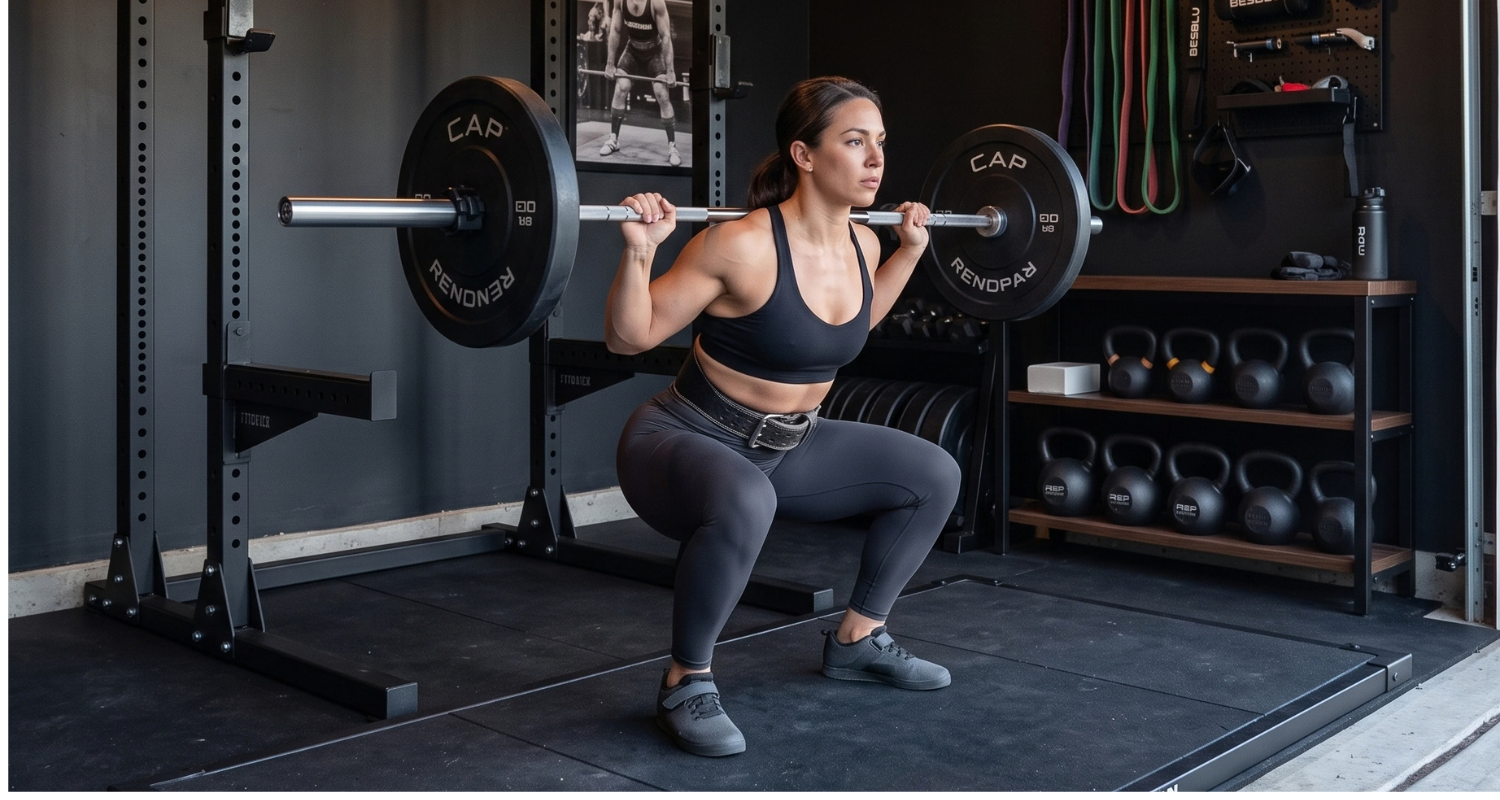
Think back to your experience at a commercial gym. You know for a fact a barbell in a power rack extends well beyond the rack itself — often 4 feet on each side when loaded with plates. A cable machine can require as much as 6 feet of clearance in front of it for full range of motion. A treadmill should have at least 3 feet behind it in case of a fall. A kettlebell swing at full extension requires a ceiling height of at least 8 feet and several feet of clearance in front of and behind the user.
When space is too tight, one of two things happens: you change your setup and movement patterns to avoid hitting something (which compromises form and increases the risk of injury), or you steer clear of some exercises entirely. You shouldn’t have to settle for either outcome.
Trainer tip: Before you finalize any layout, walk through every exercise you plan to do in that space and literally act out the movement. It seems a little much, but you’ll learn much more about your space than what your eyes alone tell you. If anything makes you pull back or compensate, the clearance isn’t enough.
Action step:
Use painter’s tape on the floor to mark the full activity zone around each piece of equipment — not just the footprint. Industry standard minimums: 3 feet on the sides of most machines, 6 feet in front of cable stations, and always check manufacturer clearance specs before finalizing placement.
2. Poor Traffic Flow That Blocks Exits and Breaks Focus
Try to conceptualize the function of your home gym like a well-designed kitchen — everything within reach, but nothing in the way. When equipment is arranged without thinking about how you actually move through the space during a workout, you wind up with a layout that constantly interrupts your training.
The most dangerous manifestation of this mistake is blocking exits. This is a fitness issue that can easily escalate into a safety issue- and not just for you but the people you love. Garages and spare rooms used as home gyms often have limited egress, and a power rack or treadmill set up too close to the only door is a serious hindrance in an emergency.
Beyond safety, poor flow kills workout momentum. If you have to climb over a bench to get to your dumbbells, you’re building quiet friction and anxiety with every transition. Over time, that friction quietly chips away at the quality of your workouts, and over time your consistency as well.

Trainer tip: Think about the supersets or circuits you use the most. The exercises you pair together should be very close or at least easily accessible without moving equipment or tip-toeing around it.
Action step:
Map a clear path from the entrance to each zone, and from zone to zone. Keep exits unobstructed at all times. If your layout forces you to move equipment to access something, the layout needs to change.
Related Post: How to Organize a Small Home Gym (Solutions That Work)
3. Equipment Facing the Wrong Direction
This right here is a major inconvenience masked in a way that sounds minor.
The direction your equipment faces affects how you perform exercises, how effectively you use your mirror (if you have one), how much natural light hits your face versus your back, and even how motivated you feel walking in the door.
Cardio equipment — treadmills, rowers, bikes — should face something stimulating: a screen, a window, a motivating wall. Facing a blank wall while running on a treadmill will likely drive you nuts long before you finish your session. On the other hand, your strength equipment should most often face your mirror, not a window. Glare from direct sunlight makes it nearly impossible to check your form, which eliminates one of the biggest advantages of training at home.
Racks and cable machines should be set up so you’re not walking into a corner when you step back to unrack or re-rack weight. And if you have any overhead pressing in your program, double-check the height clearance for the direction the bar will travel — not just where the equipment sits.
Action step:
Before anchoring anything, stand in the position you’ll be in during each main exercise and look around. What do you see? What’s the light source? Where’s the mirror? Adjust orientation around the actual experience of training, not just the aesthetics of the setup.
If you’re looking for advice to build your home gym in the first place, check out this full, immersive guide with everything you need to create your ideal fitness space: How to Set Up a Home Gym: The Complete Beginner’s Guide
4. No Dedicated Zones — The Layout That Trains Chaos
A home gym without zones isn’t a gym. It’s a room with equipment in it.
Zoning is one of the most underrated principles in home gym layout, and it’s something commercial gyms have understood for decades. When different types of training are grouped together — strength, cardio, mobility, floor work — the space becomes intuitive. You know where to go for what. You can move between training modes without hunting for equipment or rearranging your setup mid-workout.
Without zones, the chaotic layout takes a subtle psychological toll. Studies on environmental design consistently show that cluttered, disorganized spaces increase cognitive load and reduce motivation. In a training context, that means you’re spending mental energy on your environment instead of your workout.

Even in a small space, zones can be defined with flooring changes, wall color, tape lines, or simply by intentional equipment groupings. The goal isn’t size — it’s clarity.
Trainer tip: The three zones I recommend for any home gym, regardless of size: a strength zone (rack, weights, bench), a cardio or conditioning zone (treadmill, bike, jump rope area), and a floor zone for mobility, stretching, and bodyweight work. Even a 150 sq ft space can accommodate all three with smart layout.
Action step:
Sketch your space to scale and assign a zone to each area before you place any equipment. Start with floor work zone first — it’s the most flexible and the one most people forget to plan for.
5. Mirrors in Dangerous — or Useless — Locations
Mirrors aren’t just around for looks in the gym: they’re an essential form-checking tool. That being said, a mirror in the wrong place isn’t just useless but potentially dangerous.
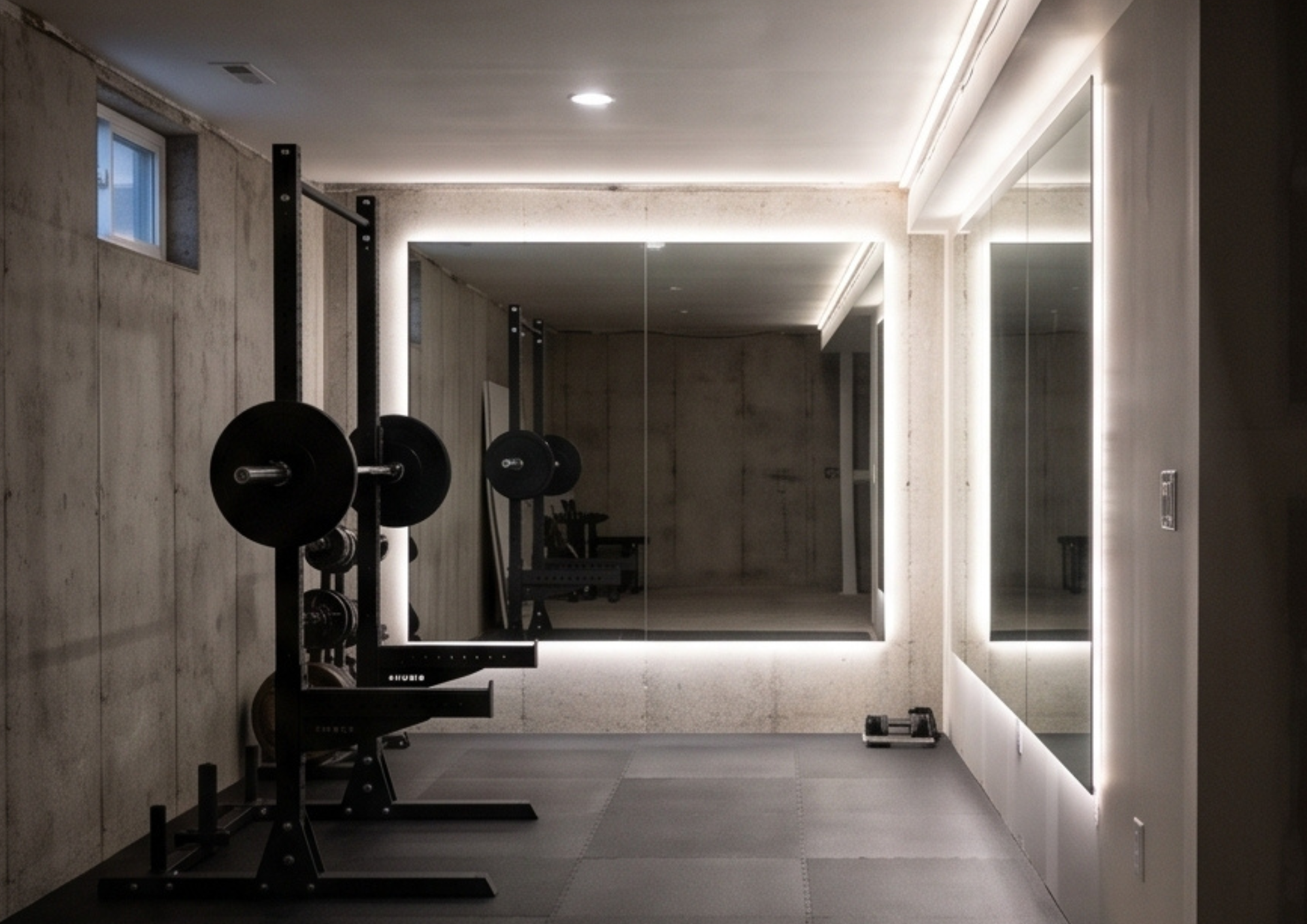
A terrible place to set a mirror is directly behind a squat rack or behind the user during any loaded barbell movement. If a mirror is behind you during a deadlift, squat, or Olympic lift, a dropped bar or a lost grip sends weight directly toward your reflection — and the glass behind it. You don’t have to use much of your imagination to picture how poorly that can go. Mirrors should never be placed in the path of dropped or racked weight.
The most common useless placement is on the wall opposite from where you actually stand during your heaviest lifts. If your squat rack is in the corner and your mirror is on the adjacent wall, you’re seeing a side profile when you need to see your front — or vice versa. Think about the specific lifts you need to monitor most, position yourself mentally doing those lifts, and put the mirror directly in your sightline.
Height matters too. Full-length mirrors are ideal, but if you’re installing individual panels, prioritize the upper body range — roughly 5 to 6 feet of mirror starting at 18 to 24 inches off the floor.
Action step:
Mount mirrors on the wall you face during your primary movements, never behind a rack or in the path of dropped equipment. If you’re in a rental or can’t mount, freestanding mirror panels positioned to the side are a safer alternative.
6. Ignoring Electrical Outlet Placement Until It’s Too Late
Electrical planning is the mistake that hurts the most, because it’s the one that’s genuinely difficult to fix after the fact.
Most home gym spaces weren’t built with training equipment in mind. Garages often have outlets on a single wall. Spare bedrooms may only have one or two, and they’re positioned for lamps and phone chargers — not treadmills drawing 15 amps. If you don’t think about electrical before you decide where your powered equipment goes, you end up with extension cords snaking across the floor (a tripping hazard), equipment that trips the breaker during high-intensity sessions, or — worst case — a treadmill or bike shoved against the only viable wall even if that wall makes no spatial sense.
Powered equipment to account for: treadmills and ellipticals (typically 15–20 amps), fans (critical for heat and air quality in enclosed spaces), speakers or display screens, lighting beyond the existing overhead fixture, and any smart home gym tech like interactive mirrors or connected displays.
Action step:
Before finalizing your layout, map your outlet locations and identify which equipment needs dedicated circuits. If you’re setting up in a garage, consult an electrician early — adding a dedicated 20-amp circuit is a relatively small investment that saves a lot of layout compromise.
7. No Space Reserved for Floor Work
Floor work gets cut from home gym layouts constantly, and it’s one of the most consequential planning oversights you can make.
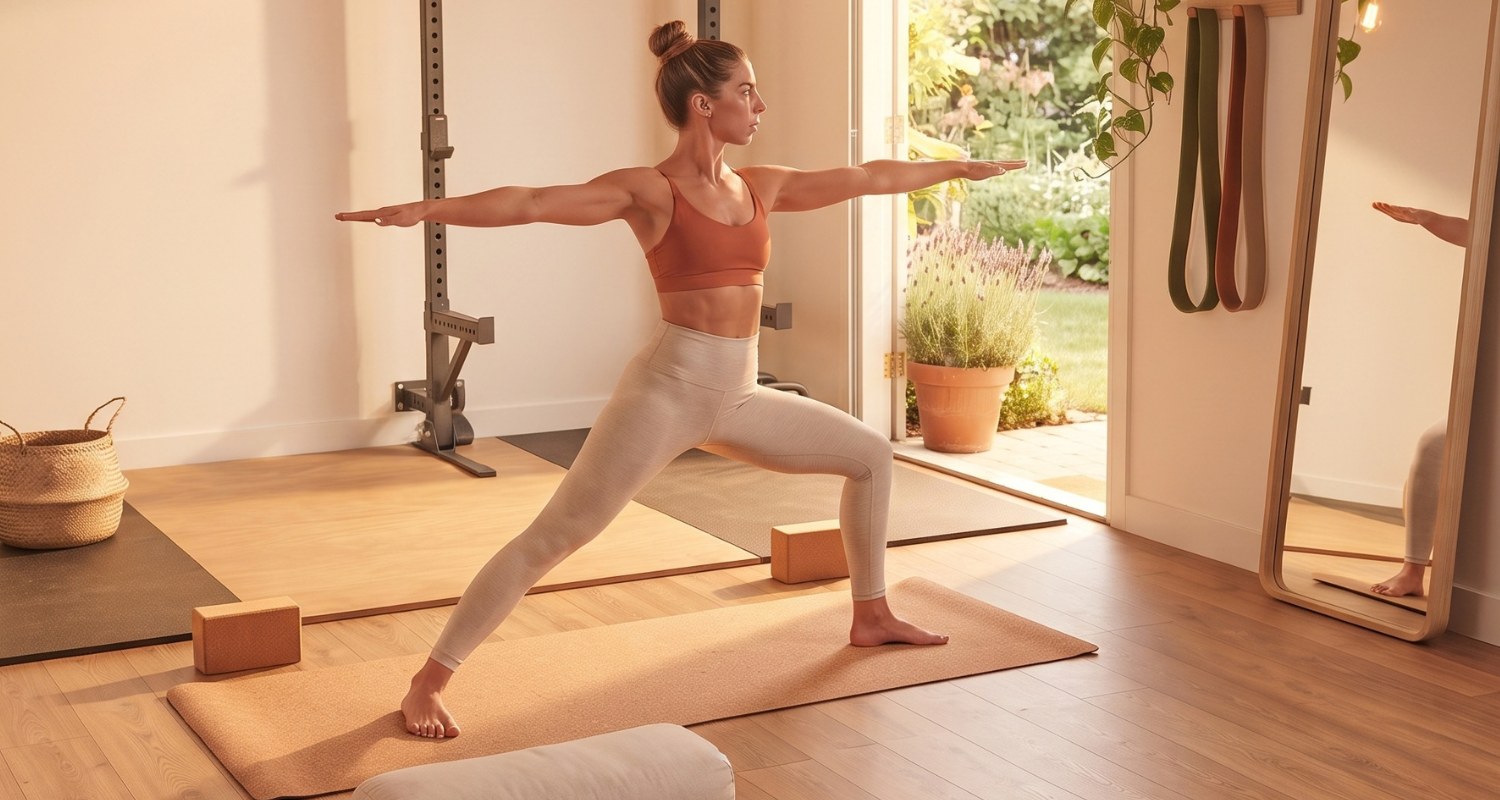
Mobility training, stretching, foam rolling, yoga, core work, bodyweight circuits — all of it requires floor space. Not a little floor space. An adult lying flat with arms extended overhead needs roughly a 6× 6 foot clear zone just to move without hitting something. Add dynamic movements like Turkish get-ups, inchworms, or crawling patterns and you need more.
When floor space isn’t planned for, it gets squeezed out. The rack goes here, the bench goes there, the cable machine fills the corner, and suddenly the only open floor space is the 18-inch gap between the treadmill and the wall. People skip the mobility work because the space makes it impossible. Flexibility and movement quality degrade. Injury risk climbs.
This matters especially for the 35–44 age range where tissue quality and recovery become increasingly important. The floor zone isn’t optional — it’s where longevity gets built.

Trainer tip: I tell every client to plan the floor zone first, not last. Decide how much unobstructed floor space you need for your mobility and recovery work, protect that space on your layout, and fit the equipment around it. Reverse the typical order and your workout quality goes up significantly.
Action step:
Reserve a minimum 6× 6 foot zone — ideally 8× 8 — that stays clear of equipment at all times. Use rubber flooring or interlocking mats to visually define it and protect the surface for floor-based work.
8. Equipment Too Close to Walls
Walls are convenient. They feel like boundaries you can push against, edges you can use. In a home gym, they’re traps.
Equipment placed flush against a wall creates several problems simultaneously. First, it eliminates the side access you need for loading, adjusting, and safe entry and exit. A bench pressed against the wall is a bench you can only access from one side — which matters when you need a spotter position, when you’re loading dumbbells onto a rack mounted above, or when you need to bail a lift safely. Second, equipment against walls often means cables, cords, and moving parts are being compressed or kinked against the surface — which creates equipment wear and, eventually, failures. Third, ventilation suffers. In an enclosed home gym space, airflow matters for both performance and equipment longevity. Equipment flush to walls blocks circulation.
The minimum clearance from a wall isn’t just about safety — it’s about giving yourself the full functionality of the equipment you paid for. A cable machine needs rear clearance for the weight stack. A rack needs side clearance for plate loading. A treadmill needs rear clearance as a safety margin.
Action step:
As a rule: leave at least 18 inches between any equipment and the wall behind it, and at least 24 inches on the side where you load weight or make adjustments. For treadmills and cardio equipment, a minimum of 36 inches behind is the safety standard.
Your Layout Is the Foundation — Get It Right Before Anything Else
Every home gym layout mistake on this list has the same thing in common: it was made before training actually happened in the space. That’s not a criticism — it’s just how planning works when you’re visualizing something that doesn’t exist yet.
But here’s the thing about a home gym: it’s not just a collection of equipment. It’s an environment you’re building to support real physical transformation — the kind that compounds over months and years. A layout that fights your training, interrupts your focus, or puts you at risk of injury is an environment working against you from day one. Home gym layout mistakes aren’t just inconveniences; they’re the silent reason good intentions don’t become consistent habits.
The right environment doesn’t guarantee results. But the wrong one quietly makes results harder at every turn.
Go back through this list. Walk your space. Tape your clearances. Sketch your zones. Make the adjustments before they become habits you have to undo.
And if you want a structured way to plan your space from scratch — including clearance standards, zone recommendations, electrical checklist, and equipment placement priorities — grab the free SOMA Home Gym Planning Checklist. It’s the same framework I use with my own clients, built specifically for the home gym environment. Because getting your layout right is the first real step toward becoming who you’re capable of being.
Leave a Reply