
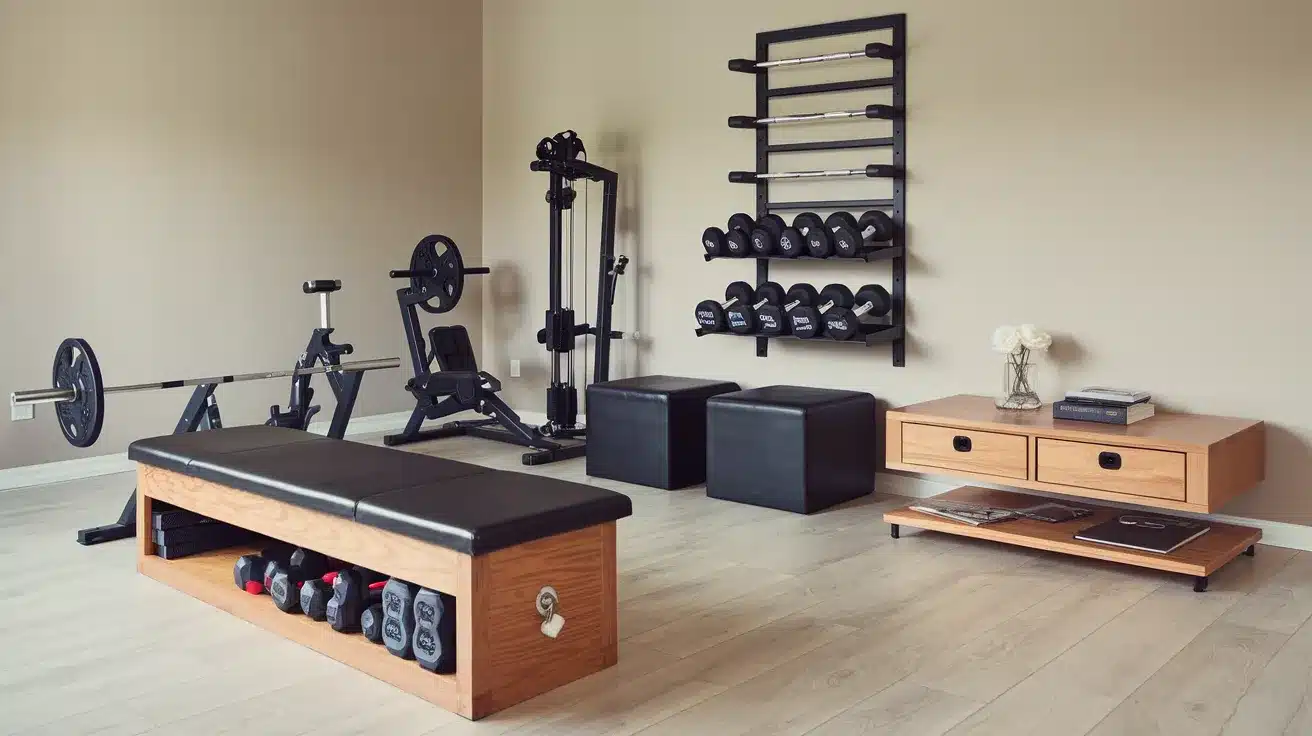
If you’ve ever built a home gym, you might have come to the same conclusion as me: anyone can own gym equipment, but how you organize it makes the difference between a mess and a functional home gym. It’s not just an aesthetic choice– you can really feel the difference a well planned/ well organized gym floor makes.
This is the part nobody talks about when they’re selling you on the dream of a home gym: equipment without organization is just clutter with good intentions. And clutter, as any trainer will tell you, is one of the biggest reasons people stop showing up.
Home gym organization ideas aren’t just about aesthetics — though a well-organized space does feel dramatically better to train in. They’re about removing friction. The fewer obstacles between you and your workout, the more likely you are to actually do it. That’s not motivation theory; that’s behavioral science.
What follows is a room-by-room, system-by-system guide to organizing your home gym in a way that assists your training — and your consistency. Whether you’re working with a dedicated room, a garage corner, or a spare bedroom that’s pulling double duty, there’s a setup here that will work for your space.
1. Go Vertical: Storage Solutions That Reclaim Your Floor Space
The single biggest mistake I see in home gym setups — and I’ve helped several clients plan their spaces — is treating the floor as the primary storage surface. This is to be expected; since we were young we’ve been conditioned to look at rooms, storage, and furniture from a horizontal perspective. Couches, tables, chairs and lamps are all grounded on the floor– and home gyms equipment is no different (or so we thought).
Floor space in a home gym is sacred. It’s where you move, stretch, do your burpees, and set up your bench. The moment you start stacking things on it, your usable workout area shrinks fast.
Vertical storage flips that equation. Walls and ceiling height are almost always wide open and teeming with potential, even in small spaces. Here are some ideas that works:
- Tall shelving units (72″ or higher) positioned along non-traffic walls can hold yoga blocks, foam rollers, medicine balls, and accessories in bins without eating into your footprint.
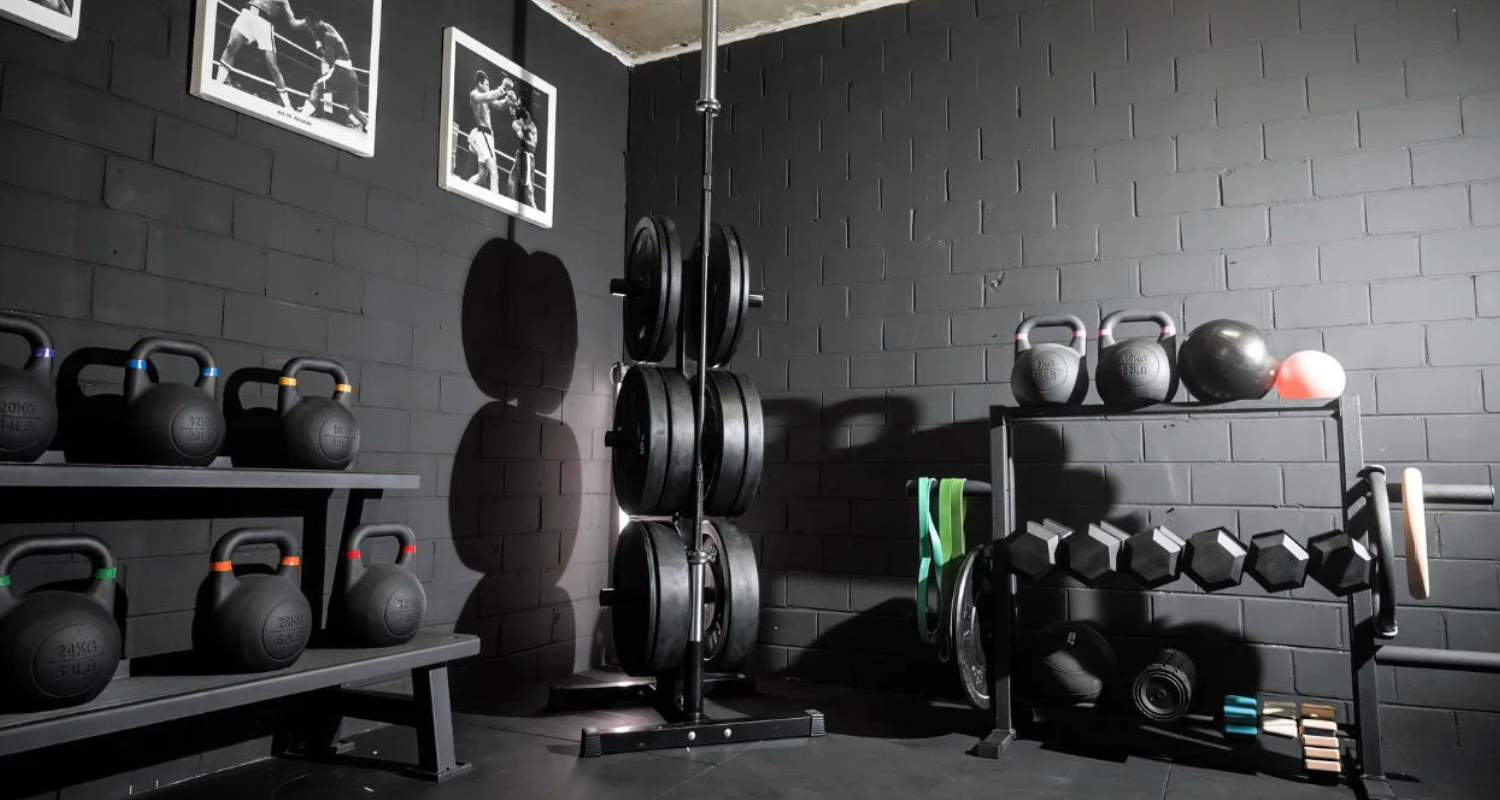
- Vertical weight plate trees — floor-standing but narrow — take up a fraction of the floor space that plates stacked horizontally would require.
- Ceiling-mounted storage racks work particularly well in garages, where overhead clearance is typically generous. These are ideal for storing things you access less frequently — extra mats, seasonal gear, foam rollers.
- Over-door organizers on interior gym room doors can handle smaller accessories like jump ropes, ankle weights, and gym gloves without requiring any wall hardware at all.

Practical takeaway:
Before you buy a single storage piece, walk your space and identify every wall and vertical surface that isn’t currently being used. Then measure height and width. You likely have more vertical real estate than you think.
2. Wall-Mounted Systems: Pegboards, Hooks, and the Magic of a Dedicated Wall
If there’s one home gym organization idea that consistently delivers more impact per dollar than anything else, it’s a dedicated wall-mounted system. When done right, it transforms a chaotic space into something that looks and functions like a professional setup.
Pegboards: The Most Flexible Option
A 4′ x 4′ or 4′ x 8′ pegboard panel, mounted to studs with 1″–2″ standoffs (to allow hooks to seat properly), gives you a completely customizable storage surface. You can rearrange hooks as your equipment changes, hang everything from resistance bands to jump ropes to ab wheels, and add shelving brackets for heavier items.
Pegboards work best when you treat them like a tool wall, not a catch-all. Group by use: one section for cardio accessories, one for mobility tools, one for small weights. Color-coded hooks or labeled sections make it even more functional.

French Cleat Systems: For Heavier Loads
If you need to store anything with real weight — kettlebells, medicine balls, heavier accessories — a French cleat wall is worth the slightly higher upfront effort. French cleats are horizontal strips of angled wood or aluminum mounted to the wall studs, and they allow you to hang custom-built brackets and holders that can support significant weight. The system is modular and endlessly reconfigurable.

Simple Hook Rails
For spaces where a full pegboard isn’t practical, a single horizontal rail with multiple hooks — mounted at shoulder height — can handle resistance bands, suspension trainers like a TRX, jump ropes, and stretching straps in a neat, accessible row.
Practical takeaway:
Choose one wall in your space and designate it your ‘system wall.’ Mount your pegboard, hook rail, or French cleats there, and commit to keeping everything off the floor and on the wall. One organized wall changes the entire feel of a space.
Related Article: Best Wall Mounted Home Gym Equipment For Small Spaces
3. Multi-Functional Furniture: Storage That Earns Its Square Footage
In a dedicated gym room, there’s no real need for furniture. But in dual-purpose spaces — a guest room that doubles as a gym, a basement that also serves as a rec room — multi-functional furniture is how you make the space work for both purposes without sacrificing either.
The approach is simple: every piece of furniture in your home gym should either serve your training or your storage — ideally both.
- Storage ottomans can hold yoga mats, resistance bands, and lighter accessories while functioning as a step-up platform or a place to sit during rest periods.
- Bench-style storage units with lift tops are excellent for keeping equipment out of sight in a living room gym setup while providing a surface for step-ups or seated exercises.
- Cube storage units (like the popular KALLAX-style shelves) are endlessly adaptable — use standard bins for accessories, dedicated cubbies for shoes or towels, and the top surface for foam rollers or speaker setup.
- A simple storage chest or trunk can hold an entire collection of resistance bands, sliders, massage balls, and small tools while blending into room decor.
The goal in a shared-purpose space is that when you’re not training, the space shouldn’t feel like a gym. When you are training, everything you need should be immediately accessible. Multi-functional furniture bridges that gap.

Practical takeaway:
Audit any existing furniture in your gym space. Could it be replaced with a storage alternative that serves the same function? A plain end table, for example, could easily be swapped for a storage ottoman that holds the same lamp but also your resistance bands.
4. Hidden Storage Ideas: Keeping the Space Clean Without Losing Function
Home gyms don’t require an entire room to get the job done. Some people make due with as much room as a living room corner, a bedroom wall, or an open basement space. However, with space this tight, any visible gym clutter can become a real quality-of-life issue.
Hidden storage doesn’t mean hiding the fact that you train. It about designing the space so that equipment is organized, contained, and out of sight when you’re not actively using it — while still being completely accessible when you are.
Related Article: How to Organize a Small Home Gym (Solutions That Work)
Closed Cabinet Systems
Floor-to-ceiling cabinets with doors — the kind you’d find in a laundry room or garage — are underrated gym storage solutions. You can store an enormous amount of equipment behind closed doors: resistance bands, jump ropes, ab wheels, yoga blocks, foam rollers, and lightweight accessories can all live neatly in a single cabinet. When the doors are closed, it’s invisible. When they’re open for training, everything is right there.
Furniture-Concealed Setups
If you’re working in a living room or bedroom, consider using a credenza, media console, or large bench with interior storage to hold your everyday training accessories. The aesthetic reads as furniture, not gym storage, but the function is there when you need it.
Under-Bench and Under-Rack Storage
The space directly under a weight bench or power rack is prime real estate. Sliding storage drawers, bins on casters, or even a simple shelf unit sized to fit beneath your bench can house plates, collars, chalk, and accessories without taking up any additional floor space.
Practical takeaway:
Identify the three things you leave out most often after training. Those are the items that need a designated ‘home’ closest to where you use them. Solve those three first, and the rest of your space will follow.
5. Plate Organization Systems: Because Hunting for the Right Weight Wastes Time
Weight plates are one of the most common organization pain points in a home gym. They’re heavy, they take up space, and when they’re stored poorly, loading a bar becomes a 5-minute workout instead of a 30-second task.
The right plate organization system depends on how many plates you have and how you train — but the goal is always the same: every plate should be visible, accessible, and easy to return after use.
Vertical Plate Trees
A good A-frame or vertical plate storage tree is the standard for a reason — it keeps plates upright and separated, allows you to see every size at a glance, and keeps them organized by weight without requiring any thought. Look for trees with individual pegs rather than a single long peg, which makes accessing specific weights much easier.
Wall-Mounted Plate Storage
For spaces where floor real estate is limited, wall-mounted plate holders are a smart alternative. These bracket into studs and hold plates flat against the wall, organized by size. They’re particularly effective in garage gyms where open wall space is available.

Sleeve-Loaded Barbell Storage
Some barbell storage setups include sleeve-style horizontal holders at different heights. Plates can be loaded directly onto the sleeves and left there, effectively storing the plates on the holder itself. This works well if you have standard training weights you load repeatedly and don’t need to mix and match constantly.
Labeling and Separation
Regardless of which storage system you use, label your plates by weight if they’re not already clearly marked. In a home gym, you’re probably the only one who knows that the faded grey 10 is actually a 10 and not a 5. Making identification effortless means you’re not second-guessing yourself mid-setup.
Practical takeaway:
Store your most-used plate weights at eye level or slightly below. The 25s and 45s you reach for in every training session should never be at floor level if you can help it — that’s a back strain waiting to happen every time you load a bar.
6. Dumbbell Storage Solutions: Organized by Weight, Accessible by Design
Unless you’re using adjustable dumbbells, regular dumbbells have a way of multiplying over time. A pair of 15s you started becomes a pair of 25s as you get stronger, and within a few years you have eight pairs scattered across three different surfaces. A proper dumbbell storage solution isn’t a luxury confined to your local commercial gym, it’s one of many home gym organization ideas that should be planned for and implemented.
A-Frame and Horizontal Dumbbell Racks
The standard tiered dumbbell rack — whether a 3-tier horizontal design or an A-frame — is the most practical option for most home gyms with multiple pairs. These racks keep dumbbells organized by weight, off the floor, and easy to return after use. For space efficiency, a compact 3-tier vertical rack typically holds 5–10 pairs in a footprint of about 36″ wide x 18″ deep.

When positioning your rack, place it adjacent to your primary training area, not against the far wall. You should be able to step back, reach for the next weight, and return in a matter of seconds.
Single-Tier Wall Shelves
For smaller collections — three to four pairs — a single sturdy wall-mounted shelf with a small lip keeps dumbbells organized without the footprint of a freestanding rack. This works particularly well in spaces where floor area is limited.

Adjustable Dumbbell Storage
If you’ve invested in adjustable dumbbells (a smart choice for space-limited setups), their storage is straightforward: the trays they come with are purpose-built, and the real question is where to position them. A small dedicated platform — even a repurposed shelf or bench — at hip height puts them exactly where you need them.
Practical takeaway:
After every training session, make returning dumbbells to their designated spot a non-negotiable part of your cooldown routine. It takes 60 seconds. It means your next session starts in an organized space. Make it a habit from day one.
7. Accessory Organization: Resistance Bands, Jump Ropes, and the Small-Item Problem
Small accessories are where organization falls apart at the seams– not dramatically, but noticeably. These accessories are easy to discard, and easy to lose, which often makes their placement low-priority compared to larger pieces that cannot be ignored. But a disorganized accessory collection slows down every session, makes it harder to rotate through your full toolkit, and just makes the space look unkempt.
Resistance Bands
Resistance bands tangle easily and are notoriously hard to store without creating a mess. Three approaches work well:
- A small open bin or basket, sorted by resistance level with a loop or tag on each band.
- S-hooks on a pegboard or hook rail, with each band looped once and hung by resistance level.
- A dedicated labeled pouch or zippered organizer if the bands live in a shared space and need to be contained.
The key is consistent return — every band back to its designated spot after every session. Bands are forgiving to work with in training; they shouldn’t be in storage.
Jump Ropes
A single dedicated hook on your pegboard or wall rail solves the jump rope problem entirely. Loop it, hang it, done. If you have multiple ropes, give each its own hook and label them (speed rope, weighted rope, etc.) so you’re grabbing the right one without thinking.
Foam Rollers, Massage Balls, and Mobility Tools
These tend to migrate because they’re used in different areas of the gym — near the mat, near the bench, near the door. A dedicated mobility bin or basket in a fixed location near your mat area consolidates everything and makes post-workout recovery feel like a deliberate part of the session, not an afterthought.
Gloves, Wraps, Chalk, and Small Items
A simple divided tray, small open-top bin, or drawer organizer handles chalk, gloves, wrist wraps, collars, and other small essentials. Keep it near the barbell or weight storage, since those items are almost always used together.

Practical takeaway:
The rule of thumb for accessories is that every item needs a named home before you use it the first time. Designate the spot before the clutter forms. Retrofitting organization is significantly harder than building it from the start.
8. Before and After: What Real Home Gym Transformations Actually Look Like
Sometimes the most useful thing isn’t another list of storage products — it’s seeing how the principles apply in a real space. Here are three common scenarios with honest assessments of what changes make the biggest difference.
Scenario 1: The Garage Gym Chaos-to-System Transformation
Before: Plates stacked on the floor, dumbbells spread across two surfaces, resistance bands in a grocery bag near the door, extension cord running across the floor. The space functioned, but every session required setup time and the overall environment didn’t inspire training.
After: A French cleat wall installed on the back wall with custom brackets for kettlebells and accessories. A 3-tier dumbbell rack placed 6 feet from the barbell. A vertical plate tree adjacent to the rack. All cables managed along the baseboard. Total transformation cost: under $400. The space now looks and functions like a real gym — because it is one.
Scenario 2: The Spare Bedroom Dual-Purpose Setup
Before: Yoga mat rolled out and left on the floor, dumbbells stacked against the closet door, resistance bands in the nightstand drawer. The room tried to be a gym and a guest room and succeeded at neither.
After: A 72″ tall closed cabinet in the corner holds all accessories, bands, and yoga props with the doors closed it reads as furniture. A compact 3-tier dumbbell rack with a small folding bench beside it occupies one wall. The mat hangs on a wall-mounted mat holder when not in use. Guests can still stay comfortably. The gym is fully functional. The key was choosing storage that hides equipment visually while keeping it accessible operationally.
Scenario 3: The Small Space Corner Gym
Before: An apartment living room with a single 4×6 corner carved out for training. Adjustable dumbbells on the floor, a resistance band collection stuffed behind the couch, a yoga mat rolled against the wall.
After: A floating wall shelf at hip height holds the adjustable dumbbell trays — off the floor, exactly where they’re needed. A 24″ x 24″ pegboard square mounted on the adjacent wall holds all resistance bands and accessories on hooks. The mat hangs on a single wall-mounted strap. The corner is now a proper training station. Nothing on the floor. Everything visible and accessible.
The pattern across every transformation: the change isn’t adding more stuff — it’s giving existing equipment a deliberate, permanent home. That shift in mindset is what separates a gym that works from one that just exists.
Related Article: Small Home Gym Organization Mistakes (And How To Fix Them)
Building a Space That Matches Your Standards
The way your home gym is organized sends a signal — either to yourself or against yourself. A chaotic, cluttered space with equipment scattered across surfaces says, subconsciously, that this is where things get tossed, not where work gets done. An organized, intentional space says something different. It says: this is a training environment. I take this seriously.
Here’s what I tell clients who are just starting to plan or improve their setup: don’t think of organization as something you do after you’ve got all the equipment. Think of it as something you build alongside your equipment. Every piece you acquire should have a designated home before it enters the space. Each surface should have a purpose. Every system you put in place should make training easier, not harder.
Home gym organization ideas aren’t about achieving a showroom aesthetic. They’re about creating an environment that removes the friction between you and your workout — one that meets you where you are and makes it easier to show up, do the work, and become the person you’re training toward.
That’s the SOMA philosophy: a home gym is the foundation your physical transformation is built on. It deserves the same intentionality you bring to your programming.
Leave a Reply