
You found a window. Maybe it’s 5:30 AM before the kids are up. Maybe it’s 10 PM after a long day and the baby is finally asleep. Maybe your office is directly above your landlord’s bedroom. Whatever the situation, you have the time and the will to train — and the last thing you need is your equipment deciding otherwise.
Quiet home gym equipment isn’t a niche category. It’s a necessity for most people who actually train at home. And yet it’s one of the most overlooked parts of the planning process. People spend hours researching the best dumbbells or the most space-efficient cardio machine, then realize on their first workout that every rep sounds like someone dropping dishes on a tile floor.
This guide is going to fix that. We’re covering the equipment that actually keeps noise down, the mistakes that make even “quiet” setups loud, and how to build a home gym that lets you train hard without running a commentary for everyone else in the building.
Why Your Home Gym is Louder Than it Needs to Be
Before we get into equipment, we should talk about why noise happens — because understanding the problem is what keeps you from solving it with the wrong tool.
Home gym noise typically comes from two places: **impact** and **vibration**. Impact is the sound of metal hitting metal, or weight hitting the floor. Vibration is the secondary sound that travels through your flooring and into the structure of your home. You can have genuinely quiet equipment and still disturb everyone in the house if you haven’t dealt with vibration transmission.
This is the part most people skip. They buy rubber-coated dumbbells — which is a good choice — and then set them down on bare concrete or hardwood and wonder why it still sounds like a construction site. The coating reduces the impact sound. It does nothing about the vibration traveling through an unpadded floor into the ceiling below.
The full solution is layered: quiet equipment *plus* proper flooring. We’ll tackle both shortly.
The Biggest Quiet Home Gym Mistakes (And How to Avoid Them)
1. Buying “quiet” cardio equipment and skipping the floor mat
Treadmills have a bad reputation for being loud — for good reasons. The motor, the belt slap, the vibration into the subfloor. Even magnetic resistance bikes and rowing machines, which are dramatically quieter, still transmit vibration if they’re sitting directly on an unsupported surface. If you’re in an apartment or a room above another living space, that vibration is your primary enemy.
The fix:
Any cardio equipment should sit on rubber flooring or at minimum a dedicated equipment mat. More on this below.
2. Using iron or chrome plates when bumper plates exist
Standard iron plates clang. That metallic crash when two plates contact each other during a deadlift or a rack pull is genuinely loud and genuinely unnecessary. Rubber bumper plates absorb the impact and reduce that sound significantly. If you’re doing any barbell work, bumper plates aren’t optional in a noise-sensitive environment — they’re the cost of training considerately.
3. Ignoring the drop zone
Most gym noise doesn’t happen during the lift. It happens at the end of it — when something gets set down, dropped, or returned to the rack carelessly. Even rubber-coated dumbbells make noise when you drop them from waist height onto the bare floor. Don’t get sloppy re-racking- build the habit of controlled returns (with the combination of good flooring) to eliminate most unnecessary noise.
4. Underestimating how far sound travels at certain hours
As someone who’s lived in suburban Missouri and the heart of New York City, I can tell you personally there are levels to how sound travels in both houses and apartments. 6 AM in a suburban house is different from 6 AM in an apartment building with shared walls and ceilings. Awareness of your situation is key. If you’re in a building where impact sound travels easily, you need to be more aggressive about your setup — better flooring, more careful equipment selection, and a realistic assessment of what time is actually reasonable.
The Quiet Home Gym Equipment That Actually Works
Rubber-Coated Dumbbells: The Foundation of Any Noise-Conscious Setup
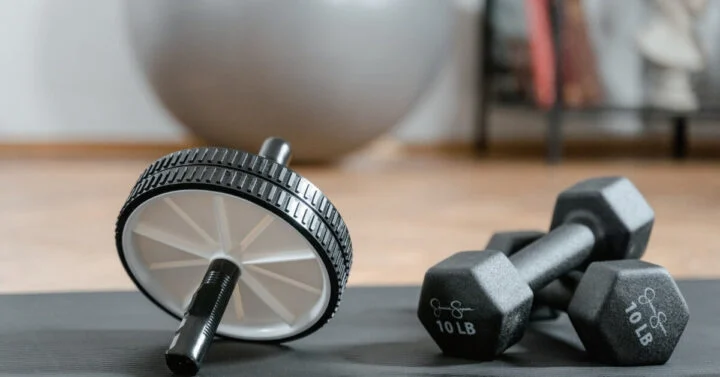
Standard hex dumbbells with bare metal surfaces are one of the loudest things in a home gym. When they contact each other, a rack, or a floor, that metallic ring carries. Rubber-coated dumbbells solve this at the source — the coating absorbs impact and eliminates the metal-on-metal sound entirely.
For most home gym setups, this is the single highest-impact swap you can make for noise reduction. It’s also just a better dumbbell to train with — more comfortable to grip, easier on flooring, and less likely to damage equipment it contacts.
One thing I tell clients who are just starting out: don’t overbuy on dumbbells early. A focused set covering the weights you’ll actually use across your current programming is almost always more useful than a full rack that leaves gaps in your actual training range.
Recommended Product
CAP Barbell Rubber-Coated Dumbbell Set (Small Set):
This set is a solid entry-level option for someone building out a focused set. Rubber coating on all contact points, a vertical rack that keeps everything organized and off the floor. Good starting point for most programs.

RITFIT Rubber Hex Dumbbell Set (Large Set):
If you’re building for serious strength training across a full weight range, the RITFIT Dumbbell Set has got you covered- thoroughly. Space-saving design keeps your footprint reasonable even at full capacity.

Best Adjustable Dumbbells for Home Gyms (2026 Review)— If you’re weight-restricted on space, adjustable dumbbells are worth a dedicated look. We break down the best options here.
Immediate Takeaway:
If you currently have bare metal dumbbells and you’re training in a noise-sensitive environment, replacing them with rubber-coated versions is your fastest noise win. Do it before anything else.
Resistance Bands: The Most Silent Option
There’s a reason resistance bands have had such a long run in home gym culture — they’re genuinely quiet. Not “quieter than dumbbells” quiet. Actually silent. No impact, no vibration, no noise transmission. If you’re training at 5 AM in an apartment building, bands are your go-to.
The knock on bands has historically been that they don’t provide enough resistance for serious training, or that they’re limited in what they can accomplish. That’s a real limitation at very high strength levels. But for most training programs — especially those focused on hypertrophy, mobility, and conditioning — bands can carry a significant portion of the work, and they do it in complete silence.
They’re also the most portable of any option, don’t require flooring accommodations, and take up almost no space. In a spare room or office gym setup, that matters.
Recommended Product:
Tribe Long Resistance Bands
Tribe Bands are a well-regarded set designed for full-body training. Multiple resistance levels, durable latex, and versatile enough to cover upper body, lower body, and full-body movement patterns. This is the kind of set that earns its place as a permanent fixture in the gym rather than a supplement to the “real” equipment.

Immediate takeaway:
If you don’t have bands in your setup yet, add them. Use them for warm-up sets, accessory work, or full training sessions when noise is a hard constraint. They cost almost nothing relative to the value they add.
Rowing Machines: The Quiet Cardio Option That Actually Delivers
Treadmills are loud by nature — the motor, the belt mechanism, and the impact of footfalls all compound into significant noise. If you have an upstairs room or any shared structure below your gym, a treadmill is going to be a problem regardless of what you put under it.
Rowing machines are a different category. A quality magnetic or water resistance rower runs quietly, with the primary sound being the rhythm of the pull and the slight mechanical noise of the resistance. That’s manageable. It’s also one of the most complete cardio investments you can make — full-body cardiovascular work, posterior chain engagement, low joint impact.
For a spare room or office gym where you need a solid cardio session without rattling the walls, a rower is often the right answer over a treadmill, even if you’ve been a runner your whole life.
Recommended Product:
Wenoker Foldable Rowing Machine
The Wenoker row machine adds a practical storage advantage on top of its quiet operation — it folds down for compact storage when not in use. Bluetooth connectivity, comfortable seat, and designed for quiet residential use. The foldability is genuinely useful if you’re running a dual-purpose room.

Immediate takeaway:
If you’re currently using or planning a treadmill as your primary cardio, seriously consider whether a rower serves your goals equally well. For general conditioning and cardiovascular health, the answer is usually yes — with significantly less noise.
Rubber Bumper Plates: Non-Negotiable for Barbell Work
If you’re doing barbell training — deadlifts, squats, Olympic variations — iron plates in a noise-sensitive environment are going to create problems. The sound of iron plates contacting each other during a lift, or contacting the floor during a controlled descent, is distinct and carries.
Rubber bumper plates absorb that impact. They also protect your floor and your barbell sleeves, so the noise reduction is a bonus on top of an equipment investment that already makes sense.
The thickness of bumper plates does take up more room on the bar than iron plates at equivalent weight, which is worth factoring into your planning. But for anyone training in an environment where noise matters, it’s not really a trade-off — it’s just the right choice.
Recommended Product:
Rendpas Rubber Bumper Plates
Rendpas plates come in a range from 10–45 lb with stainless steel inserts for durability. Solid option for home gym barbell work — designed to handle deadlifts and heavy pulling without the noise or floor damage of iron.

Immediate takeaway:
If you currently use iron plates and train in a noise-sensitive environment, start replacing them with bumpers as you can. Begin with your working weights and go from there.
Quality Rubber Flooring: The Piece That Makes it All Work
All the quiet equipment in the world won’t fully solve your noise problem if you haven’t addressed the floor. This is where vibration transmission happens — and it’s where most people underinvest.
Good rubber flooring does two things: it absorbs impact at the surface level, and it creates a decoupling layer between your equipment and the subfloor below. That decoupling is what prevents vibration from traveling through the structure of your home. Thicker rubber does both things better.
For most home gym spaces, a minimum of 3/8″ thick interlocking rubber tiles is the starting point. If you’re doing heavy barbell work or you have shared flooring below your gym space, 3/4″ is worth the upgrade.
Don’t skimp here. The flooring is literally the foundation that every other piece of equipment sits on. Getting it wrong undermines everything else you’ve invested in.
Recommended Product:
PRAISUN Thicker Rubber Flooring Tiles
PRAISUN tiles are an interlocking tile system with a thicker-than-standard profile for better vibration absorption. Easy to install, easy to reconfigure if your space changes, and built for the impact loads of actual training — not just light cardio.

The Best Flooring for Home Gyms: Rubber, Foam, or Carpet?— We go deep on flooring options, thickness recommendations by use case, and what to put under cardio equipment specifically.
How to Soundproof a Home Gym Without Major Renovations — If noise is a serious constraint in your space, this is the full guide to structural soundproofing beyond just equipment selection.
Immediate takeaway:
Before your next workout, check what’s under your feet. If it’s bare concrete, bare hardwood, or a thin yoga mat, that’s your first project. Get rubber flooring down before adding more equipment.
Magnetic Resistance Bikes: Quiet Cardio That Doesn’t Ask Much of Your Space
Spin bikes with friction resistance systems are notoriously loud — the flywheel noise, the pad contact, the general mechanical churn. Magnetic resistance bikes eliminated all of that. The resistance is created through magnetic fields, not physical contact with the flywheel, so the primary sound during a ride is your breathing and the very slight hum of the flywheel spinning.
In a shared living space or apartment, this is a meaningful difference. You can run an intense interval session on a magnetic resistance bike at any hour without disturbing anyone.
They’re also compact, don’t require the same flooring setup as treadmills, and offer enough training variety (steady-state, intervals, threshold work) to build real cardiovascular fitness. For an office gym or small spare room, a magnetic resistance bike often outperforms every other cardio option on the quiet/footprint/effectiveness combination.
Recommended Product:
MERACH Magnetic Resistance Bike
This bike is a well-built magnetic resistance option with an app-connected experience that makes structured training easier to stick to. Whisper-quiet operation, adjustable resistance levels, compact profile. This is the kind of bike that gets used because it’s genuinely enjoyable to train on, not just because it’s there.

Immediate takeaway:
If you want cardio in your setup and you’re prioritizing noise, start here before looking at treadmills or even rowers. Magnetic bikes deliver the best combination of quiet operation, training quality, and ease of setup.
Yoga and Bodyweight Equipment: Already Silent, Worth Having
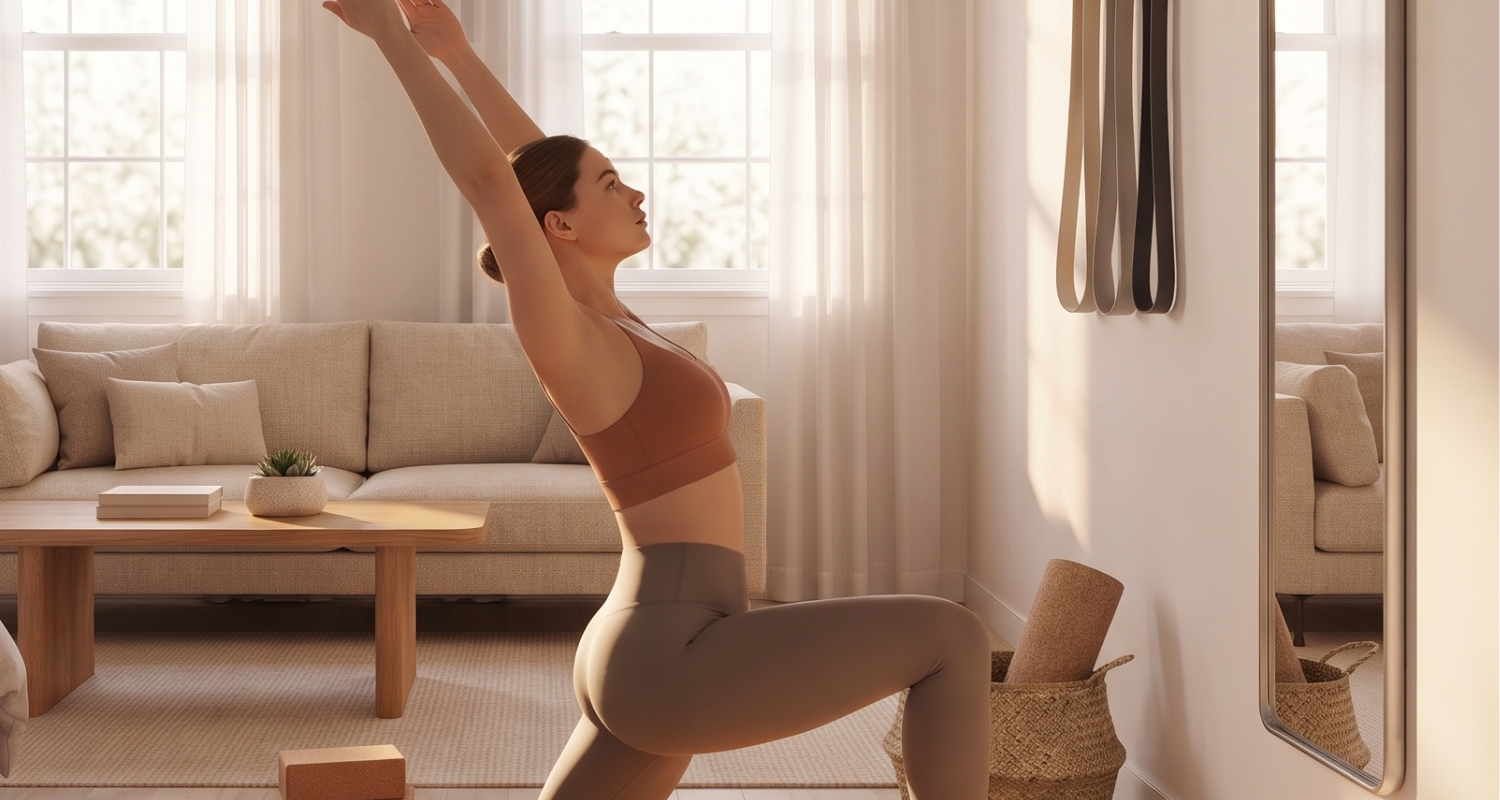
It goes without saying that yoga and bodyweight training are naturally quiet with no impact, no vibration, and no mechanical noise. But equipment quality still makes a difference– even for an activity as simplistic as yoga. See how serene and peaceful you feel when your feet are slipping and sliding under a mat with no grip. At the end of the day quality products lead to quality experiences.
A good yoga mat provides both cushioning and grip, which reduces the subtle squeaking and shifting sounds of a mat that’s moving around under you. Blocks, straps, and bands extend what you can do without adding any noise footprint at all.
This category of equipment also has the smallest space requirement of anything in your gym. A 6′ x 4′ area, a good mat, and a handful of accessories give you enough room for a complete mobility, flexibility, and bodyweight strength program. In an office gym where floor space is genuinely limited, this might be your primary training setup.
Recommended Product:
Clever Yoga 7-Piece Starter Pack
The package includes a mat, blocks, a strap, and a carrying bag — everything needed to run a complete practice or bodyweight program without needing to source components individually. Good quality across the board and practical for both home use and travel.

Immediate takeaway:
Don’t treat yoga and bodyweight equipment as a compromise. A well-designed program built around bands, bodyweight movements, and mobility work can drive real physical transformation. The lack of noise is a feature, not a consolation.
What a Practical Quiet Setup Looks Like (by Space Type)
Apartment or room above another living space
Your priority is vibration control above everything else. Start with thick rubber flooring across the entire training area. Choose a magnetic resistance bike or rowing machine over any treadmill. Stick to rubber-coated dumbbells and bumper plates, and be deliberate about controlled equipment returns. Bands for any movement you can accomplish with them.
Spare bedroom or office gym
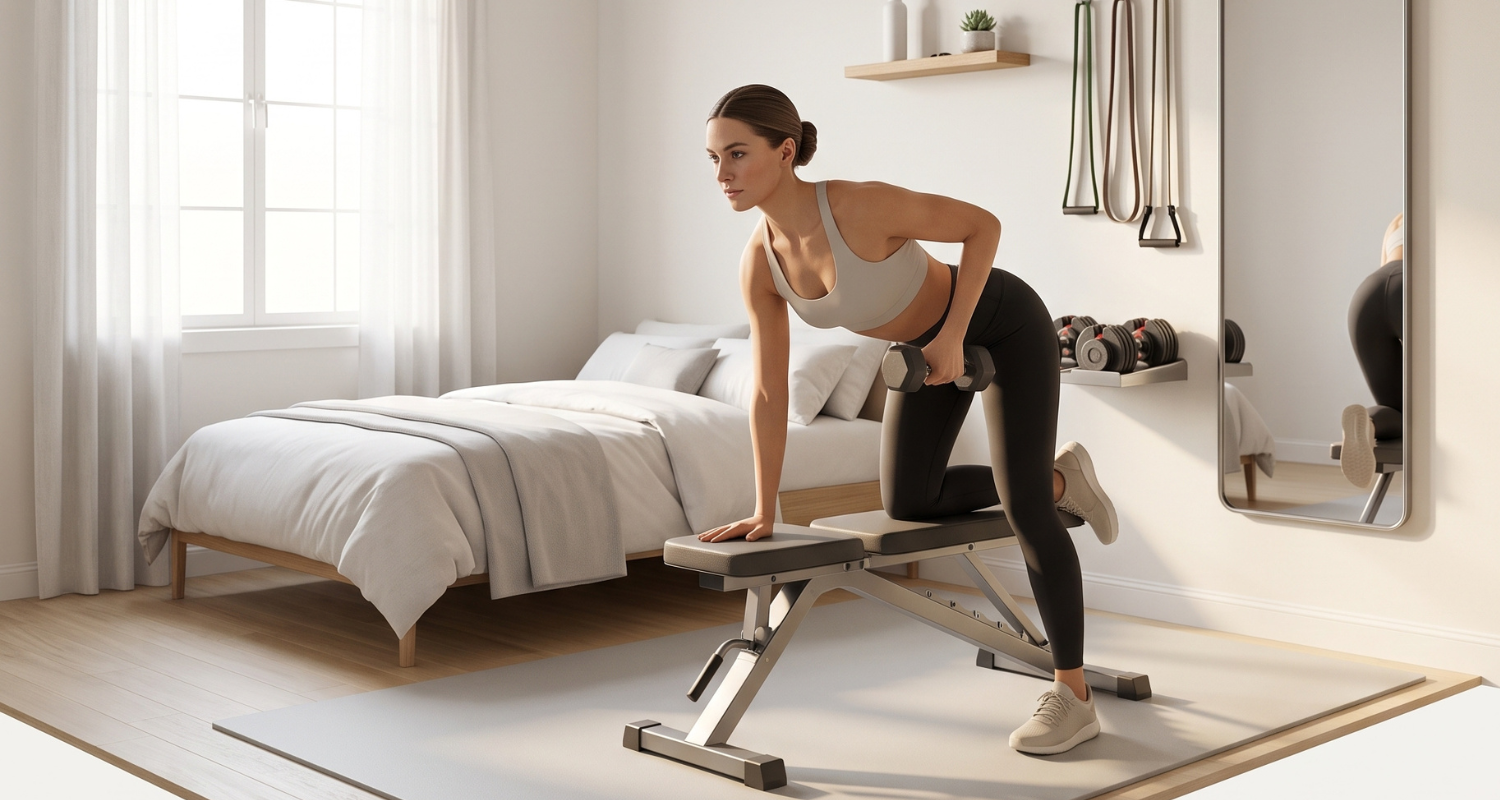
More flexibility on equipment, but ceiling height and structural considerations still matter. A rower that folds for storage is worth prioritizing. Magnetic bike for cardio. Full rubber flooring. Dumbbells for strength, bands for supplementary work. This setup can fit in roughly a 10′ x 10′ footprint with smart organization.
Garage gym
More latitude on noise (concrete or insulated walls help significantly), but if you share a wall with the house or if the garage is attached below a bedroom, floor vibration is still a real consideration. Bumper plates matter here. Quality flooring matters. Heavy barbell work on bare concrete is audible in the house above it even if the garage itself seems well-isolated.
The Bigger Picture
Every choice you make about your home gym is a choice about how seriously you’re taking your own training. Quiet equipment isn’t a luxury accommodation for early-morning people or apartment dwellers — it’s the difference between a gym you can actually use consistently and one that creates friction every time you try to show up.
The best home gym is one that removes every possible reason not to train. Bad flooring gives you a reason. Loud equipment that you can only use during a two-hour window gives you a reason. Getting these fundamentals right removes them.
This is what the SOMA philosophy comes back to every time: the environment you build is the foundation your transformation gets built on. You can have the best programming in the world, but if your gym creates friction — logistical, social, or auditory — you will find reasons to skip. Remove the friction, and you show up. Show up consistently, and everything else follows.
Build It Right From the Start
If you’re still in the planning phase of your home gym, use this as a foundation: start with the flooring, choose equipment that respects the realities of your living situation, and don’t underestimate how much a thoughtful setup changes your relationship with training.
The gym you build right now is the one you’ll be training in for years. Build it like you mean it.
by Micah Le’Gare, CPT and Fitness Nutrition Specialist — Founder of SOMA.FITNESS*

Leave a Reply