
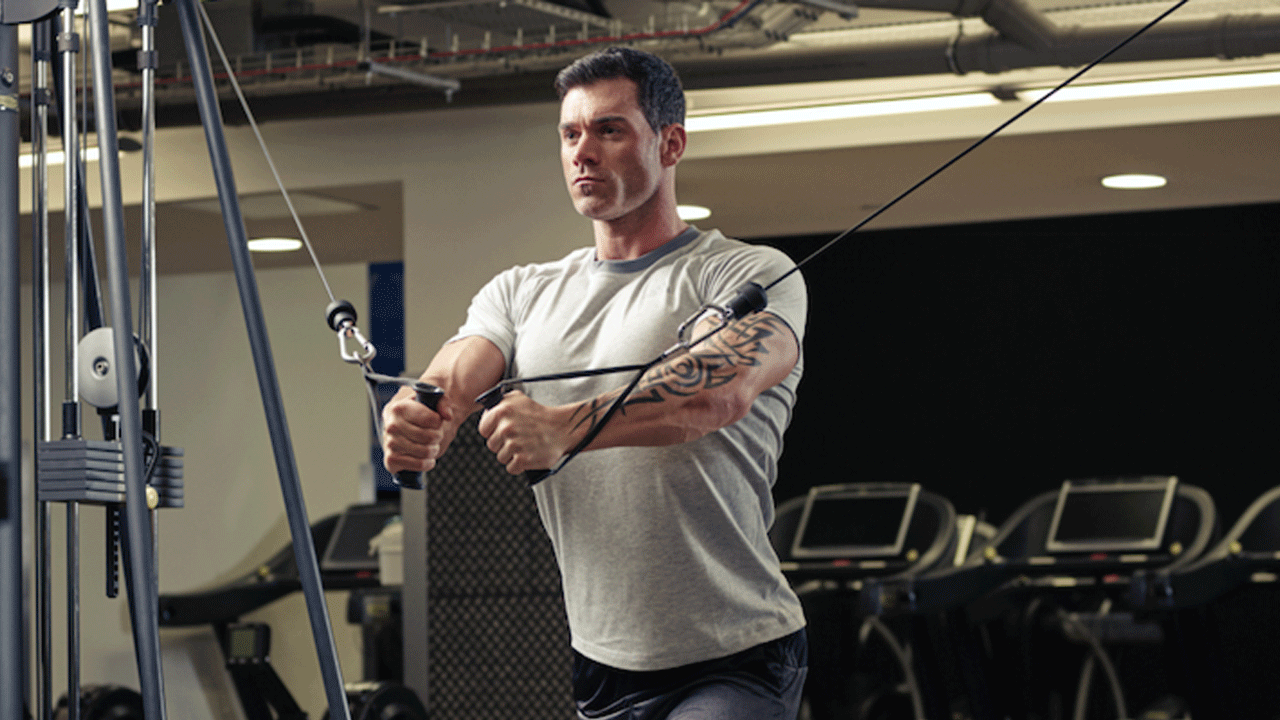
Beginning any fitness journey can be a daunting task, and strength training has its share of challenges. Without the right approach you could find yourself like the vast majority of gym-goers; present, but aimlessly drifting from machines and workouts with no results. You don’t want to end up like this, and I’d personally hate for you to waste your time, but this begs the question– how do you start strength training properly?
The fortunate news is that strength training is far simpler than the fitness industry would have you believe. You don’t need the latest equipment or the fanciest gym membership, just a straight-forward strategy, some basic understanding of what you’re doing, and a lot of consistency to see progress.
This guide is here to help you with two of those three points; we’ll give you a solid foundation of strength training principles and provide you a basic plan to help you tackle the first few weeks of your fitness journey with confidence. So without any delay, let’s get into it!

What Is Strength Training and Why Should You Do It?
Strength training– also known as resistance training or weightlifting— defines any type if physical exercise that requires muscles to contract against a form of external resistance. This can include a lot of different tools including barbells, dumbbells, kettlebells, machines, bands, bodyweight and much more.
Unlike cardio that works the cardiovascular system primarily, strength training causes adaptation of skeletal muscle (depending on which group of muscles you’re training). This mechanical tension on the muscle fibers creates a chain-reaction of adaptation that makes you bigger (more muscular) and stronger over time.
The Science of Getting Stronger
As you lift weights that challenge your muscles, tears are created on a microscopic level. As these same muscles recover, the body works to repair the fibers, and as a result are rebuilt larger and stronger than before— a process otherwise known as protein synthesis. The repetition of this cycle over weeks, months, and even years can add literal pounds of lean muscle mass to one’s frame.
In the first couple of weeks (4-8 weeks) most practitioners experience the majority of their strength gains from neural adaptation— a process in which the nervous system recruits fibers more efficiently in order to coordinate movement patterns and reduce inhibitory signals.
After this initial neural phase, hypertrophy (actual muscle growth) becomes the dominant driver of strength gains. This is where patience becomes essential: meaningful muscle development takes months of consistent training, not weeks.
Benefits of Strength Training Beyond Looking Better
A vast majority of beginners start strength training for aesthetic reasons, but there are health benefits that far exceed most people’s expectations:
- Improved bone density: Resistance training stimulates bone remodeling, reducing the risk of osteoporosis and fractures later in life.
- Enhanced metabolic rate: Muscle tissue burns more calories at rest than fat tissue, meaning more muscle modestly raises your resting metabolism.
- Better insulin sensitivity: Regular strength training improves how efficiently your cells use glucose, reducing the risk of type 2 diabetes.
- Reduced injury risk: Stronger muscles, tendons, and connective tissue protect joints and make everyday activities safer.
- Mental health benefits: Strength training consistently shows improvements in anxiety, depression, and self-efficacy in research literature.
- Functional longevity: Muscle mass naturally declines with age. Building and maintaining it is one of the most powerful things you can do for long-term quality of life.

Essential Concepts Before You Begin
Before hitting the gym, it’s important to understand some of the concepts that will make your workout experience far more effective and every other article, video, or coaching cue you run into far simpler to digest.
Progressive Overload: The Master Principle
Progressive overload is one of the biggest concepts to grasp when approaching strength training. It means gradually increasing the demands placed on your muscles over time so they continue adapting. Without progressive overload, you plateau.
The most straightforward form of progressive overload is adding weight to the bar over time. But it also includes adding reps, adding sets, reducing rest time, improving technique, or increasing training frequency. As a beginner, simply adding a small amount of weight each session or week is usually sufficient to drive progress.
Reps, Sets, and Rest
| Term | Definition | Common Beginner Range |
| Rep (repetition) | One complete execution of an exercise movement | 5–12 per set |
| Set | A group of consecutive reps performed without resting | 2–4 sets per exercise |
| Rest interval | Time between sets to allow partial recovery | 60–180 seconds |
| 1RM (one-rep max) | The maximum weight you can lift for one rep | Used to calculate training loads |
Compound vs. Isolation Exercises
Compound exercises involve multiple joints and muscle groups simultaneously. Examples include the squat, deadlift, bench press, overhead press, and row. These movements deliver the most training stimulus per unit of time and should form the backbone of any beginner program.
Isolation exercises target a single muscle group (e.g., bicep curls, tricep pushdowns, leg extensions). They have value for addressing weak points and aesthetic goals, but beginners don’t need many of them. The compound movements will build your biceps, triceps, and legs far more efficiently in the early stages.
Volume, Intensity, and Frequency
These three variables govern how much work you do and how hard you work:
- Volume: Total amount of work, typically measured as sets × reps × weight. More volume generally drives more growth, but only up to the point your body can recover from.
- Intensity: How heavy the weight is relative to your maximum capability, often expressed as a percentage of 1RM or as RPE (Rate of Perceived Exertion). Beginners should generally stay away from true maximal efforts.
- Frequency: How often you train a muscle group per week. Most research suggests training each muscle group at least twice per week is superior to once-a-week training for beginners.
Recovery: The Overlooked Variable
Strength is not built during workouts. It’s built during recovery. Your training session is the stimulus; everything you do between sessions determines how well you adapt. Sleep is the most powerful recovery tool available. Aim for seven to nine hours per night. Nutrition, hydration, stress management, and avoiding excessive training volume also critically impact recovery quality.
Related Article: Best Active Recovery Workouts
Choosing the Right Beginner Program
One of the most common beginner mistakes is program hopping — switching from one routine to another every few weeks because something new looks appealing. This is almost always counterproductive. The best program is one you can commit to consistently for at least three to six months.
Beginners have a remarkable ability to make progress on nearly any program, because your body is so unaccustomed to training stimulus that almost any consistent resistance exercise will trigger adaptation. This is often called “newbie gains.” The key is picking a well-structured program and sticking with it.
Characteristics of a Good Beginner Program
- Full-body focus: Training the whole body two or three times per week ensures high frequency, which maximizes the neural adaptations beginners need.
- Emphasis on compound movements: The bulk of your time should be spent on squats, deadlifts, presses, and rows.
- Simple progression model: You should know exactly what weight to lift each session and how to increase it over time.
- Manageable volume: Beginners don’t need a lot of volume to grow. Three to five sets of a handful of exercises is sufficient — and sustainable.
- Room for technique development: The program should leave you with energy to focus on movement quality, not just grinding through reps.
Popular Beginner Programs Worth Considering
Several time-tested programs meet these criteria. None is definitively “the best” — the best one is the one you’ll follow consistently.
StrongLifts 5×5
One of the most popular beginner programs ever created. You train three days per week, alternating between two workouts (Workout A: Squat, Bench Press, Barbell Row; Workout B: Squat, Overhead Press, Deadlift). You perform five sets of five reps on most exercises and add weight every session. Simple, effective, and well-supported by beginner success stories.
Starting Strength
Developed by coach Mark Rippetoe, Starting Strength uses a similar structure to StrongLifts but with slight variations in exercise selection and a 3×5 set-rep scheme on most lifts. Its accompanying book is one of the most detailed technical resources on barbell technique available.
GZCLP
Created by powerlifter Cody Lefever, GZCLP organizes exercises into tiers by importance and includes more volume than the above programs. It’s slightly more complex but offers more flexibility and has gained a loyal following among those who want a little more variety.
Beginner Full-Body Dumbbell or Bodyweight Programs
If you’re training at home or don’t have access to barbells, dumbbell and bodyweight programs can deliver excellent results. The principles are identical — progressive overload, compound movements, consistent frequency. Bodyweight progressions (e.g., progressing from knee push-ups to full push-ups to pike push-ups to handstand push-ups) provide an effective substitute for adding weight.
The Foundational Movement Patterns
Regardless of which program you choose, you’ll be training the same fundamental movement patterns. Mastering these early will serve you for the rest of your lifting career.

The Hip Hinge
The hip hinge is the foundation of deadlifts, Romanian deadlifts, kettlebell swings, and good mornings. The movement involves bending at the hips while maintaining a neutral spine, loading the hamstrings and glutes.
To practice the hip hinge, stand facing a wall about a foot away. Push your hips back until they touch the wall, keeping your back flat and a slight bend in the knees. This teaches the fundamental hip-back motion without loading the spine. Once this feels natural, you’re ready to progress to a loaded deadlift.
The Squat Pattern
Squatting is a natural human movement — babies squat perfectly. Adult lifters often lose this motor pattern from years of sitting. The squat trains the quadriceps, glutes, hamstrings, and core simultaneously, making it arguably the most valuable exercise in existence.
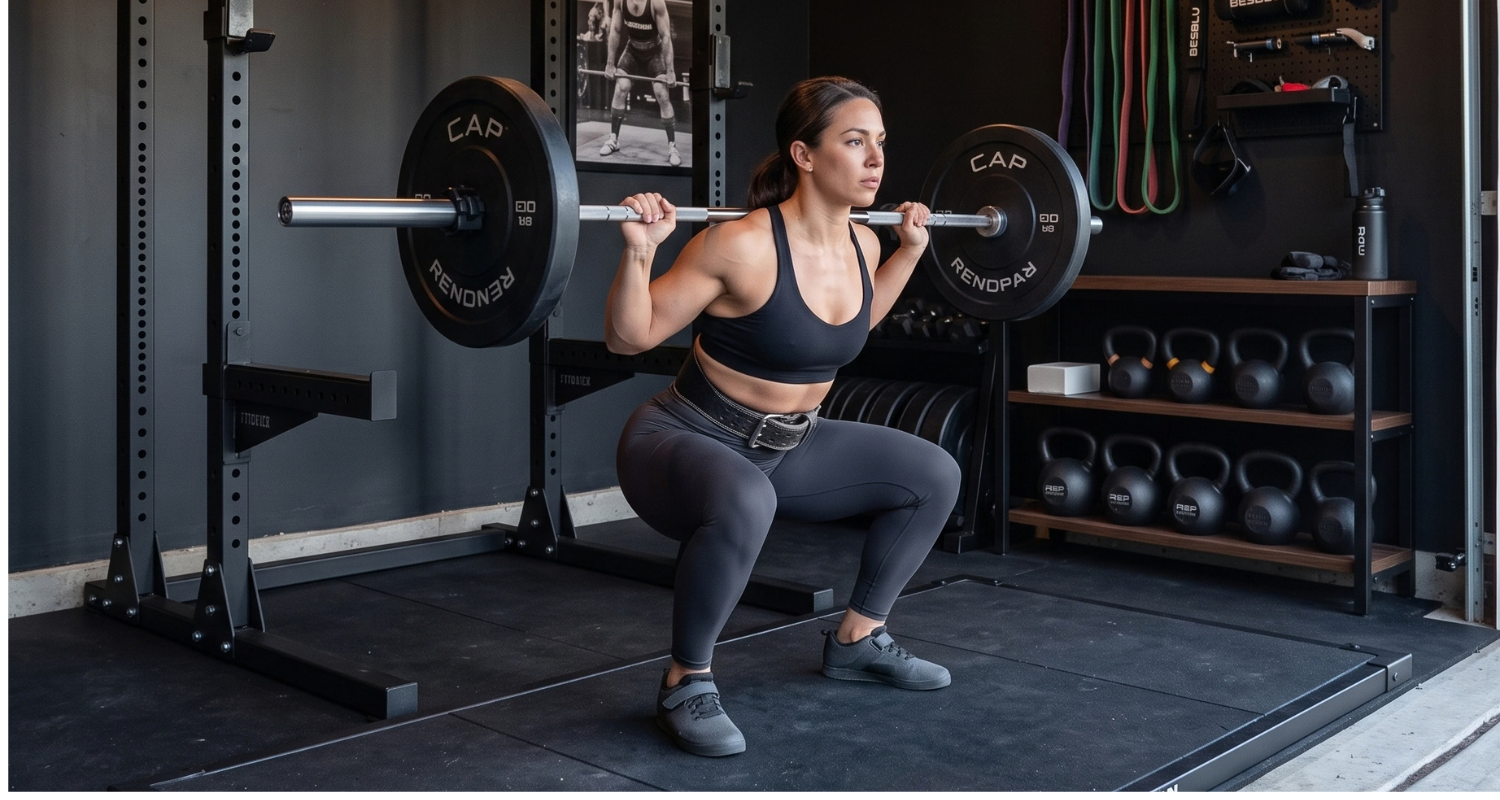
Start with a goblet squat (holding a dumbbell or kettlebell at your chest) to learn the pattern before progressing to a barbell back squat. Focus on keeping your chest up, knees tracking over your toes, and reaching depth (hip crease below the knee is the goal) without letting your lower back round.
The Vertical Push (Overhead Press)
The overhead press builds the shoulders, triceps, and upper chest while demanding significant core stability. Begin with dumbbells or a barbell at shoulder height, press directly overhead until your arms are fully extended, then lower under control. Avoid excessively leaning back, which turns it into an incline press and risks lower back strain.
The Horizontal Push (Bench Press / Push-Up)
The bench press is the most iconic upper body exercise and builds the chest, shoulders, and triceps. If you don’t have a bench, push-ups are a highly effective substitute — once you can perform three sets of 20 with perfect form, consider progressing to weighted variants or feet-elevated push-ups.
For the barbell bench press, lie on a flat bench with your feet flat on the floor, grip the bar just outside shoulder width, lower the bar to mid-chest under control, then press back to the starting position.
The Row (Horizontal Pull)
Rows counterbalance pressing movements and are essential for shoulder health and posture. The barbell row, dumbbell row, cable row, and inverted row all train the upper back, lats, rear deltoids, and biceps. Most beginners benefit from emphasizing pulling movements because modern life (hunching over screens) leaves the upper back chronically weak.
The Vertical Pull (Pull-Up / Lat Pulldown)
Pull-ups are a gold standard upper body exercise but require significant relative strength. If you can’t yet perform pull-ups, use a lat pulldown machine, resistance band-assisted pull-ups, or Australian rows (feet elevated rows on a bar at hip height) as substitutes while you build toward them.
A Note on Form and Technique
Good technique is not about perfectionism — it’s about safety and efficiency. Focus on learning the correct movement pattern with a light, manageable weight before adding load. Record yourself from the side to check your form. Use online resources, reputable YouTube channels, and if possible, a single session with a knowledgeable coach to get personalized feedback. Most technique issues correct themselves once you understand what you’re aiming for.
Related Article: Best Compound Exercises for Muscle Growth
Structuring Your First 12 Weeks
The first 12 weeks of training are simultaneously the most exciting and the most critical. This is when the foundation gets laid. Progress is rapid, motivation is usually high, and the habits you build now will determine your long-term trajectory.
Weeks 1–2: The Learning Phase
Use these weeks to practice movement patterns with light weights — significantly lighter than you think you need. The goal is not to challenge your muscles maximally; it’s to build the neural pathways and movement patterns you’ll use for the rest of your training career. Think of it as writing the software before installing the hardware.
Train two to three times per week. Keep sessions to 45–60 minutes. Prioritize how movements feel over how much weight you’re lifting. Take notes in a training log — this habit pays enormous dividends over time.
Weeks 3–6: Building the Base
By week three, fundamental patterns should feel increasingly natural. Begin adding weight incrementally — typically 5 lbs (2.5 kg) on upper body exercises and 10 lbs (5 kg) on lower body exercises per session, provided the previous weight felt manageable and form remained solid. This is the linear progression phase, where you can quite literally add weight every single workout.
If a particular weight feels too heavy and form breaks down, stay at that weight until it feels comfortable. There is no shame in taking an extra session or two at the same load.
Weeks 7–12: Developing Consistency
By week seven, training should feel like a normal part of your week rather than a novelty. Progress on linear progression will begin to slow — this is completely normal. You may start missing reps at a given weight, which is your cue to deload (reduce weight slightly) and reset rather than grinding at a stalled weight.
Use this phase to refine technique, identify weak points, and experiment with any accessory exercises your program recommends. By week 12, you will be dramatically stronger than when you started — even if the mirror hasn’t caught up yet.
Sample Three-Day Full-Body Beginner Week
| Day | Exercises | Sets × Reps |
| Monday (A) | Squat | 3 × 5 |
| Bench Press | 3 × 5 | |
| Barbell Row | 3 × 5 | |
| Wednesday (B) | Squat | 3 × 5 |
| Overhead Press | 3 × 5 | |
| Deadlift | 1 × 5 | |
| Friday (A) | Squat | 3 × 5 |
| Bench Press | 3 × 5 | |
| Barbell Row | 3 × 5 |
Rest days can include light activity like walking, yoga, or recreational sports, but avoid intense exercise that could interfere with recovery.
Nutrition Fundamentals for Strength Training
You cannot out-train a poor diet — but you also don’t need a PhD in nutrition to eat in a way that supports strength training. A few key principles cover the vast majority of what you need to know.

Protein: The Foundation
Protein provides the amino acids your body uses to repair and build muscle tissue. Without adequate protein, your body cannot fully capitalize on the training stimulus you’re providing. Most research suggests aiming for 0.7 to 1 gram of protein per pound of bodyweight per day (approximately 1.6 to 2.2 grams per kilogram) as an effective target for people doing resistance training.
High-quality protein sources include chicken, turkey, beef, eggs, fish, dairy (Greek yogurt, cottage cheese), and plant-based options like tofu, tempeh, legumes, and edamame. Getting enough protein is the single most important nutritional priority for a strength trainee.
Calories: The Energy Equation
Whether you should eat in a caloric surplus (more than you burn) or deficit (less than you burn) depends on your goals:
- Building muscle is the primary goal: A modest caloric surplus of 200–400 calories above maintenance supports muscle growth without excessive fat gain. Many beginners can gain muscle and lose fat simultaneously (“recomposition”) simply by training consistently and eating adequate protein.
- Fat loss is the primary goal: A moderate deficit of 300–500 calories below maintenance allows fat loss while preserving muscle, provided protein intake is high. Progress will be slower, but it is entirely possible to get stronger while losing weight.
- Neither is the priority right now: Eating at maintenance while focusing on training and protein intake is a valid approach, especially for true beginners.
Carbohydrates and Fats
Both carbohydrates and fats are important — don’t demonize either. Carbohydrates are your muscles’ preferred fuel source during intense exercise. Eating carbohydrates around your training sessions (before and after) can support performance and recovery. Fat is essential for hormone production, joint health, and the absorption of fat-soluble vitamins. Focus on unsaturated fats (olive oil, nuts, avocado, fatty fish) while limiting trans fats.
Hydration
Dehydration impairs strength, endurance, and cognitive function. Aim for at least half your bodyweight in ounces of water per day (e.g., a 160 lb person should aim for 80 oz), and more on training days. A simple indicator: your urine should be pale yellow, not dark.
Supplements: What’s Worth It for Beginners
The supplement industry is enormous, aggressively marketed, and largely unnecessary for beginners. The few supplements with genuine evidence behind them for strength trainees include:
- Creatine monohydrate: The most well-researched performance supplement in existence. It increases phosphocreatine availability in muscles, allowing slightly more reps at a given weight. Safe, cheap, and effective. Take 3–5 grams daily.
- Protein powder: Not a magic supplement — simply a convenient way to hit your protein target if whole foods aren’t sufficient. Whey, casein, and plant-based options all work well.
- Vitamin D: Many people are deficient, especially those in northern latitudes or with limited sun exposure. Deficiency can impair muscle function and recovery.

Everything else (pre-workouts, fat burners, BCAAs, testosterone boosters) either has weak evidence, is redundant if you’re eating enough protein, or is potentially harmful. Save your money.
Related Article: 12 Best Muscle Recovery Supplements for Fitness
Gym Etiquette and Practical Tips for Beginners
Walking into a gym for the first time can feel intimidating. Understanding the unwritten rules of gym culture will help you feel more confident and ensure you’re a considerate member of the community.
Basic Gym Etiquette
Re-rack your weights: Always return dumbbells, barbells, and plates to where they belong when you’re finished. Leaving weights on the floor or on a bar is one of the most universally disliked behaviors in any gym.
Wipe down equipment: Use the gym’s provided spray and paper towels to wipe sweat from benches, machines, and pads after use.
Don’t monopolize equipment: During busy hours, avoid occupying multiple pieces of equipment simultaneously or texting for extended periods between sets while others wait.
Ask before working in: If someone is using equipment and you want to share it, simply ask, “Mind if I work in?” Most experienced gym-goers are happy to share.
Headphones signal focus: If someone is wearing headphones, they generally prefer not to be interrupted. Respect that signal.
Limit unsolicited advice: Unless someone asks for help or is doing something genuinely dangerous, keep your technique opinions to yourself.
Practical Tips for Your First Sessions
- Arrive with a plan: Know exactly what exercises you’re doing before you walk in. Wandering aimlessly wastes time and increases anxiety.
- Start at off-peak hours if possible: Early mornings and midday on weekdays tend to be quieter. Evenings and weekend mornings are typically the busiest.
- Track every workout: Write down what you lifted, for how many reps, and how it felt. This data is invaluable for making programming decisions and staying motivated.
- Learn to use the equipment safely before adding weight: Ask gym staff for a brief orientation if you’re unfamiliar with how barbells, racks, and machines work.
- Use collars on barbells: Collar clips prevent plates from sliding off during a set, which can be genuinely dangerous.
- Don’t use the squat rack for exercises easily done elsewhere: Barbell curls in the squat rack when all the dumbbells are available is a classic faux pas.
Avoiding Common Beginner Mistakes
Most beginner mistakes follow predictable patterns. Being aware of them in advance dramatically reduces your chance of making them.
Too Much, Too Soon
The enthusiasm of a new training regimen can lead to overtraining — doing too much volume or training too frequently before your body has built the resilience to handle it. The result is excessive soreness, fatigue, injury, and burnout. More is not better; appropriate is better. Follow your program as written, especially regarding volume and frequency.
Ego Lifting
Using more weight than your technique can support is the fastest path to injury. Lifting is not a competition with the person next to you. Lower the weight, nail the technique, and earn the heavier loads over time. A 135 lb squat done through a full range of motion with a neutral spine is more valuable than a 225 lb squat that’s half depth with a rounded back.
Neglecting Recovery
Many beginners believe more training = more results. In reality, training is the stimulus and recovery is where the adaptation happens. Chronically underslept, overstressed, or undernourished lifters make poor progress regardless of how hard they train. Prioritize sleep above almost everything else.
Expecting Overnight Results
Visible body composition changes typically take 8–12 weeks of consistent training to become noticeable, and meaningful physique changes often take 6–12 months. Strength, however, will improve quickly. Focus on performance metrics (adding weight to the bar, hitting more reps) rather than aesthetics in the first several months. The mirror will catch up.
Skipping the Warm-Up
A proper warm-up raises muscle temperature, increases range of motion, activates the nervous system, and dramatically reduces injury risk. Before strength training, spend five to ten minutes on light cardio (stationary bike, rowing machine, or fast walking), then perform movement-specific warm-up sets with progressively heavier loads before your working sets.
Program Hopping
Switching programs every two to four weeks before giving any program time to work is one of the most common mistakes in beginner training. Commit to a program for at least 8–12 weeks. Real progress accumulates over consistent effort, not novelty.
Ignoring Pain Signals
There is a difference between muscle soreness (normal, diffuse, peaks 24–48 hours after training) and pain (sharp, localized, occurring during movement). Do not train through pain. Joint pain, sharp muscle pain, or any pain that doesn’t resolve quickly should be evaluated by a medical professional before continuing. Most training injuries are avoidable; the ones that happen are often made worse by ignoring them.
Building Long-Term Habits and Staying Motivated
The biggest predictor of long-term results in strength training is not the program you choose, the gym you join, or the supplements you take. It’s consistency over time. A mediocre program followed consistently for two years will outperform a perfect program followed sporadically for two months every time.

The Habit Framework
Treat workouts like appointments you cannot reschedule. Put them in your calendar. Choose a consistent time of day that fits your schedule — the best time to work out is when you’ll actually do it. Create environmental anchors: pack your gym bag the night before, set your training shoes by the door, have your pre-workout meal ready.
Research on habit formation consistently shows that the first six to eight weeks are the most difficult. After that, the habit becomes increasingly automatic. If you can push through the initial friction, going to the gym stops feeling like a decision.
Tracking Progress
Keep a training log — a simple notebook, spreadsheet, or phone app works equally well. Record the date, exercises, sets, reps, and weight for every session. Periodically look back at where you started versus where you are now. Nothing combats motivational slumps more effectively than undeniable evidence of your own progress.
Consider taking progress photos every four weeks in consistent lighting. The mirror lies because you see yourself every day and changes are imperceptible on a session-to-session basis. Photos taken a month apart reveal the changes clearly.
Finding Your “Why”
Sustainable motivation is not the same as excitement. Excitement is high at the beginning and fades. Sustainable motivation comes from a clear understanding of why you’re doing this. Write down your reasons. Maybe it’s to keep up with your kids, reduce back pain, build confidence, reverse health markers, or prove something to yourself. Return to these reasons when motivation dips.
Community and Accountability
Training with a partner, joining an online community (forums, social media groups), or even sharing your goals with a trusted friend significantly increases adherence. Accountability structures don’t need to be formal — even just knowing someone will ask about your workout adds meaningful social pressure to follow through.
Managing Setbacks
Missed workouts, illness, travel, and life stressors will interrupt your training. This is not failure — it’s the normal texture of a sustained fitness practice. The only mistake is letting a short disruption become a permanent one. Resume training as soon as circumstances allow, reduce the weight slightly if you’ve missed more than a week, and continue.
Related Article: Finding Motivation
When to Progress Beyond Beginner Programming
A common question among people who have been training for a few months is: when am I no longer a beginner? The functional answer: you’ve graduated from beginner programming when linear progression consistently stalls despite proper recovery and nutrition, usually around three to nine months of consistent training.
At this point, your body has adapted to the simple demands of beginner programs and needs more sophisticated stimuli to continue growing. This is when intermediate programming concepts like periodization, training blocks, and more nuanced volume management become relevant.
Signs You’re Ready to Progress
- Linear progression has stalled on multiple lifts despite three or more sessions at the same weight with good recovery.
- You can perform the major compound lifts with solid, consistent technique across all rep ranges.
- You have a strong grasp of how your body responds to training — what volume you can handle, how long you need to recover, what triggers progress for you.
- You’ve completed at least 12 weeks of consistent training on a structured program.
What Intermediate Programming Looks Like
Intermediate programs typically introduce weekly or monthly progression cycles instead of session-to-session increases. They often include more exercise variation, periodization (planned variation in volume and intensity), and specialization phases. Programs like GZCLP (which has built-in intermediate stages), 5/3/1 by Jim Wendler, and Texas Method are commonly recommended transition programs.
You don’t need to rush this transition. Many people spend six months to a year on beginner programming with continued results if they remain diligent about progressive overload and recovery. There is no badge of honor for advancing prematurely.
Putting It All Together: Your Action Plan
You now have a comprehensive understanding of how to start strength training. But information without action is just entertainment. Here is your concrete starting point:
- Choose a program. Pick StrongLifts 5×5, Starting Strength, or a comparable full-body beginner program. Don’t overthink it — all of them work.
- Schedule three training days. Put them in your calendar with non-negotiable status. Monday/Wednesday/Friday or Tuesday/Thursday/Saturday work well.
- Buy or borrow a notebook. Log every workout from day one. Your future self will thank you.
- Start lighter than you think you should. Spend the first two weeks learning movement patterns. Resist the ego.
- Hit your protein target. Aim for 0.7–1.0 grams per pound of bodyweight daily. Everything else in nutrition is secondary.
- Prioritize sleep. Seven to nine hours. Non-negotiable.
- Commit to 12 weeks. Ignore any urge to switch programs. Give your body time to respond.

Learning how to start strength training is a decision that will pay dividends for the rest of your life. The first session is the hardest. The first month is the most uncertain. But on the other side of those early weeks is a version of you that is stronger, more capable, and more confident in your own body.
The barbell doesn’t care how old you are, what shape you’re in, or how intimidated you feel walking into the gym. It only asks that you show up, do the work, and come back next time. Everything else follows from that.
Quick Reference: Beginner Strength Training Cheat Sheet
| Category | Recommendation |
| Training frequency | 3 days per week, full body |
| Session length | 45–60 minutes |
| Sets per exercise | 3–5 working sets |
| Reps per set | 5–12 reps |
| Rest between sets | 90–180 seconds (compound), 60–90 seconds (isolation) |
| Weight progression | Add 5 lbs upper body / 10 lbs lower body per session when you complete all reps |
| Protein target | 0.7–1.0 g per lb bodyweight |
| Sleep | 7–9 hours per night |
| Creatine | 3–5 g daily (optional but evidence-backed) |
| Program commitment | Minimum 8–12 weeks before switching |


Leave a Reply