
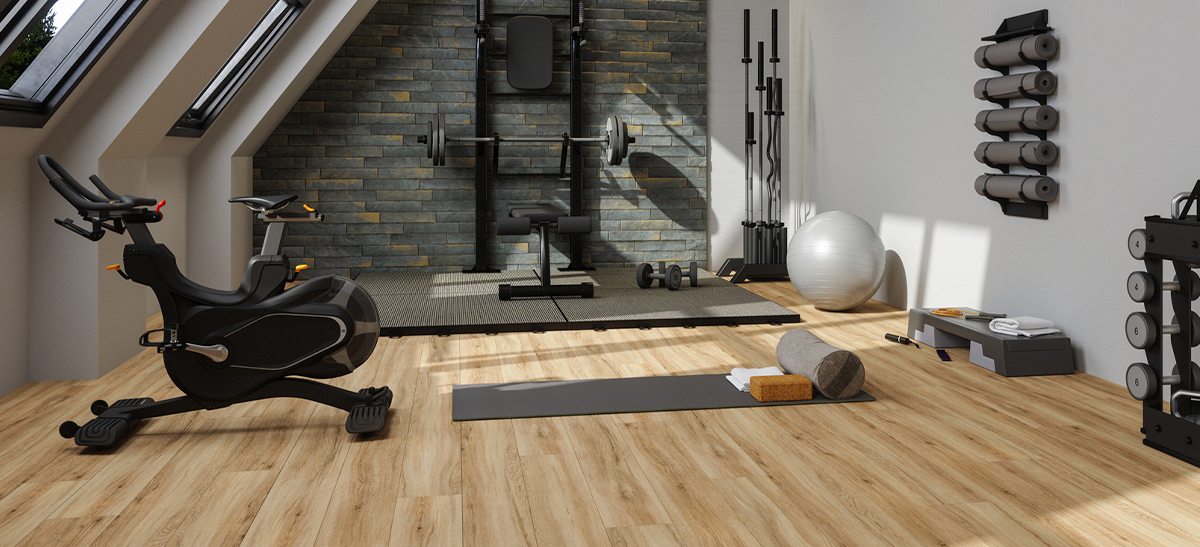
One of the biggest myths standing between people and their dream home gym is the belief that you need a massive, dedicated space to make it work. The reality? Most people overestimate how much room they actually need — and that misconception keeps a lot of would-be home gym owners stuck paying monthly membership fees they don’t need.
The truth is that home gym space requirements aren’t one-size-fits-all. How much room you need depends on three core factors: the equipment you choose, your preferred training style, and how smartly you lay everything out. A powerlifter needs a very different footprint than someone who does yoga and bodyweight circuits. A dedicated spare room isn’t necessarily better than a well-organized garage corner — it just depends on how you use it.
In this guide, we’ll cut through the guesswork and give you a realistic, practical breakdown of what different home gym setups actually require. Whether you’re working with a compact 50-square-foot nook or a spacious 400-square-foot garage, you’ll find a configuration that works for your goals, your budget, and your space. We’ll walk through small, medium, and large home gym examples — with real dimensions — so you can stop guessing and start planning.
The 4 Factors That Determine Home Gym Space Requirements
Before you start measuring walls or browsing equipment, it helps to understand what actually drives your space needs. Most people only think about whether a piece of equipment physically fits — but that’s just one piece of the puzzle. Here are the four factors that really determine how much room your home gym needs.
1) Equipment Footprint
Every piece of equipment has a fixed floor footprint, and those numbers add up quickly. Here’s a general sense of what the most common items take up:
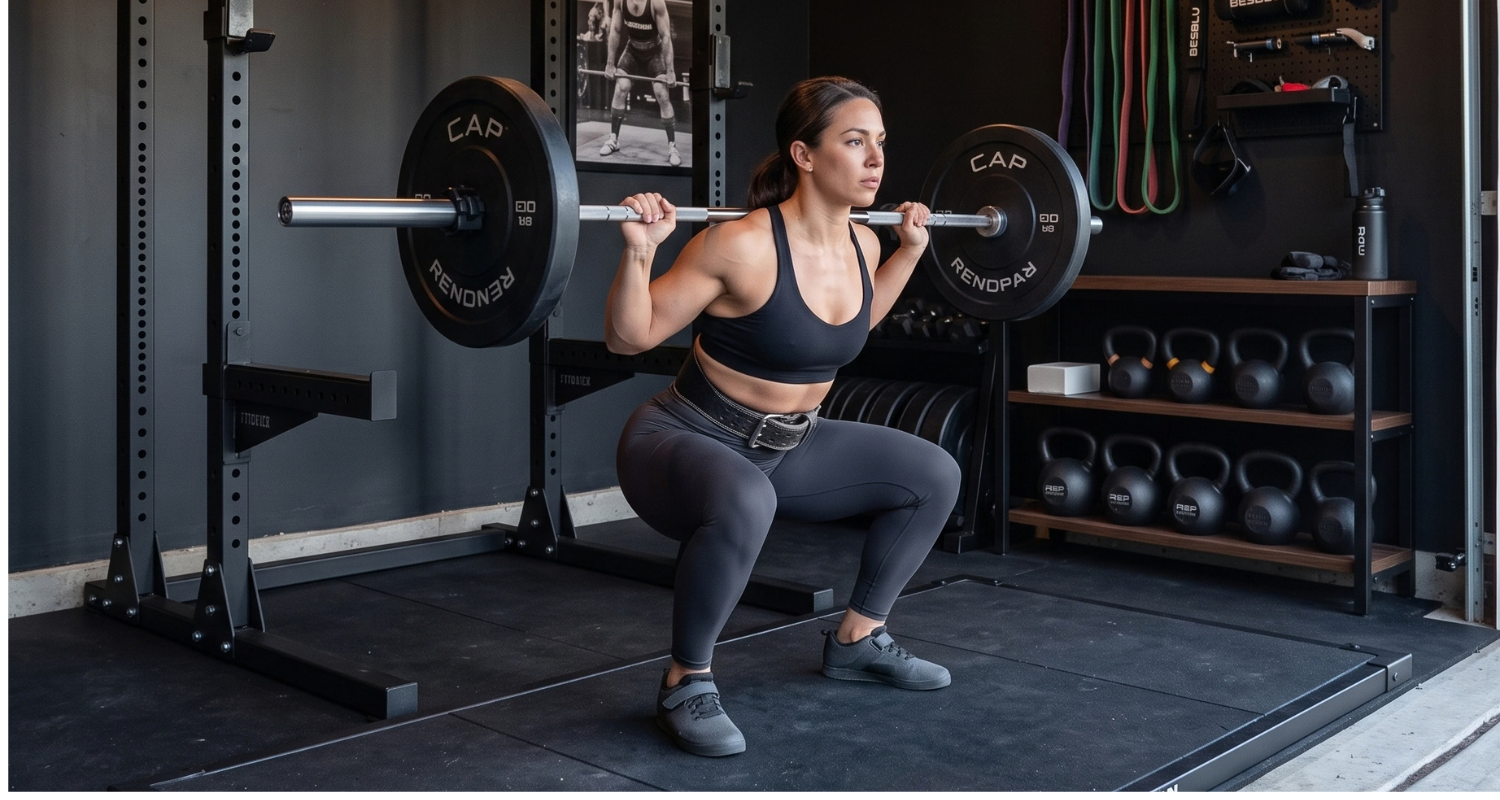
Power rack: Typically 4′ x 4′ to 5′ x 5′, though you’ll need additional clearance around it for loading plates and stepping in and out.
Example equipment: Titan Fitness T-2 Series Short Power Rack
Flat/adjustable bench: Roughly 2′ x 4′ — small on its own, but it needs open space around it for pressing movements
Example equipment: Finer Form Foldable Flat Bench
Barbell: 7 feet long when stored horizontally; best kept on a vertical wall mount to preserve floor space
Example equipment: Mikolo 7ft Olympic Barbell
Dumbbells: A single pair takes up almost nothing, but a full rack can run 2′ x 6′ or more depending on weight range
Example Equipment: NUOBELL Adjustable Dumbbells 5-80 lbs
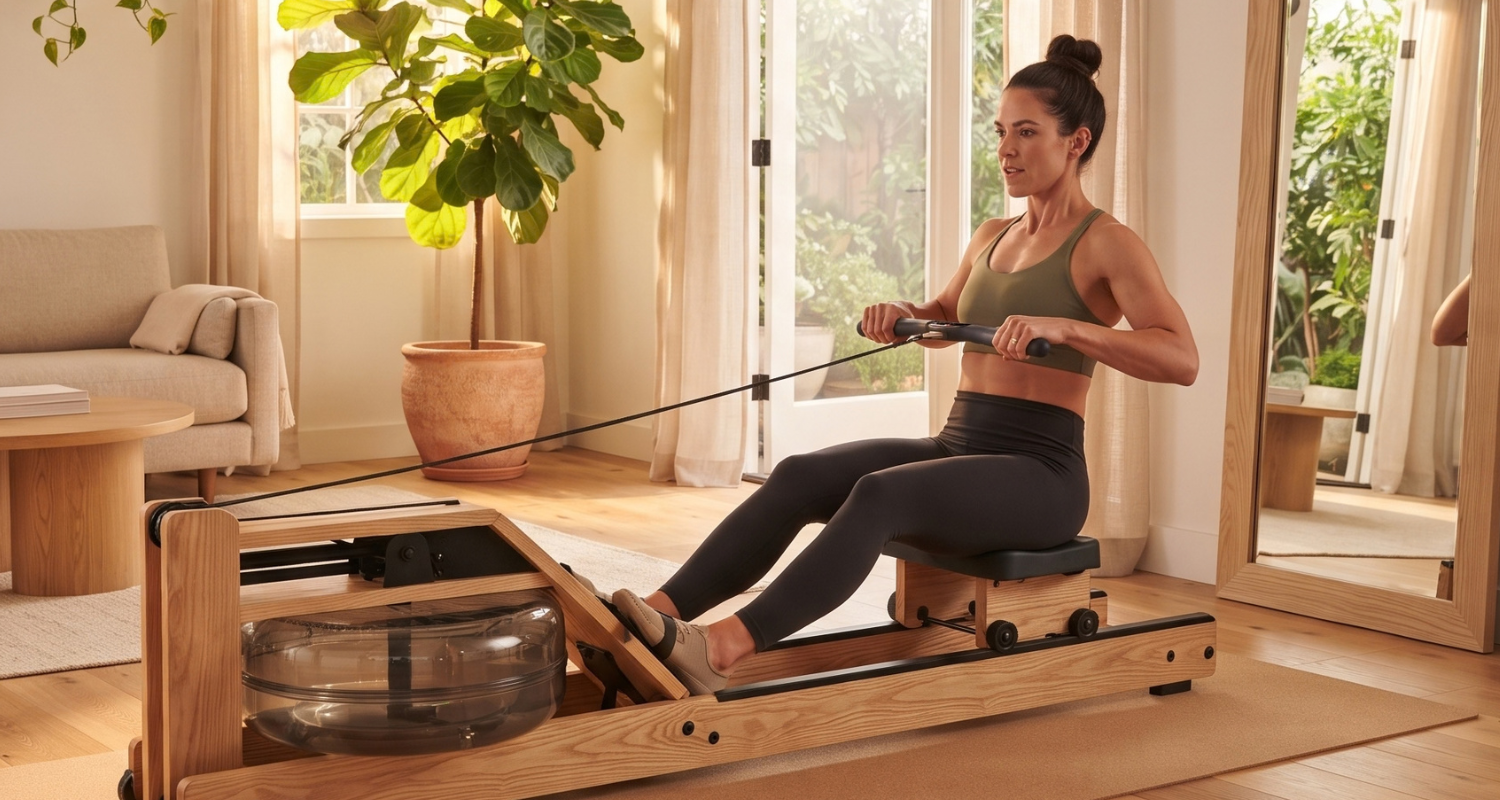
Cardio machines: This is where footprints get serious — treadmills average 3′ x 6′, rowing machines around 3′ x 8′, and stationary bikes closer to 2′ x 4′
Example Equipment: BFT25 Folding Treadmill
2) Movement Clearance
Equipment footprint only tells half the story. The space you need while training is often larger than the equipment itself. Ignoring movement clearance is the most common planning mistake home gym builders make.
Here are some key lifts and the clearance they demand:
- Deadlifts: You need at least 2–3 feet in front of and behind the bar to set up, lift, and step back safely
- Overhead press: Arm span plus a buffer — plan for at least 4 feet of open space in front of you
- Lunges: A single lunge stride covers about 4–5 feet, and if you’re walking lunges, you need a clear lane of 10+ feet
- Cable movements: A cable machine itself is bulky, but you’ll also want 5–6 feet of open space in front of it for full range of motion on pulls and presses
A good rule of thumb: add at least 2 feet of clearance on every active side of your equipment.
3) Ceiling Height
Ceiling height is the factor most people completely forget about — until they nearly put a barbell through a light fixture. Standard residential ceilings sit at 8 feet, which is workable for most training styles but can be a limitation for certain movements.
Where ceiling height really matters:
- Overhead barbell lifts (strict press, push press, jerks): You need enough room for a 7-foot bar held at full arm extension above your head — realistically, 9–10 feet of ceiling clearance is ideal
- Pull-up bars and rigs: A wall-mounted pull-up bar needs enough room above it for your body to hang and pull up without your head hitting the ceiling
- Rack height: Many commercial-grade power racks run 7–8 feet tall. Measure your ceiling before buying — some racks also require ceiling anchor points for stability
If you’re working with a standard 8-foot ceiling, you’ll want to shop specifically for low-ceiling-friendly racks and avoid loading barbells for overhead work unless you have a clear zone.
4) Storage & Organization
Smart storage is the single biggest space-multiplier available to home gym owners. The same 150 square feet can feel cramped or completely manageable depending on how well-organized it is.
A few storage solutions that meaningfully reduce your active footprint:
- Wall-mounted plate storage: Keeps plates off the floor and frees up the area around your rack
- Vertical barbell holders: A horizontal barbell leaning against the wall can eat up several feet of usable space; a vertical holder mounted to the wall takes up almost none
- Dumbbell wall racks: Vertical or angled wall racks keep dumbbells accessible without requiring a freestanding rack in the middle of the floor
- Pegboards and hooks: Ideal for resistance bands, straps, jump ropes, and accessories that would otherwise pile up on surfaces
Related Article: How to Organize a Small Home Gym (Solutions that Work)
Minimum Space Needed for Common Home Gym Equipment
Knowing your equipment’s footprint is one thing — knowing how much total space each piece realistically demands is another. The chart below breaks down both, so you can add up your numbers before you commit to a layout.
| Equipment | Floor Footprint | Recommended Space (with clearance) |
| Power Rack | ~4′ x 4′ | ~8′ x 8′ |
| Adjustable Bench | ~4′ x 2′ | ~6′ x 4′ |
| Barbell + Plates | 7′ length | 9’–10′ working width |
| Dumbbell Rack | 3’–6′ wide | 6’–8′ working area |
| Treadmill | ~7′ x 3′ | ~9′ x 4′ |
| Rowing Machine | ~8′ x 2′ | ~10′ x 4′ |
| Stationary Bike | ~4′ x 2′ | ~6′ x 3′ |
The gap between “floor footprint” and “recommended space” is where most home gym planning goes wrong. A power rack technically fits in a 4′ x 4′ square, but try loading a barbell, stepping back to unrack, and performing a squat in that same square — it doesn’t work. Every piece of equipment needs a personal bubble, and those bubbles overlap when your layout isn’t thought through.
This is why equipment layout often matters more than total square footage when it comes to home gym space requirements. A 150-square-foot room with a smart layout will outperform a 250-square-foot room where equipment is placed haphazardly. Before buying anything, sketch out your layout to scale — even a rough drawing on graph paper can reveal conflicts that would otherwise cost you money to fix.

Example Home Gym Layouts by Room Size
Now that you know what individual pieces of equipment require, let’s put it all together. Here’s what a realistic, functional home gym looks like at three different size ranges — so you can find where your available space lands and plan accordingly.
Small Space Gym (50–80 sq ft)
Typical locations: Apartment corner, spare bedroom corner, large closet
Don’t let the square footage fool you — a 50–80 sq ft space is genuinely enough to build a capable, well-rounded gym if you choose your equipment wisely. The key is prioritizing versatility over variety and leaning heavily on compact, multi-use gear.
A realistic equipment setup for this size:
- Adjustable dumbbells — replace an entire dumbbell rack in roughly 2 sq ft of floor space
- Foldable bench — folds flat against the wall when not in use, reclaiming valuable floor space
- Resistance bands — near-zero footprint, hang on a hook, and add meaningful resistance variety
- Foldable squat rack — wall-mounted options fold flat when not in use and extend only when you’re training
What you can train: Upper body pressing and pulling, lower body work, core, conditioning circuits — essentially a full-body program with some creativity.
What you’ll sacrifice: Heavy barbell compound work is difficult at this size unless you have a wall-mounted rack and a very efficient layout. Cardio machines are largely off the table.
Medium Home Gym (100–150 sq ft)
Typical locations: Spare bedroom, sectioned-off basement area, single-car garage corner
This is the sweet spot for most home gym owners. At 100–150 sq ft, you have enough room to accommodate a legitimate strength training setup without needing a dedicated full room or garage. This size rewards good layout planning — a well-organized 120 sq ft gym can feel surprisingly spacious.
A realistic equipment setup for this size:
- Half rack — smaller footprint than a full power rack, still supports squats, bench press, and pull-ups
- Barbell + plate set — pairs naturally with the half rack for a full strength training foundation
- Flat/adjustable bench — positioned inside or just outside the rack’s footprint
- Compact dumbbell rack — a 3-tier rack with fixed dumbbells, or adjustable dumbbells to save space
- One compact cardio machine — a rowing machine or folding bike fits well; a treadmill is possible but will dominate the room
What you can train: Full strength training programs, barbell compounds, accessory work, and light cardio. This size supports most intermediate lifting programs comfortably.
What you’ll sacrifice: You likely won’t have room for a dedicated lifting platform and a cardio machine simultaneously — you’ll need to prioritize one or work around the other.
Large Home Gym (200–300+ sq ft)
Typical locations: Full garage, large basement, bonus room
At 200–300+ square feet, you’re working with genuinely generous space — enough to build a gym that rivals a commercial facility for your specific training needs. The focus here shifts from “what can I fit?” to “how do I organize this well?”
A realistic equipment setup for this size:
- Full power rack — enough room for a full-size, 8-foot rig with safeties, pull-up bar, and plate storage attachments
- Deadlift/lifting platform — a dedicated 8′ x 8′ platform protects your floor and defines your lifting zone
- Full dumbbell set with rack — room for a proper freestanding rack covering a useful weight range
- Multiple cardio machines — space for a treadmill and a rower, or a bike and a ski erg
- Storage wall — pegboard, wall-mounted plate trees, barbell holders, and accessory hooks keep the floor clear
What you can train: Everything. A 200–300 sq ft gym built thoughtfully can support powerlifting, Olympic lifting, bodybuilding, conditioning work, and functional fitness without compromise.
What you’ll want to plan for: Flooring becomes a serious consideration at this size — rubber gym flooring for the full square footage adds up in both cost and installation effort. Lighting and ventilation also matter more in a large enclosed space like a garage or basement.
Ceiling Height Requirements for a Home Gym
Floor space gets all the attention, but ceiling height is just as critical a variable in your home gym space requirements — and it’s the one constraint you absolutely cannot work around after the fact. You can rearrange equipment, add wall storage, or swap a full rack for a half rack. You cannot raise your ceiling. So it’s worth understanding exactly what different ceiling heights allow before you commit to a space or an equipment list.
The Three Ceiling Height Benchmarks
7 feet — Functional minimum A 7-foot ceiling is workable, but it comes with real limitations. You can comfortably train most lower-body movements, use a bench, perform dumbbell work, and run through bodyweight circuits. What you’ll struggle with is anything that puts weight or your body overhead. Most people at 6 feet tall or above will find a 7-foot ceiling uncomfortably low for overhead pressing and nearly impossible for pull-ups without a very precise bar placement. It’s a ceiling height that rewards programming creativity but punishes anyone who wants a traditional barbell-focused setup.
8 feet — Comfortable for most setups Eight feet is the standard residential ceiling height, and the good news is that it handles the majority of home gym setups reasonably well. Most power racks fit within this clearance, standard bench press and squat work is completely unaffected, and pull-up bars are mountable with enough room for most users to hang and pull fully. The caveat is overhead barbell work — strict press and push press with a full 7-foot barbell requires careful positioning, and taller lifters may find it genuinely restrictive.
9+ feet — The ideal ceiling for a serious home gym At 9 feet and above, nearly every constraint disappears. Overhead barbell pressing becomes comfortable for any height lifter, pull-up bars can be mounted at a true optimal height, tall commercial-grade racks fit without issue, and the added vertical space makes the entire gym feel more open and less claustrophobic during intense training. If you’re choosing between two potential gym spaces and one has 9-foot ceilings, that alone can be a deciding factor.
Three Specific Considerations to Plan Around
Overhead press clearance The math here is straightforward but often overlooked. Take your height, add your arm length overhead, then add the length of the barbell being pressed (typically 7 feet) — and that’s the minimum ceiling clearance you need for a bar to travel safely from shoulder to full lockout. For a 5’10” lifter with average proportions, that puts the bar at roughly 7.5–8 feet at lockout, leaving almost no margin in a standard 8-foot room. Lifters 6 feet and above should plan for a 9-foot ceiling or specifically avoid overhead barbell pressing in their programming if the space doesn’t allow it.
Pull-up bar height A pull-up bar needs to be mounted high enough for your body to hang fully extended without your feet touching the floor — and then leave enough room above the bar for your chin to clear it at the top of the rep. For most average-height users, this means the bar itself should be mounted at 7.5–8 feet, which requires at least 8 feet of total ceiling clearance, and ideally more. In a 7-foot ceiling, wall-mounted angled pull-up bars can work as a workaround, but they limit your grip width and range of motion compared to a true overhead bar.
Tall rack dimensions Full-size power racks typically stand between 7 and 8.5 feet tall. In an 8-foot ceiling room, that leaves inches — sometimes literally — between the top of the rack and the ceiling. This matters for two reasons: first, many racks require a few inches of clearance above them for assembly and for the pull-up bar to function properly; second, some rack configurations include ceiling-mounted attachments for stability that are impossible in low-clearance rooms. Always check the assembled height of any rack against your actual ceiling measurement before purchasing.
How to Maximize Space in a Small Home Gym
Square footage is fixed — but how much of it you can actually use is largely within your control. These four strategies consistently make the biggest difference in small home gym setups.
Use Your Walls The floor is prime real estate in a small gym; the walls are free storage. Plate peg holders, dumbbell wall shelves, and vertical barbell holders all move clutter off the floor and onto surfaces that would otherwise go completely unused. A single wall storage system can reclaim 10–15 square feet of floor space that would otherwise be eaten up by freestanding storage equipment.
Choose Compact Equipment from the Start The easiest way to save space is to buy equipment that was designed with space in mind. Adjustable dumbbells replace an entire rack’s worth of fixed weights in a 2-square-foot footprint. Folding benches and wall-mounted folding racks retract flat when not in use, effectively disappearing between sessions. These aren’t compromises — for a small gym, they’re the smarter choice.
Prioritize Multi-Purpose Equipment Every piece of equipment that serves more than one function is a net space gain. A power rack with an integrated pull-up bar eliminates the need for a separate pull-up station. A bench with attachment points for leg extensions or preacher curls removes the need for additional machines. When every square foot counts, multi-functionality isn’t a nice-to-have — it’s the whole strategy.
Keep the Floor Open This is the one rule that ties everything else together: protect your open floor space at all costs. A gym where every inch of floor is occupied by equipment isn’t just cramped — it’s unsafe. You need clear lanes for movement, room to step back from a rack, and space to bail on a lift if needed. When in doubt, store it on the wall, not the floor.
The Bottom Line on Home Gym Space Requirements
The biggest takeaway from everything we’ve covered is simple: you probably need less space than you think. A well-planned 80-square-foot corner can deliver a more effective workout than a poorly organized 300-square-foot garage. Space is a variable — planning is the constant that determines whether it works.
To recap the framework:
- 50–80 sq ft gets you a fully functional training space for strength, conditioning, and mobility work with the right compact equipment
- 100–150 sq ft opens the door to a complete barbell and rack setup that supports serious intermediate programming
- 200–300+ sq ft gives you the freedom to build a gym with virtually no compromises
Before you start buying equipment, measure your space — including ceiling height — and sketch out a layout. Account for movement clearance, not just equipment footprint. Use your walls. Choose multi-purpose gear where you can. And resist the urge to fill every square foot just because you have it.
Home gym space requirements aren’t about finding the perfect room. They’re about understanding what your training actually needs, and building around that — whatever size space you’re starting with.
Related Article: How to Set Up a Home Gym: The Complete Beginner’s Guide

Leave a Reply