
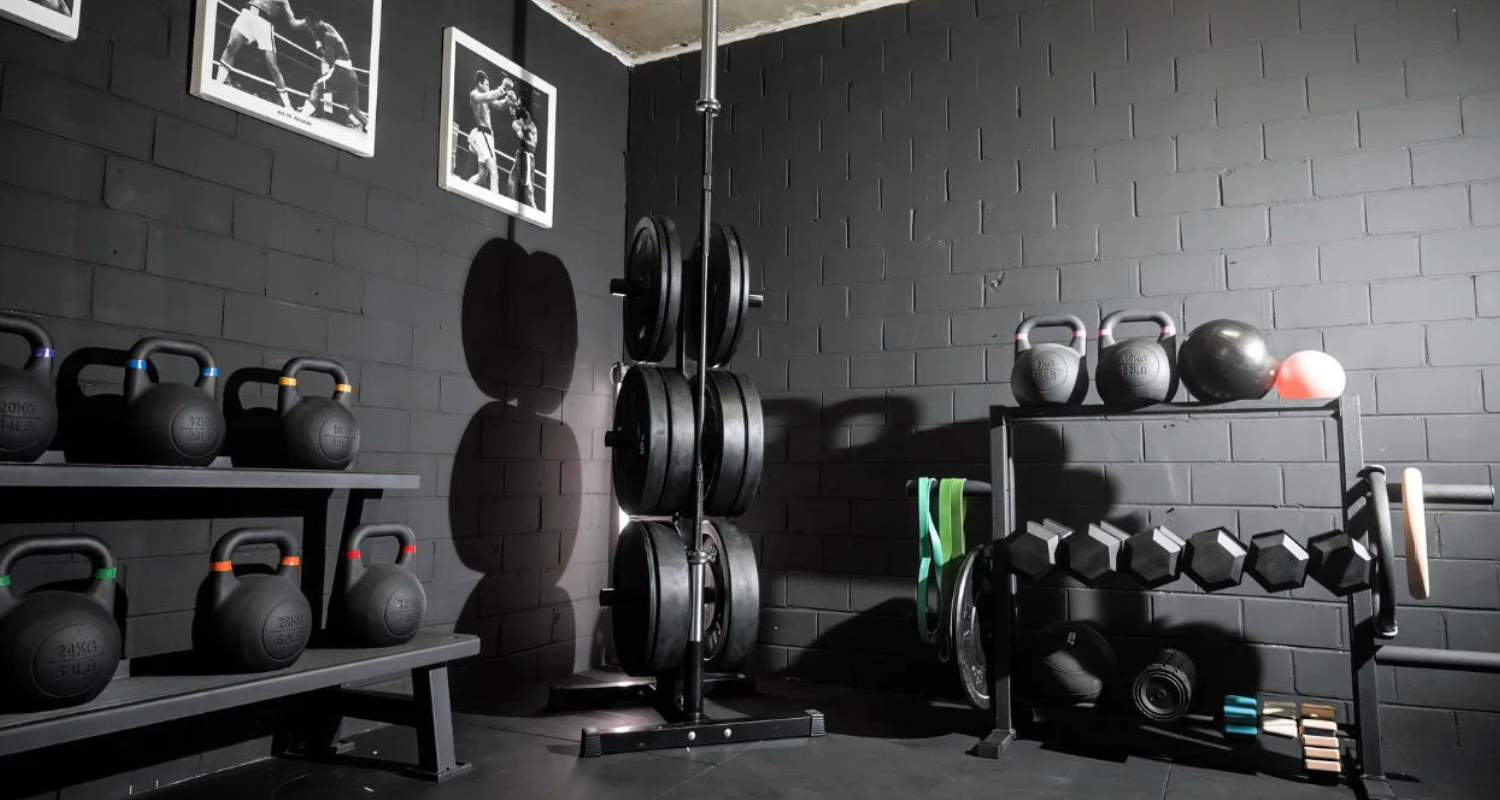
The basement has a quality the garage doesn’t.
It is already underground. Already enclosed. Already separated from the rest of the house by a ceiling and a staircase that function as more than architectural transitions — they function as psychological ones. The moment you descend those stairs into a dark, amber-lit training space, something shifts. The house above recedes. The day’s obligations recede. What remains is the space, the equipment, and the session.
The garage Athlete Cave has the open door — the outdoor connection, the strip of morning light, the driveway that extends the training space beyond four walls. The basement Athlete Cave has something different and in many ways more powerful. Complete enclosure. Acoustic separation from every living space in the house. The specific psychological quality of a training environment that is genuinely underground, genuinely its own world, and genuinely inaccessible to everything that doesn’t belong in it.
This is not the compromise version of the Athlete Cave. It is the most contained and focused version of it — the gym that the rest of the house doesn’t know is happening, built for the athlete who drops a barbell at 5am without waking anyone, trains at maximum intensity without monitoring the output, and walks back upstairs when the session is finished having left nothing of it behind except the work.
Here is everything you need to build it.
What Makes the Athlete Cave Basement Gym Different
The basement Athlete Cave and the garage Athlete Cave share the same visual language — dark walls, dark rubber flooring, focused amber lighting, matte black equipment, raw steel and cast iron. The aesthetic is identical. The experience of training in each one is not.
Three characteristics define the basement version specifically and distinguish it from every other training environment in this guide.
The enclosure is complete in a way no other room type achieves. Four walls, a ceiling, and a staircase. No garage door to open, no ambient exterior light, no outdoor sounds filtering through a gap at the floor. The basement Athlete Cave is the most sealed training environment available in a residential setting — and that sealing is not a limitation. It is the design feature that makes everything else this space does possible. The psychological transition of descending a staircase into darkness and amber light cannot be replicated by walking through a door into a garage. The basement makes the transition physical. You go down. The house stays up. What’s down here is yours.

The acoustic separation is the most practically significant advantage the basement holds over every other room type in this guide. A basement gym with appropriate flooring absorbs the impact of dropped barbells, the rhythmic output of an assault bike at maximum wattage, and the full vocal expression of a heavy deadlift PR without transmitting any of it meaningfully to the living spaces above. The athlete who has been moderating training intensity to avoid disturbing the household — who has been setting the bar down instead of dropping it, who has been choosing quieter equipment over more appropriate equipment, who has been timing sessions around household schedules rather than training schedules — has been training in the wrong room. The basement solves all of this simultaneously and permanently.
The temperature is the most consistently comfortable of any room type in the guide year-round. Below-grade spaces maintain a naturally more stable temperature than above-grade rooms — cooler in summer without active cooling systems, more consistently temperate in winter without the extreme cold that garage training in northern climates produces in the months when training motivation is already challenged. The basement Athlete Cave is the most year-round usable training environment available in a home gym context and the one that requires the least seasonal infrastructure investment to remain so.
The Space Setup: Design, Flooring, Lighting, Storage, and Mistakes to Avoid
The basement setup section covers terrain specific to below-grade environments — ceiling height management, moisture control, acoustic performance, and the specific lighting decisions a windowless space requires. These considerations don’t exist in the same form in any other room type in this guide. Addressing them before the first piece of equipment arrives is the difference between a basement gym that works correctly from day one and one that develops problems that are expensive and disruptive to correct after the training space is established.
Wall color
Dark charcoal or near-black throughout — Benjamin Moore Wrought Iron or Sherwin-Williams Peppercorn in flat matte finish. The basement has one advantage over the garage for this color application: basement walls are typically drywall over concrete block or poured concrete rather than the painted concrete block or OSB common in garages. Properly primed drywall takes flat paint more cleanly and produces the smooth, even, light-absorbing matte surface that the Athlete Cave dark wall needs to achieve its atmospheric quality. Prime with a high-hide primer before applying the dark top coat — skipping this step produces an uneven finish that becomes more visible as the ambient lighting reveals surface variation.
Paint the ceiling the same dark charcoal as the walls. This is the decision most basement gym builders resist and most Athlete Cave basement gyms that work correctly make. The instinct in a low-ceilinged basement is to paint the ceiling white or light to create the visual impression of height. Resist this completely. A dark ceiling in an Athlete Cave basement creates the focused, contained tunnel effect that is the defining psychological characteristic of this space — the quality that makes walking down the stairs feel like entering a dedicated training environment rather than a repurposed storage room. The low ceiling, far from feeling oppressive in a dark-ceilinged space with appropriate lighting, becomes part of the intentional containment that separates this gym psychologically from every other room in the house.
If the basement has exposed ceiling joists rather than a finished ceiling, paint them the same dark charcoal as the walls. Exposed joists painted dark read as industrial and deliberate — an architectural detail that fits the Athlete Cave identity. Exposed joists left in their raw wood tone against dark walls read as unfinished. The paint is what makes the difference between a space that looks designed and one that looks in progress.
Flooring
Horse stall mats in three-quarter inch thickness, dark charcoal or black rubber, covering the full training zone floor before any equipment arrives. The basement flooring decision has one additional consideration the garage doesn’t — moisture management beneath the mats.
Concrete basement floors can wick moisture from below, particularly in climates with seasonal groundwater fluctuation or in basements with drainage issues. Moisture trapped between a rubber mat and a concrete floor accumulates over time — producing the musty odor that makes a basement gym unpleasant to train in and the surface corrosion on equipment legs that indicates a moisture problem that has been present for months. Address this before the mats go down rather than after.
Check the concrete floor for moisture with a simple test: tape a twelve-inch square of plastic sheeting to the concrete surface and seal the edges completely. Leave it for twenty-four hours. Condensation on the underside of the plastic indicates moisture wicking through the concrete. If moisture is present, a concrete sealer applied to the clean dry floor before the mats are laid provides a meaningful moisture barrier at minimal cost.
A plywood subfloor layer between the sealed concrete and the rubber mats provides additional moisture isolation and significantly improves the acoustic performance of the floor for impact training. Three-quarter inch plywood sheets laid across the full training zone, joints staggered, with the horse stall mats on top — the three-layer system of sealed concrete, plywood, and rubber mat is the most complete basement gym floor available and the one that performs best acoustically for the barbell dropping that the Athlete Cave training profile produces.
Related Post: Horse Stall Mats for Home Gym Garage Flooring: The Complete Guide
Lighting
The basement Athlete Cave has no natural light. This makes the lighting system the single most important design decision in the entire build — more important than the wall color, more important than the equipment selection, more important than any other element in the space. Unlike the garage where Edison pendants supplement ambient light from the open door or high windows, the basement requires the artificial lighting to do all of the atmospheric and functional work simultaneously. Get this right and the basement becomes the most dramatically lit and atmospherically compelling Athlete Cave possible. Get it wrong and it becomes a gym that simply feels underground — dark in the way a basement is dark by neglect rather than dark in the way the Athlete Cave is dark by design.

Edison filament pendant lights over the primary training zone — two to three pendants on chains from the ceiling joists or a surface-mounted track, positioned directly above the lifting platform and the rack. Warm amber filament bulbs visible inside the glass. The pendant drop length must account for ceiling height and overhead movement clearance — in a basement with eight-foot ceilings a short chain or a surface-mounted Edison-style fixture is more appropriate than a long-chain pendant that encroaches on overhead pressing and pull-up clearance. The warm amber pools these fixtures cast on the dark rubber floor and the loaded barbell are the visual signature of the Athlete Cave basement and the detail most responsible for the space feeling intentional.
LED strip lighting along the ceiling perimeter in warm white — an addition specific to the basement that the garage setup doesn’t require. A warm white LED strip running along the top edge of all four walls provides a secondary ambient light source that fills the corners and edges of the space with a soft warm glow — preventing the areas beyond the pendant light pools from feeling claustrophobically dark rather than atmospherically dark. The strip is subtle and low-output relative to the pendants. Its contribution is the difference between a basement that feels focused and contained and one that feels incomplete at the edges.
LED shop lights mounted on the ceiling joists and aimed at the rack zone and the lifting platform provide the functional lighting layer — sufficient lumens for safe form checking during heavy movements, clear visibility of the safety arm positions, and accurate reading of plate loading at the collars. Warm white at 3000K maintains visual coherence with the Edison pendant warmth rather than introducing the clinical quality of cool white.
Related Post: Home Gym Lighting Ideas: How Light Transforms a Training Space
Moisture and humidity management
A dehumidifier running continuously during training months is non-negotiable in most basement training environments. The target relative humidity is below 50% year-round — above this threshold steel equipment begins to develop surface rust within weeks, rubber flooring develops the odor that makes a basement gym progressively less appealing to train in, and the training environment becomes physically uncomfortable in ways that accumulate quietly until they become a motivation problem.
A 50-pint dehumidifier covers most basement gym footprints effectively. Connect a drain hose to the nearest floor drain rather than manually emptying the reservoir — a dehumidifier that requires daily manual emptying is one that gets turned off when the schedule gets busy and the problem it was installed to prevent returns within a week. Continuous drainage removes that friction entirely.
Check the dehumidifier’s humidity reading before the first training session and confirm it reaches the target range within the first twenty-four hours of operation. A basement with significant moisture infiltration may require a higher-capacity unit or a combination of dehumidification and drainage solutions before the training environment is appropriate for equipment installation.
Storage
Same dark walnut lumber shelving on heavy matte black steel brackets as the garage — scaled to the basement’s typically smaller footprint. Matte black plate tree beside the rack. Matte black pegboard panel for accessories, bands, straps, and chalk. Wall-mounted barbell J-hooks at chest height for the secondary barbell.
Storage organization in the basement Athlete Cave matters more than in the garage because the enclosed space accumulates visual clutter more rapidly and the artificial lighting quality is consistent and revealing at all hours rather than influenced by the forgiving variation of natural light. An organized basement gym looks organized at 5am and at 10pm. A disorganized one looks equally disorganized at both hours under the same artificial lighting. The organized display of training equipment is the visual signal that this space was built with intention and is maintained that way.
The three mistakes specific to the Athlete Cave basement gym
The first mistake is painting the ceiling white to make the space feel taller. This single decision undermines the Athlete Cave aesthetic more completely than any other because it creates an irreconcilable visual contradiction — dark walls designed to create focus and containment beneath a light ceiling that visually expands the space in a completely different direction. The two cannot coexist without the space looking like a mistake was made somewhere. Paint the ceiling dark. Accept the low ceiling as an asset rather than managing it as a liability. The Athlete Cave basement is not trying to feel like a tall room. It is trying to feel like a focused one.
The second mistake is skipping moisture management and discovering the problem six months later. The rust on the barbell collar, the mat odor that has gradually become impossible to ignore, the surface corrosion on the rack uprights — these are all symptoms of a moisture problem that was present from the first week and addressed from the sixth month. The cost of a dehumidifier and a concrete sealer before the equipment arrives is a fraction of the cost of replacing rusted equipment or re-installing flooring that has developed a permanent odor problem.
The third mistake is installing a single overhead LED panel and expecting it to produce the Athlete Cave atmosphere. A single flat overhead LED in a basement gym produces a space that is dark because it is a basement — not dark because it was designed to be. The distinction is immediately visible and immediately felt. The Edison pendants and the LED perimeter strip together create a space that is dark by intention. A single flat panel creates a space that is dark by insufficiency. The investment in appropriate lighting is what determines which of those two experiences the basement gym produces.
Related Post: Home Gym Layout Mistakes: The Decisions That Cost People Time and Money
Training Setup 1: Barbell Strength and Powerlifting
For the reader whose primary training goal is maximal strength development using the barbell — squats, deadlifts, bench press, overhead press, and barbell rows as the foundation of every training week — and who values acoustic separation from the household above all other room-type considerations.

The basement powerlifting setup’s defining advantage over the garage version is the one that matters most to a serious strength athlete: the freedom to train at full intensity without managing the acoustic output of that training in consideration of anyone else.
The Equipment
The barbell drop on a heavy deadlift set. The slam of a missed snatch. The audio expression of a genuine maximum effort squat. In a basement gym with appropriate flooring these sounds are absorbed by the structure of the space rather than transmitted through it. In a garage they travel through a door, through walls, into the neighbor’s property and the household’s sleep. The difference is significant enough that the athlete who has been limiting themselves acoustically should consider it among the strongest arguments for choosing a basement over a garage for serious strength training.
Titan Fitness Full Deadlift Platform- 8FT x 4FT

For the rack, a full power rack in matte black or raw steel is the correct choice — with one basement-specific caveat that overrides every other selection criterion. The ceiling height determines the rack. Not the brand, not the cable attachment compatibility, not the weight rating — the ceiling height.
Titan Fitness T-2 Series Short Power Rack

Before researching any specific rack model, measure from the basement floor to the lowest point of the ceiling or the lowest joist. Standard full power racks with integrated pull-up bars require a minimum of 90 to 96 inches of ceiling clearance. Many basements — particularly those in older homes — have ceiling heights of 84 to 90 inches. This does not eliminate the power rack option. It redirects it toward compact or low-ceiling-specific rack models designed for exactly this situation and available from multiple quality manufacturers.
Overhead pressing clearance is the second ceiling height consideration. The full range of motion of an overhead press from a rack — the barbell traveling from shoulder height to full lockout overhead — requires ceiling clearance above the athlete’s full arm extension. Measure this in the specific position where the rack will be placed before ordering. If ceiling height does not permit overhead pressing safely from a racked bar, a squat stand or a belt squat machine can serve the lower body work while overhead pressing is performed from the floor or omitted from the program.
For the barbell, raw steel or black oxide finish — the same recommendation as the garage.
CAP Olympic Barbell

A lifting platform in the basement should use three-layer construction — sealed concrete base, plywood layer, horse stall mat top — specifically for acoustic performance under heavy deadlift sessions in a space with a living area above it. The acoustic difference between a two-layer and a three-layer platform under a 400-pound deadlift drop is audible from the floor above and worth the additional material investment before a family member provides that feedback directly.
Black bumper plates, chalk block on the upper shelf, dark upholstery adjustable bench in front of the rack — the same visual language as the garage powerlifting setup, fully appropriate and fully coherent in the basement context.
Rendpas 2-Inch Olympic Bumper Plates

Training Setup 2: Conditioning and Athletic Performance
For the reader training for athletic performance or conditioning capacity who values the acoustic freedom of a basement environment for the full intensity expression that conditioning work requires.

The basement conditioning setup has one significant difference from the garage version: the outdoor extension is not available. The driveway sled push, the sprint from the open garage door, the farmer carry around the property perimeter — these are the conditioning tools that make the garage Athlete Cave uniquely suited to athletic performance training. The basement does not offer them.
This is a genuine constraint and worth naming directly rather than working around it with optimistic language. The basement conditioning program is fully contained within the training space. If the conditioning program the athlete wants to run requires outdoor movement, the garage is the better room type for that specific training approach. If the program can be run entirely within the basement footprint — and most conditioning programs can be adapted to do so effectively — the basement’s acoustic freedom and temperature consistency make it the superior environment for high-intensity indoor conditioning work.
The Equipment
For the conditioning anchor piece, the assault bike or rowing machine represents a decision the basement context makes more nuanced than in the garage. The assault bike at maximum output produces significant noise — the fan and the frame under load are audible through a basement ceiling and may be disruptive in a living space directly above. The rowing machine is significantly quieter and produces a conditioning stimulus that is equally demanding. In a basement directly below a bedroom or primary living area, the rowing machine is the more acoustically considerate choice. In a basement below a garage, storage area, or utility space where the ceiling transmission is less consequential, the assault bike is completely appropriate.
Wenoker Exercise Bike

Kingsmith Foldable Rower

Cast iron kettlebells handle the conditioning complexes and loaded carries that develop both cardiovascular capacity and functional strength within the basement footprint. Battle ropes anchored to the rack base provide upper body conditioning work. A plyo box in dark wood or black serves step-up and lower intensity plyometric work — confirm ceiling height before adding any box jump programming where the full jump and landing requires clearance that a low basement ceiling may not provide.
REP Fitness Kettlebell Set

CAP Barbell 3-in-1 Plyometric Box

Training Setup 3: Bodybuilding and Hypertrophy
For the reader whose primary training goal is muscle development and physique improvement, drawn to the basement Athlete Cave for the complete privacy that serious hypertrophy training benefits from most.

The basement hypertrophy setup has one quality that no other training configuration in this guide provides at the same level: complete privacy. The basement gym is the most private training environment available in a residential setting.
This matters for hypertrophy training specifically in a way it matters less for powerlifting or conditioning. Hypertrophy training at effective intensity — the sets taken to or near muscular failure that drive genuine adaptation — requires a quality of focus and a willingness to be visibly uncomfortable that many athletes moderate when they are aware of an audience, however casual. The basement Athlete Cave removes the possibility of audience entirely. The training that happens here is for no one but the person doing it. That privacy produces a different quality of effort over time and that quality of effort produces different results.
The Equipment
For the rack, the cable attachment is the piece that elevates the basement hypertrophy setup from a barbell-and-dumbbell program to a complete training system. The cable attachment on the power rack handles lat pulldowns, seated cable rows, face pulls, cable flyes, and tricep pushdowns — the isolation and cable work that hypertrophy programming stacks on top of its compound barbell foundation — without requiring a dedicated cable machine that would consume the basement’s limited floor space.
POOBOO Multi-Functional Machine Power Cage

A full-length mirror mounted flush against the longest basement wall is the most visually distinctive addition in the hypertrophy setup. In the Athlete Cave basement specifically, a large mirror against a dark wall under warm amber pendant lighting creates one of the most dramatically lit training environments in residential gym design. The reflection of a dark, amber-lit training space in a large mirror doubles the perceived depth of the basement, creates a visual focal point for form checking during isolation movements, and produces a training environment that looks and feels like a serious facility rather than a converted storage room. Mount the mirror before the rack is positioned — choose the mirror wall first and arrange the equipment around it.
Accessories
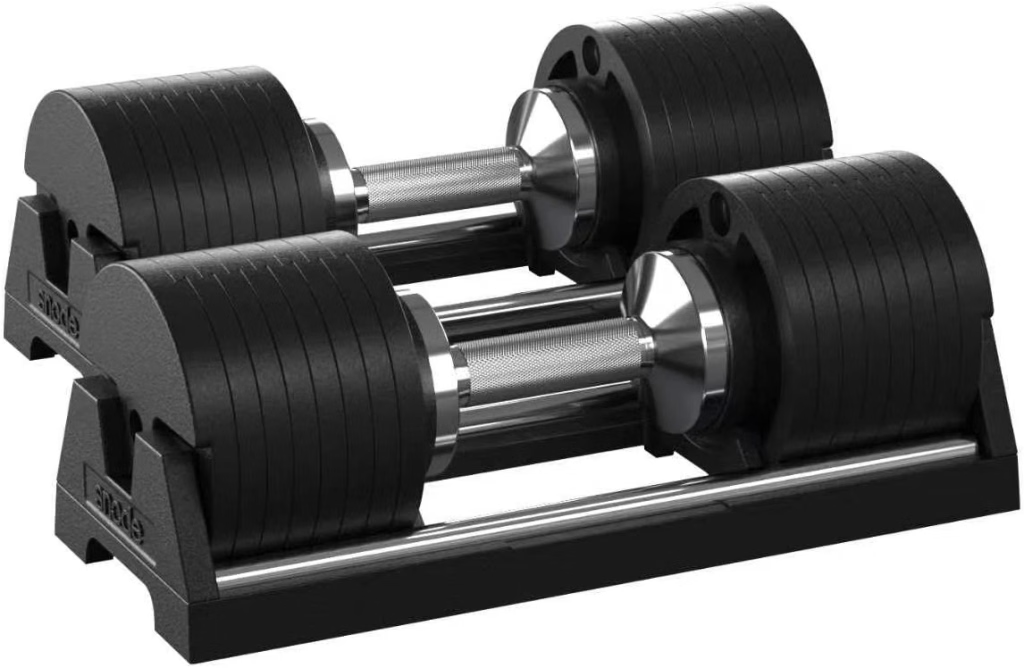
Adjustable dumbbells in a dark or matte finish serve the unilateral and isolation work alongside the cable system. An adjustable bench for the full range of incline, flat, and decline pressing positions. Resistance bands on the pegboard for warm-up, shoulder health, and high-repetition finisher work.


Training Setup 4: Functional Fitness and CrossFit-Style Training
For the reader who trains with constantly varied functional movements at high intensity and values the acoustic freedom of a basement environment to do so without the output management that above-grade spaces and consideration for neighbors requires.
The basement functional fitness setup is the most acoustically liberated training configuration in this guide. The assault bike at threshold pace, the barbell cycling in a heavy MetCon, the kipping pull-up on the integrated bar, the kettlebell snatch — all of these movements produce sound and impact that a basement gym absorbs more completely than any other room type in a residential home. The athlete whose functional fitness training has been self-moderated by consideration of others is training in this configuration in the wrong room. The basement solves the acoustic constraint entirely.
The Equipment
The equipment profile adapts from the garage functional fitness setup in one meaningful way. The outdoor training extension — the run piece, the sled push, the driveway carry — is replaced by its indoor equivalent. Assault bike or rowing machine sprints substitute for running intervals. Loaded carries within the training zone substitute for outdoor farmer walk programming. Shuttle runs within the basement footprint substitute for longer outdoor sprint work. These are genuine substitutions rather than compromises — the metabolic and conditioning demand is equivalent and in several cases the indoor version produces more controlled and measurable training data than the outdoor variation.
For the rack, a folding wall-mounted squat rack is more appropriate for the functional fitness basement setup than a full power cage.
Mikolo 2″ x 2″ Folding Wall Mounted Squat Rack

The floor space that a full cage occupies is floor space that functional fitness programming needs for conditioning movements, sled alternatives, and the lateral and rotational movements that varied programming produces. A folding rack deploys from the wall for barbell and pull-up work and returns to the wall when the conditioning piece begins — giving the basement functional fitness athlete the full floor space their program requires without permanently sacrificing it to a static piece of equipment.
Accessories
Gymnastics rings from ceiling joist anchors are the most valuable addition to the basement functional fitness setup that the garage version cannot match as cleanly. Basement ceiling joists provide the most structurally sound and permanently accessible overhead anchor available in any residential training environment. Ring installation requires a single hardware visit and produces a ring setup that is more permanently secure and more consistently positioned than any rack-mounted or portable ring system. Muscle-ups, ring dips, ring rows, and ring pull-ups become available in the training program the moment the rings are installed — which in a basement takes approximately thirty minutes and produces a training capability that significantly expands the programming available in the space.
GHB Gymnastic Rings Wooden Gym Rings 1.25″

The Room the House Never Knew It Needed
Most basements are where things go that don’t have anywhere else to go.
The boxes from the last move. The holiday decorations. The equipment from the phase that didn’t stick. The furniture from the room that was redecorated. The basement accumulates what the rest of the house outgrows — useful, stored, and genuinely underestimated.
The Athlete Cave basement gym is the decision to stop storing things and start building something.
Dark charcoal walls that took a weekend and transformed the psychological character of a space that had been accumulating things for years. A dehumidifier that addressed the moisture that was silently compromising everything stored there. A lighting system that made the underground, windowless quality of the space feel like an asset rather than a deficiency. A rack against the back wall, a platform on the floor, Edison pendants casting warm amber pools on dark rubber — and stairs that now function as a transition between the life above and the training below.
The house above continues. The day continues. The obligations continue. Below all of it, separated by a ceiling and a staircase and the specific quality of a dark, focused, amber-lit space that exists for one purpose only — the work continues too.
That is the Athlete Cave basement gym. Not the compromise version of a serious training environment. The most enclosed, most acoustically free, most psychologically complete version of the Iron Paradise available in a home.
Build it like it was always down there waiting.
If you’re still exploring the five home gym aesthetics and deciding which one reflects who you are, the free SOMA Dream Gym Style Guide walks you through all of them — with mood boards, equipment guides, and the framework for finding the space that feels like yours.
Leave a Reply