

If your back day has quietly turned into “arms and whatever,” you’re not alone — and you’re not doing anything wrong. You’re just missing the one piece of equipment every gym-built back program assumes you have: a cable machine. So the lat pulldowns get skipped. The seated rows get swapped for something with dumbbells that doesn’t quite hit the same. And over time, back training becomes the thing you mean to get to.
Here’s the good news: you don’t need a cable stack to build a strong, developed back at home. A power rack and a set of dumbbells cover every major pulling pattern your back needs — vertical pulling, horizontal pulling, rear delt work, and posterior chain strength. This is a complete home gym back workout power rack program, built specifically for the equipment you already have, not the equipment you wish you had.
Why a Power Rack + Dumbbells Is Enough for Back Training
I get some version of this question from almost every client who trains at home: “How am I supposed to build a real back without a lat pulldown machine?” It’s a fair question, and it deserves a real answer instead of blind reassurance.
Your power rack already solves your biggest gap — vertical pulling. With a pull-up bar built in (or attachable), you have access to pull-ups, chin-ups, and every regression that leads up to them. That’s the same movement pattern a lat pulldown trains, just loaded with your own bodyweight instead of a stack. For most people, bodyweight is plenty of resistance to build a wide, strong back for years.
Dumbbells fill in everything else. Single-arm and two-arm rows replace cable rows and seated rows, and they come with a built-in advantage: unilateral work exposes and corrects side-to-side imbalances that a bar or machine can hide. Rear delt flyes and face-pull-style raises with light dumbbells cover the upper back and shoulder health work most home gym back workout power rack routines skip entirely.
What you’re not missing: a machine that isolates a muscle a dumbbell or bar can’t reach. You’re missing convenience, not capability. Takeaway: if your rack has a pull-up bar and you own a pair of adjustable dumbbells, you already have every tool this program requires.
If you don’t have a power rack or adjustable dumbbells and are looking for some solid recommendations, here are some of our top picks:
EQUIPMENT PICKS
Goimu C1-V4 Power Cage
A full power cage rated to 2,000 lbs with a built-in pull-up bar and lat pulldown/cable station — solving the two biggest home gym gaps at once: safe heavy lifting and vertical pulling. Compact footprint (under 18 sq. ft.) makes it realistic for a garage or spare room.

Mikolo Smith Machine with Weight Stack
For anyone who wants cable rows and lat pulldowns without loading plates by hand, this all-in-one system pairs a Smith machine with a pin-loaded weight stack and dual pulleys — the closest a home gym gets to a commercial cable station in one footprint.

CloudFire Adjustable Dumbbells
A space-saving dumbbell set that replaces a full rack of fixed weights with one adjustable pair — ideal for rows, RDLs, and rear delt work without a wall of iron eating your floor space. Quick-twist adjustment keeps you moving between sets instead of swapping plates.

NuoBull Adjustable Dumbbells
Built for lifters who’ll outgrow a starter set fast — a wide weight range in 5-lb increments means the same pair takes you from your first dumbbell row to years of progressive overload, with a steel-knurled handle that feels like a real dumbbell, not a toy.

Back Muscle Anatomy Basics (And Why This Program Covers All of It)
You don’t need a kinesiology degree to train back effectively, but knowing what you’re targeting helps you feel the work instead of just going through the motions.
Your lats (latissimus dorsi) are the large muscles that give your back width — they’re the primary mover in every pull-up and row. The traps run from your neck down your upper back and are worked hard by rows and rack pulls. Your rhomboids, tucked between your shoulder blades, are responsible for that “squeeze” feeling on a well-executed row. Your rear delts cap off your shoulders from behind and are frequently neglected — which shows up as rounded-forward posture. And your erector spinae, running along your spine, are your postural foundation, trained directly by Romanian deadlifts and rack pulls.

This program is built around all five, not just the ones that are easy to feel working. Takeaway: if a back exercise doesn’t clearly target one of these five areas, it’s not earning a spot in your routine — and nothing in this program is filler.
Equipment Needed
- A power rack with a pull-up bar (fixed or attachable)
- Adjustable dumbbells, or a set spanning a reasonable range
- An adjustable bench (flat/incline)
- Optional: a resistance band for pull-up assistance or warm-ups
That’s it. You do not need a cable machine, a lat pulldown attachment, or a barbell for this program to work — though if you have a barbell, rack pulls become an easy addition. If you’re still deciding what belongs in your space, [LINK: how to choose a power rack for a home gym] walks through what actually matters when you’re buying.
The Power Rack Back Workout: A Complete Program
This is the core of your home gym back workout power rack routine — four movement categories that, together, train every part of your back through its full range of pulling function.
Vertical Pull Movements
Vertical pulling is what your power rack does best, and it should anchor every serious home gym back workout power rack program.
Pull-ups / Chin-ups
3–4 sets of as many quality reps as possible. Grip the bar just outside shoulder width (pull-ups, palms away) or shoulder width with palms facing you (chin-ups, which bias the biceps more). Pull your elbows down and back, not just up — imagine driving your chest toward the bar.
- Beginner: Negative pull-ups — jump or step to the top position and lower yourself for 3–5 seconds. 3 sets of 5.
- Intermediate: Band-assisted pull-ups, reducing band tension as you progress. 3 sets of 6–8.
- Advanced: Weighted pull-ups using a dip belt or a dumbbell held between your feet. 4 sets of 5–8.
Takeaway: if you can’t yet do a strict pull-up, don’t substitute it away — regress it. Negatives build the same strength curve.
Horizontal Pull Movements
This is where dumbbells replace cable rows almost perfectly.
Single-Arm Dumbbell Rows
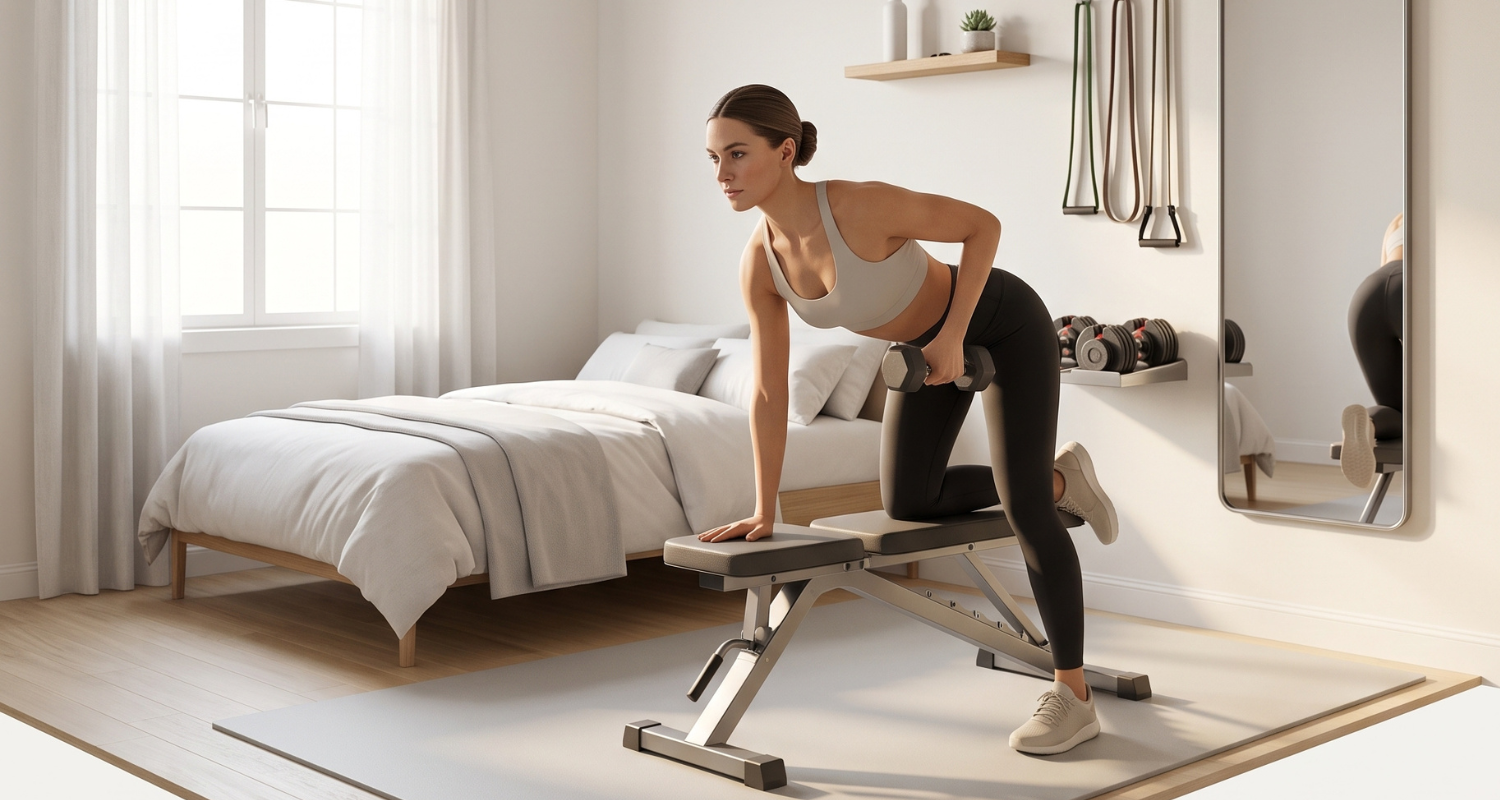
3 sets of 8–12 per side. Brace your free hand on a bench, keep your back flat, and row the dumbbell to your hip, not your shoulder. Think about leading with your elbow.
Chest-Supported Incline Rows
Lie face-down on an incline bench with a dumbbell in each hand. This removes any momentum or lower-back compensation, making it one of the safest, most isolated rowing options in any home gym.
Kroc Rows
A heavier, higher-rep single-arm row (12–15 reps) that allows a slight body English to move real weight. Best used once you’ve built a base with strict rows.
- Beginner: Chest-supported incline rows — no balance or bracing demands.
- Intermediate: Single-arm dumbbell rows.
- Advanced: Kroc rows for volume and grip strength.
Takeaway: if your lower back is doing the work instead of your lats, drop the weight and rebuild the movement from a supported position first.
Rear Delt & Upper Back Isolation
The most commonly skipped part of any back day — and the one I flag most often with clients.
Rear Delt Flyes
3 sets of 12–15. Hinge forward at the hips, soft bend in the knees, and raise light dumbbells out to the sides, squeezing your shoulder blades together at the top. This is a light-weight, high-control movement — ego lifting here just recruits your traps instead.
Dumbbell Face-Pulls (bent-over version)
Row the dumbbells up toward your face/forehead level rather than your hips, elbows flaring high. This targets the rear delts and upper traps more directly than a standard row.
Takeaway: if you can’t feel this in your rear delts within the first few reps, the weight is too heavy — drop it and rebuild the mind-muscle connection first.
Lower Back & Posterior Chain
Dumbbell Romanian Deadlifts
3 sets of 8–10. Hinge at the hips with a soft knee bend, dumbbells tracking close to your legs, until you feel a stretch in your hamstrings. This is the single best posterior chain movement available without a barbell.
Rack Pulls
(if your rack and a barbell allow it) — Set safety pins at knee height and pull the bar from there, training your upper back and erectors through a shortened, heavier range of motion than a full deadlift.
Takeaway: don’t skip posterior chain work because it “isn’t back training” — your erectors are back muscles, and they’re the ones keeping your spine safe under every other lift in this program.
Sample Weekly Program: Three Ways to Structure Your Back Training
Here’s where most home gym back workout power rack guides stop short — a program is only useful if you know exactly when to do it. Pick the template that fits your split.
Full Back Day (1x/Week)
| Exercise | Sets | Reps | Rest |
|---|---|---|---|
| Pull-ups (or negatives) | 4 | AMRAP / 5 | 90 sec |
| Single-arm dumbbell row | 3 | 8–12 | 60 sec |
| Chest-supported incline row | 3 | 10–12 | 60 sec |
| Dumbbell RDL | 3 | 8–10 | 90 sec |
| Rear delt flyes | 3 | 12–15 | 45 sec |
Back + Biceps Day
| Exercise | Sets | Reps | Rest |
|---|---|---|---|
| Chin-ups | 3 | AMRAP / 6 | 90 sec |
| Single-arm dumbbell row | 3 | 8–12 | 60 sec |
| Dumbbell RDL | 3 | 8–10 | 90 sec |
| Rear delt flyes | 2 | 12–15 | 45 sec |
| Dumbbell bicep curls | 3 | 10–12 | 45 sec |
Option 3: 2x/Week Frequency (Split into A/B Sessions)
Session A
| Exercise | Sets | Reps | Rest |
|---|---|---|---|
| Pull-ups | 4 | AMRAP / 5 | 90 sec |
| Kroc row | 3 | 12–15/side | 75 sec |
| Rear delt flyes | 3 | 12–15 | 45 sec |
Session B
| Exercise | Sets | Reps | Rest |
|---|---|---|---|
| Chin-ups | 3 | AMRAP / 6 | 90 sec |
| Chest-supported incline row | 3 | 10–12 | 60 sec |
| Dumbbell RDL | 3 | 8–10 | 90 sec |
Takeaway: if back is a priority area for you, Option 3 will outpace Option 1 in progress — frequency drives adaptation faster than volume crammed into a single day. For a broader look at structuring your week, [LINK: how to build a weekly home gym workout split] can help you slot this in around your other training days.
Related Post: Best Strength Training Programs for Beginners
Progressive Overload Without a Machine Stack
The most common objection to a home gym back workout power rack program is progression — a machine lets you add 5 pounds with a pin; dumbbells often jump in 5–10 pound increments per side, which can feel like a big leap.
Here’s what I tell clients: weight is only one lever. Add reps before you add weight — if you’re hitting the top of your rep range for two sessions in a row, that’s your signal to increase load. Slow your tempo down, especially on the lowering (eccentric) portion of rows and pull-ups — a 3-second lowering phase adds real difficulty without adding a single pound. Add pause reps, holding for one to two seconds at the point of peak contraction (top of a row, top of a pull-up). And use unilateral loading — you can often go heavier on a single-arm row than half your two-arm row weight, which opens up a wider progression range than it first appears.
Takeaway: track your reps and tempo, not just your weight — most people plateau because they’re only watching one variable.
Related Post: What is Progressive Overload? a Beginner’s Guide
Common Mistakes in a Home Gym Back Workout Power Rack Routine
Rounding your back on rows. This is the mistake I correct most often. A rounded back on a dumbbell row shifts load away from your lats and onto your spine. Keep a flat back and a slight chest-up position throughout — if you can’t maintain it, use a bench for support or drop the weight.
Kipping or swinging on pull-ups. Using momentum to get your chin over the bar might look like progress, but it’s training your ability to swing, not your ability to pull. Slow down, especially on the way up.
Neglecting rear delts entirely. It’s the section of this program clients are most likely to skip — and the one that shows up first as poor posture. Don’t cut it for time.
Skipping a warm-up before RDLs or rack pulls. Your lower back and hamstrings need to be warm before you hinge under load. A few bodyweight hip hinges and light dumbbell RDLs before your working sets go a long way toward preventing strain.
Takeaway: every one of these mistakes is a form issue, not an equipment issue — they’ll follow you into a commercial gym just as easily if left uncorrected.
Frequently Asked Questions
Can you build a full back with just dumbbells? Mostly, yes — dumbbells alone cover horizontal rowing, rear delt work, and posterior chain training. The one gap is vertical pulling, which is why pairing dumbbells with a power rack (for pull-ups) rounds out a truly complete home gym back workout power rack program.
Do I need a lat pulldown machine? No. Pull-ups and chin-ups train the same movement pattern, using your bodyweight as resistance instead of a stack. For most lifters, bodyweight provides years of progressive overload before it becomes a limiting factor.
How often should I train back at home? Once a week is enough to maintain and slowly build back strength. If back development is a specific priority, training it twice a week — splitting volume across two sessions, as shown in Option 3 above — tends to produce faster results.
What if I can’t do a single pull-up yet? Start with negatives and band-assisted reps. Nearly everyone can build to a strict pull-up within a few months of consistent practice.
Building the Back You’re Capable Of
A strong back doesn’t require a wall of cable machines — it requires a program that’s actually built around the equipment you have, and the consistency to run it. Your power rack and a set of dumbbells aren’t a compromise; they’re a complete system, covering every pulling pattern your back needs to develop strength, width, and posture that holds up over time.
That’s the SOMA philosophy in practice: your home gym isn’t just a convenience that saves you a drive — it’s the environment you’re building your physical potential inside of. The right setup, used consistently, will outperform an expensive gym membership you visit inconsistently, every time.
If you’re still mapping out what your space needs — rack, bench, dumbbells, and beyond — grab our free [Home Gym Planning Checklist] to make sure you’re building a setup that supports every part of your training, not just the parts that are easy to shop for.


Leave a Reply