
You know that feeling when you’ve finally finished setting up your home gym? The equipment is in place. The flooring looks great. Everything has a purpose, and the room looks exactly how you imagined it.
Fast-forward six months.
There’s a resistance band hanging off the bench. A kettlebell sitting by the door. A foam roller that’s somehow made its permanent home in the middle of the floor.
Sound familiar?
The problem usually isn’t that you bought too much equipment. It’s that you never figured out where everything was supposed to go. And that’s why home gym storage ideas deserve just as much attention as the equipment itself.
Think about it. You can spend weeks choosing the perfect flooring, lighting, and power rack, but if your accessories end up scattered everywhere, the room quickly loses that intentional look you worked so hard to create.
The good news? You don’t need expensive cabinets or a complicated organization system to fix it.
You just need storage that works with your space, your equipment, and your personal style.
And that’s where things get interesting.
A matte-black pegboard might look fantastic in an Athlete Cave, but it would feel completely out of place in a Naturalist gym. Likewise, a woven seagrass basket might complement a warm, plant-filled workout room, but probably wouldn’t be your first choice for an Industrial Loft.
Storage isn’t just about hiding clutter.
It’s part of your gym’s design.
In this guide, we’ll explore practical home gym storage ideas for all five SOMA.FITNESS archetypes, along with a few simple organization habits that will help your space stay looking as good as it did on day one.
Let’s get into it.
Five Home Gym Storage Ideas That Work in Any Space
Before we start talking about specific aesthetics, let’s cover a few organization principles that apply to just about every home gym. Whether you’re working with a spare bedroom, basement, or garage, these five rules will make your life easier.
1. Give Every Piece of Equipment a Home
This is probably the most important rule. If something doesn’t have a designated storage spot, there’s a good chance it’ll eventually end up on the floor. And once one item gets left out, others tend to follow. Before buying new storage equipment, take inventory of what you already own. Dumbbells, resistance bands, weight plates, kettlebells, yoga mats, foam rollers—everything. Then decide where each item belongs. It doesn’t need to be complicated.
Your resistance bands might hang on a few wall hooks. Kettlebells might sit on a low shelf. Your yoga mat might roll into a basket. The important thing is that everything has a consistent place to return to after a workout.

2. Keep Equipment Close to Where You Use It
Here’s a mistake that’s easy to make. You install a beautiful storage rack on the opposite side of the room from your main training area. It looks great. But now every time you need a resistance band, you have to walk across the room to get it.
Eventually, you start leaving the bands near your bench instead.
That’s why I recommend storing equipment close to where you actually use it. Keep weight plates near your power rack. Store resistance bands near your bench or anchor station. Keep mobility equipment close to your stretching area. The less effort it takes to access and return something, the more likely you are to keep your gym organized.
3. Use Your Walls Before Your Floor
If you’re working with a small home gym, floor space is valuable. And every storage rack, cabinet, or equipment stand you add takes up some of it. That’s why vertical storage is usually one of the smartest places to start.
Wall-mounted dumbbell racks, hooks, shelves, and pegboards can help keep equipment accessible without crowding your training area.
Of course, not everything belongs on a wall.
Heavy kettlebells and large weight collections may be better suited to properly rated low shelving or freestanding racks. But whenever wall storage is practical and safe, it’s worth considering.
4. Match Your Storage to Your Gym’s Aesthetic
This is where organization becomes part of the design. Your storage shouldn’t look like something you added at the last minute- it should feel like it belongs in the room. For an Athlete Cave, that might mean matte-black steel and dark walnut shelving. For a Clean Minimalist gym, slim racks and concealed storage are usually a better fit. And for a Naturalist space, light wood and woven baskets can make the storage feel like part of the décor.
The goal is simple. Choose materials and finishes that complement the rest of your gym.
5. Make Cleaning Up Easy
You shouldn’t need fifteen minutes to put your equipment away after every workout. Ideally, a quick thirty-second reset should be enough to return the room to its usual appearance. But that only works when your storage is easy to access. If you have to move three pieces of equipment to reach a basket, you probably won’t use it consistently. Make putting things away as convenient as possible. And one last thing before we move on.
Don’t overlook weight capacity and proper installation.
Dumbbells, kettlebells, and weight plates are much heavier than ordinary household items. If you’re installing wall-mounted storage, use hardware rated for the combined load and appropriate for the wall construction. That may mean securing racks into structural studs or using suitable masonry anchors for concrete and brick. Never rely on ordinary drywall anchors to support heavy free weights.
Related Post: Home Gym Storage Ideas: How to Organize Any Space for Serious Training
Related Post: Home Gym Organization Ideas: Storage Systems & Strategies That Actually Work
Athlete Cave Home Gym Storage Ideas: Rugged, Organized, and Ready for Work
The Athlete Cave isn’t supposed to look delicate. It’s a training space built around intensity, strength, and serious equipment. And the storage should reflect that.
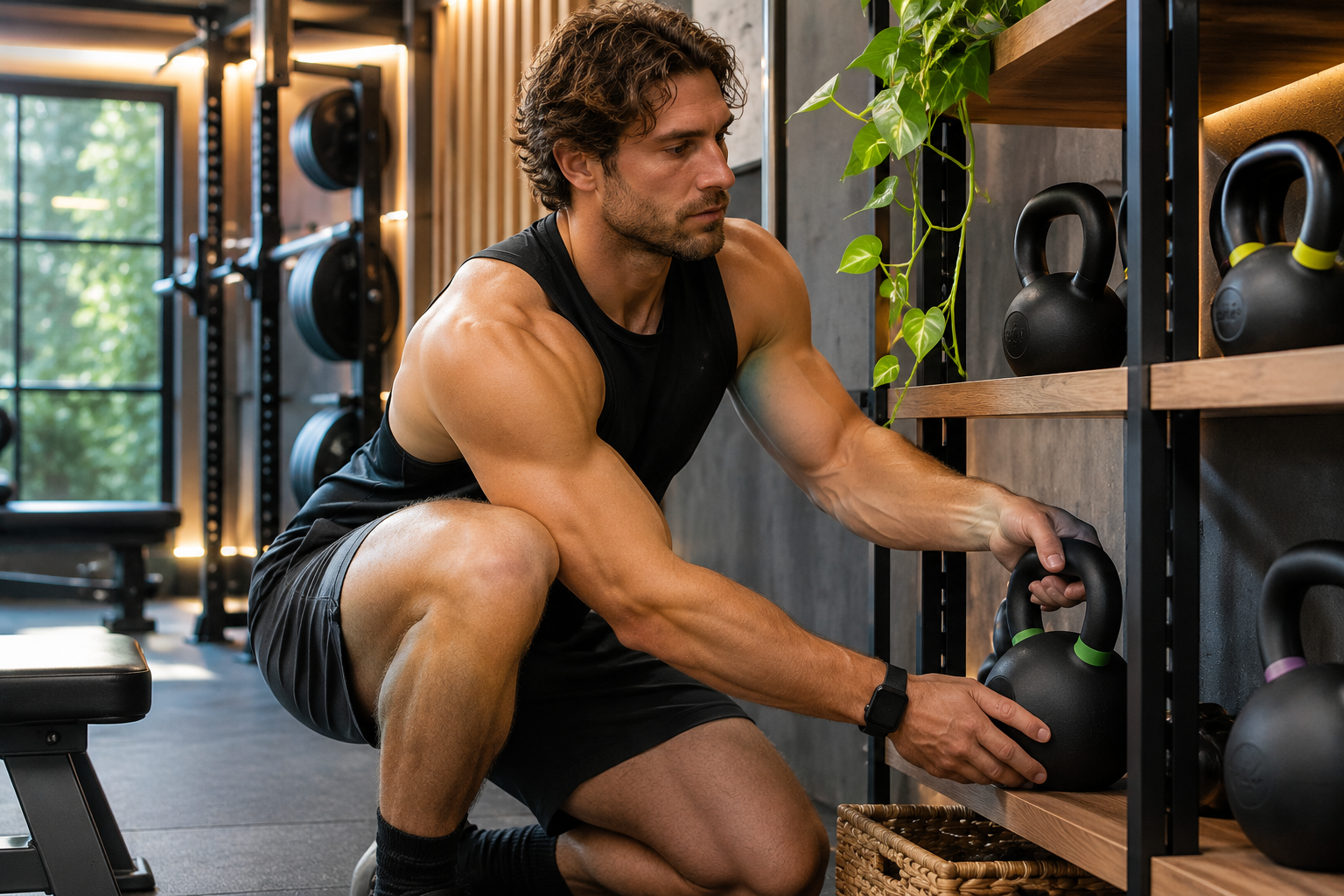
Instead of hiding everything away, the Athlete Cave puts its equipment on display. A row of kettlebells arranged by size. Weight plates stacked neatly beside the rack. Resistance bands hanging from a dark pegboard. These aren’t things you need to conceal. They’re part of what gives the room its personality.

Dark Walnut Shelving With Matte-Black Brackets
One of my favorite storage combinations for this aesthetic is dark-stained lumber mounted on heavy matte-black steel brackets. The wood adds warmth, while the steel maintains that rugged, industrial appearance. Use the lower shelves for kettlebells, provided they’re properly rated for the weight. The upper shelves can hold lighter accessories like chalk, your training journal, and a water bottle.
It’s simple, practical, and visually consistent.
Matte-Black Plate Tree
If you have a barbell setup, a plate tree is one of the easiest ways to keep your training area organized. Position it near the rack so your plates are always within reach. Store heavier plates toward the bottom and lighter plates above, following the rack manufacturer’s loading recommendations. I’d also recommend choosing a plate tree with a little more capacity than you currently need. That way, you have room to expand your collection without replacing your storage system.

Matte-Black Pegboard
A pegboard is another excellent addition. And in an Athlete Cave, I’d paint it the same charcoal or near-black color as the walls. That way, the panel blends into the background while your equipment remains visible. Use it to organize resistance bands, lifting straps, collars, and other accessories. Arrange everything based on how frequently you use it.
Wall-Mounted Barbell Hooks
If you own more than one barbell, wall-mounted steel J-hooks can keep your secondary bar off the floor. Install them at a comfortable height using hardware rated for the bar’s weight and the wall construction.

Matte-Black Dumbbell Rack
For dumbbells, stick with a matte-black rack. It complements the rest of the equipment and maintains the room’s dark, focused appearance. Chrome or bright silver might work in a Performance Studio, but they can feel out of place here.

Clean Minimalist Home Gym Storage Ideas: Less Clutter, More Space
The Clean Minimalist takes a very different approach. Where the Athlete Cave proudly displays its equipment, the Clean Minimalist tries to make storage almost disappear. The goal is to finish your workout, put everything away, and have the room look just as peaceful as it did before you started. That means fewer visible items, slim storage solutions, and a little discipline about what you bring into the space.

Low-Profile Wall-Mounted Dumbbell Rack
Choose a slim dumbbell rack in matte steel. Ideally, it should sit close to the wall without protruding too far into the room. A muted finish works particularly well against warm-white walls because it doesn’t draw unnecessary attention.
One Floating Shelf
Here’s a simple rule I like for this aesthetic. Three items maximum. Your floating shelf might hold a water bottle, a training journal, and a small plant. That’s it. If you want to add something new, remove something else first. The idea isn’t to make the shelf look empty for the sake of it. It’s to keep it from becoming a place where random accessories accumulate.

Natural-Fiber Basket
A single woven basket beneath your bench can handle smaller accessories. Think foam rollers, stretching straps, and resistance bands. Seagrass or woven cotton in a neutral color works well with the Clean Minimalist’s warm, understated palette. Just make sure the basket is sized appropriately for what you’re storing.
Wall Hooks in a Straight Line
A few matte-steel wall hooks can keep bands, towels, and other lightweight accessories off the floor. Install three to five hooks in a clean horizontal line. Even spacing makes a difference here. When the room is intentionally simple, small inconsistencies become more noticeable.

Foldable Bench
If your bench is designed for upright storage, give it a dedicated spot against the wall. Once the workout is over, it goes right back there. No improvising.

Industrial Loft Home Gym Storage Ideas: Raw Materials, Practical Design

The Industrial Loft is all about celebrating materials that look like they belong in a workshop or warehouse. Raw steel. Dark-stained lumber. Exposed brick. Concrete. And your storage should feel like a natural extension of those materials. This isn’t the aesthetic for glossy white cabinets or decorative plastic organizers. You want something rugged, functional, and visually connected to the architecture of the room.
Rough-Sawn Lumber Shelves
Start with two or three shelves made from rough-sawn lumber. Stain them dark walnut and mount them on heavy steel brackets. Against exposed brick or concrete, this combination looks fantastic. Use lower shelves for heavy kettlebells and higher shelves for lighter accessories. As always, make sure the shelving and mounting hardware are rated for the equipment’s weight.
Large Matte-Black Pegboard
If you have enough wall space, consider a full 4-by-8-foot pegboard. It’s a much more substantial storage feature than the smaller panels used in other aesthetics. And in an Industrial Loft, that works in your favor. A large matte-black pegboard with steel hooks can feel like something you’d find in a well-organized workshop. Use it for resistance bands, straps, collars, and other accessories.
Steel Plate Tree and Wall Hooks
For plates and barbells, stick with raw steel or matte-black storage. A sturdy plate tree beside the rack keeps your weights accessible. Wall-mounted J-hooks can handle secondary barbells. The simpler the hardware looks, the better it fits the space.

Concrete and Masonry Anchors
If you’re mounting storage to exposed brick, concrete block, or poured concrete, pay close attention to the anchors. Different masonry materials require different hardware. And a shelf loaded with cast-iron kettlebells can place a substantial load on the wall. Choose an anchoring system rated for the actual substrate and expected weight.
The Industrial Loft Finish Rule
Try to stick with four main materials:
- Matte-black steel
- Raw steel
- Dark-stained wood
- Exposed concrete or brick
You don’t need every item to match perfectly. But keeping your storage within this material palette will make the room feel more cohesive. A bright plastic bin might be convenient, but it probably won’t contribute much to the industrial atmosphere. Whenever possible, choose storage that looks like it belongs in the space.

Naturalist Home Gym Storage Ideas: Make Organization Part of the Décor
The Naturalist is probably the easiest archetype to make feel like an ordinary living space. And that’s exactly the point. Instead of emphasizing heavy equipment or industrial materials, the Naturalist uses wood, plants, woven textures, and earth tones to create a warm, inviting environment. Your storage should support that atmosphere. Ideally, someone walking into the room should notice the beautiful shelves and baskets before realizing they’re looking at gym storage.

Light Oak Floating Shelves
Light oak shelves are a great starting point. They add warmth without making the room feel heavy. And if you want to give the storage area a little more personality, add a trailing plant. A pothos hanging over the edge of the shelf can soften the appearance of the wall and make the space feel more alive. Just keep plants and watering away from electrical equipment and anything that could be damaged by moisture.
Seagrass and Jute Baskets
Woven baskets are some of the best storage options for this aesthetic. Use one for resistance bands and mobility accessories. Keep another for yoga blocks, straps, and other lightweight props. From across the room, they look like ordinary home décor. Up close, they’re doing a useful job.

Wooden Dowel Hooks
Instead of steel hooks, try wooden dowels. They work well for lightweight accessories like resistance bands and stretching straps. And if your bands come in earth tones—olive, terracotta, sand, or muted brown—they can actually contribute to the room’s color palette. Arrange them by resistance level to keep everything practical.
Outdoor Gear Hooks for Garage Gyms
If your Naturalist gym is in a garage, consider adding a dedicated hook for outdoor training gear. Jump ropes, gloves, or trail shoes can have their own designated spot. It’s a small detail that acknowledges the connection between your indoor workouts and outdoor activities.

Performance Studio Home Gym Storage Ideas: Clean, Precise, and Mirror-Friendly

If you’re building a Performance Studio, there’s one thing you need to remember. Your mirror reflects everything. That includes the beautiful equipment you’ve carefully selected. But it also includes every resistance band, water bottle, and foam roller you’ve left lying around. Which means organization is especially important. The Performance Studio should feel polished and intentional, almost like a boutique fitness facility.
Your storage can remain visible, but it needs to look deliberate.
Brushed-Metal or Chrome Dumbbell Rack
Unlike the Athlete Cave, the Performance Studio actually benefits from polished finishes. A slim wall-mounted dumbbell rack in brushed metal or chrome can look fantastic. Position it on a wall perpendicular to the mirror. That way, the rack becomes part of the room’s organized reflection without dominating the entire view.
Slim Resistance Band Organizer
Keep your bands arranged neatly on a wall organizer. Neutral black and grey bands work particularly well with the Performance Studio’s cool, restrained color palette. Sort them by resistance level so they’re easy to find during a workout.

Home Gym Storage Ideas by Equipment Type
Not everyone chooses storage based on an aesthetic.
Sometimes you just want to know where to put your dumbbells.
And that’s completely fair.
Here are a few practical storage recommendations based on the equipment you own.
| Equipment | Recommended storage |
|---|---|
| Dumbbells | Wall-mounted rack where structurally appropriate, or a compact freestanding rack |
| Resistance bands | Wall hooks or a band organizer, sorted by resistance |
| Yoga mats and props | A basket or vertical stand near the stretching area |
| Kettlebells | A low, weight-rated shelf or sturdy floor rack |
| Weight plates | A stable vertical plate tree with appropriate capacity |
| Folding cardio equipment | Manufacturer-approved folded storage against a wall or beneath suitable furniture |
The key is choosing a solution that makes the equipment easy to access without interfering with your workouts. And once you’ve found something practical, match the finish to your gym’s aesthetic.
A matte-black rack might be perfect for an Athlete Cave. A light wood shelf might be better for a Naturalist. A brushed-metal organizer might make more sense in a Performance Studio. The function stays the same. The appearance changes to fit the room.
Build a Gym That Stays Organized
Here’s the thing about a well-designed home gym. It doesn’t need to stay perfectly clean every second of the day. You’re supposed to use it. You’re supposed to sweat, move equipment around, and challenge yourself.
But when the workout is over, everything should have somewhere to go. That’s what separates a gym that stays organized from one that gradually becomes another storage room. And it doesn’t require the most expensive cabinets or the fanciest organization system. It requires a little planning.
Give every item a designated place. Keep equipment close to where you use it. Take advantage of your walls when it’s practical. Choose storage that complements the room. And make putting everything away as easy as possible. The best home gym storage ideas aren’t necessarily the most creative ones. They’re the ones you’ll actually use.
Because when your equipment is organized, you spend less time searching for things, moving clutter, or rearranging the room. You can walk in, start your workout, and focus on what matters. Your Iron Paradise should make training easier—not give you another room to clean.
If you’re still deciding which home gym aesthetic fits your personality and training style, the free SOMA Dream Gym Style Guide walks you through all five—with mood boards, equipment guides, and a framework for creating a space that reflects who you’re becoming.
Leave a Reply