
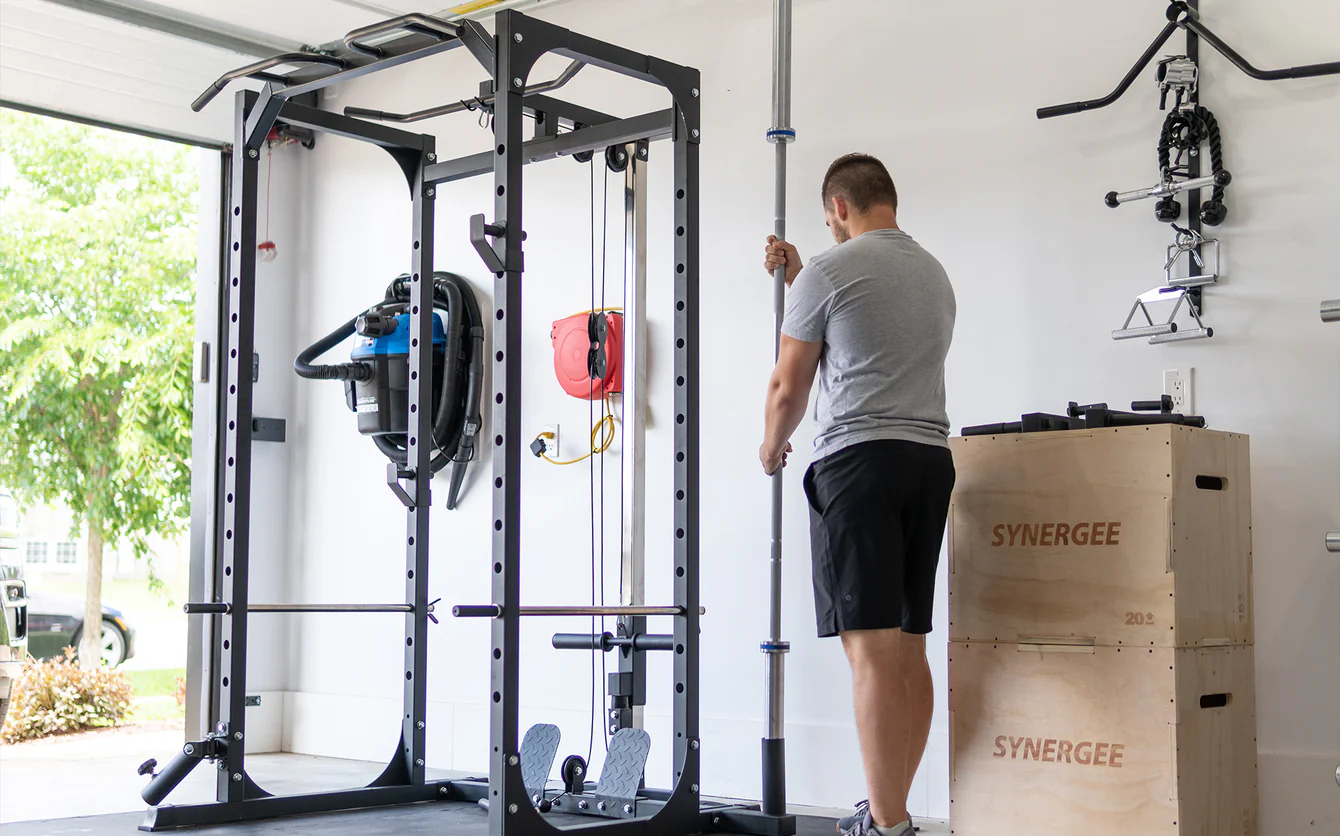
The One Piece of Equipment That Changes Everything
Here’s the truth no one tells you when you’re planning a home gym: most people piece together equipment for months — resistance bands, adjustable dumbbells, a bench — and still feel like something is missing. That something is a power rack. It’s the difference between a collection of gear and an actual training environment.
A power rack doesn’t just let you squat and bench safely without a spotter. It anchors your entire setup. It signals — to you, every time you walk in — that this space is serious. And for the growing adult building a home gym because their schedule doesn’t allow for gym commutes, or because they’re done training around other people’s energy, choosing the right rack is the most important equipment decision they’ll make.
I’ve spent years training clients and testing equipment, and I evaluated every rack on this list against the same five criteria: weight capacity, footprint, safety features, value, and build quality. No filler picks. No brand partnerships influencing the rankings. Just an honest look at what belongs in a real home gym.
Quick Picks: Best Power Rack for Home Gym at a Glance
| Pick | Best For | Price Range |
|---|---|---|
| MAJOR FITNESS F22 Power Rack | Best Overall | $500–$700 |
| C1-V4 Power Cage | Best Budget (Under $400) | $250–$380 |
| PASYOU Adjustable Squat Power Rack | Best Half Rack / Squat Rack | $200–$350 |
| Mikolo 2″x2″ Folding Wall Mounted Squat Rack | Best Compact / Foldable | $300–$450 |
| Mikolo 3″x3″ Power Cage | Best Heavy-Duty | $600–$900 |
| pooboo Multi-Functional Machine Power Cage | Best with Cable Pulley System | $500–$750 |
| Titan Fitness T-2 Series Short Power Rack | Best for Low Ceilings | $400–$600 |
| Major Fitness Drone MAX V Smith Machine | Best with Smith Machine | $800–$1,100 |
The Best Power Rack Picks for Home Gyms in 2026
1. Best Overall: MAJOR FITNESS F22 Power Rack

| Dimensions: | 68.9″W × 55.5″D × 82.5″H Steel: 2″×3″ 14-gauge (front uprights) |
| Weight Capacity: | 1,600 lbs (rack); 400 lbs per side (cable system) |
| Uprights: | 14 height positions; 17 cable pulley positions |
| Included: | Sandwich J-hooks, safety arms, dip bars, T-bar, lat pulldown bar, straight bar, stirrup handles, landmine, 6 band pegs |
| Pulley System: | Dual independent 2:1 ratio plate-loaded cables |
| Warranty: | 1 year (parts and labor) |
What you want: You want a rack that does everything well — squats, bench press, pull-ups, safety catches — without paying commercial gym prices or sacrificing your garage to a piece of equipment that takes up half the space.
Why it works: The MAJOR FITNESS F22 is the rack I’d put in my own garage, and it’s what I recommend to most clients who ask me where to start. It’s a full cage design with proper J-hooks, steel safety bars, and an integrated pull-up bar — which means you’re not buying attachments separately on day one. The 11-gauge steel frame holds up to 1,000 lbs, which covers every lifting scenario the vast majority of home gym athletes will ever encounter.
What earns it the top spot on this list isn’t any single feature — it’s the ratio. At this price point, you usually sacrifice either steel quality or usability. The F22 doesn’t make you choose. The hole spacing is tight enough for precise safeties positioning, the uprights are wide enough for standard barbells, and assembly is manageable for one person with basic tools in two to three hours.
Practical takeaway: Before you buy, measure your ceiling height. The F22 stands 82 inches tall — ideal for standard 8-foot ceilings, but worth confirming before it arrives.
2. Best Budget Power Rack (Under $400): C1-V4 Power Cage

| Dimensions: | 57.56″D × 44.72″W × 77.44″H |
| Steel: | 2″×2″ 13-gauge alloy steel frame |
| Weight Capacity: | 2,000 lbs (rated); 43.35″ internal cage depth |
| Footprint: | ~17.88 sq. ft. floor space |
| Included: | 2 J-hooks, safety spotter arms, lat pulldown bar, T-bar, V-handle, tricep rope, cable bar, 360° landmine, elastic band bars, 6 counterweight racks with clamps, pulley system |
| Pulley System: | High-low 1:1 cable ratio; covers ~90% of cable exercises |
| Warranty: | 2 years |
What you want: You’re not ready to spend $600 on a rack when you’re still figuring out if strength training is going to stick. But you also know that training without safety catches is how people get hurt — and that a squat stand wobbling under load is terrifying.
Why it works: The C1-V4 Power Cage is the honest answer to that problem. It’s not built like a Rogue, and it’s not trying to be. But it gives you four-post stability, adjustable J-hooks, and safety bars at a price point that makes it a legitimate starting rack rather than a compromise you’ll regret.
The steel gauge is thinner than premium options (14-gauge vs. 11-gauge), and the weight capacity tops out around 500–600 lbs — more than enough for intermediate lifters, but something to factor in if you’re planning to push heavy loads long-term. The frame is stable when properly anchored to the floor, which I’d call non-negotiable regardless of the rack you buy.
Practical takeaway: Anchor this rack to a rubber mat or, better, to the floor itself. At this price tier, the difference between a stable training environment and a wobbly one is almost always anchoring.
3. Best Half Rack / Squat Rack: PASYOU Adjustable Squat Power Rack

| Steel: | 2″×2″ heavy-duty steel tubing; unit weighs 66 lbs |
| Weight Capacity: | 600 lbs (J-hooks, recommended working load); 1,800 lbs (safety bumpers, recommended working load) |
| Adjustment Positions: | 14 J-hook height positions; 7 bumper positions |
| Safety System: | 4 reinforced bumpers (2 per side) with screw-locked anti-slip pads |
| Design Details: | Anti-loosening damping screws; 4 anti-slip foot pads; three-sided steel-wrapped uprights |
| Footprint: | Open/half-rack design — no rear posts |
| Warranty: | 1 year with 24/7 customer support |
What you want: Your space is tight, your ceiling is low, or you simply don’t need the full enclosed cage — but you still want the safety of adjustable catches without training in the open air with a squat stand.
Why it works: This is where the distinction matters, and I want to clear it up because it confuses a lot of buyers: a squat stand is two independent posts with no connection at the top. A half rack connects those posts at the top or rear, adding stability without fully enclosing you. A full power cage encloses you on all four sides. The PASYOU sits in that half rack middle ground — it’s more stable than a stand, more open than a cage.
The adjustable design makes it genuinely flexible for multiple users or multi-exercise programming. The height range accommodates shorter athletes and taller ones without awkward work-arounds. Where it gives up ground to a full cage is depth — there are no rear safeties, so proper bail-out technique matters more here.
Practical takeaway: If you’re training alone and still building your bail-out confidence, add resistance band safeties to the front posts. It’s a simple, inexpensive addition that significantly raises your margin for error.
4. Best Compact / Foldable Power Rack: Mikolo 2″x2″ Folding Wall Mounted Squat Rack

| Dimensions (Open): | 47″W × 19.7″D × 85.8″H |
| Dimensions (Folded): | 47″W × 2″D × 85.8″H |
| Steel: | 2″×2″ 13-gauge steel uprights; textured powder coat finish |
| Weight Capacity: | 1,000 lbs total; J-hook capacity: 400 lbs |
| Wall Depth When Folded: | ~2″ from wall — negligible floor footprint |
| Transition Time: | ~15 seconds to switch between folded and open positions |
| Included: | Quick-attach pull-up bar (reaches 89″ height), UHMW-lined J-cups, 360° dual-size T-bar landmine attachment |
| Warranty: | 1 year (parts replacement) |
What you want: You have a one-car garage, an apartment with a dedicated room, or a shared space that has to function as more than a gym. A full cage would take it over completely — so you’re stuck choosing between your car and your clean pull.
Why it works: You don’t have to make that trade. The Mikolo folding wall-mounted rack is designed to fold flat against the wall when not in use, reclaiming the floor space you need. It’s one of the most searched categories in the home gym space right now, and for good reason — it solves a real problem that a traditional rack cannot.
The 2″x2″ steel uprights and the wall-mount design mean the rack is only as strong as your wall anchor, which is the key variable to get right. Mount into studs with proper hardware — this is not a drywall anchor situation. Done correctly, it’s remarkably solid. The J-hooks and safety pins fold with the unit, so there’s no disassembly between sessions.
Practical takeaway: Before purchasing, identify your stud spacing. Standard stud spacing is 16 inches — measure and confirm yours before the rack arrives to avoid installation delays.
5. Best Heavy-Duty Power Rack: Mikolo 3″x3″ Power Cage

| Dimensions: | 42″L × 46.1″W × 90.6″H; inside depth: 36″ |
| Steel: | True 3″×3″ 14-gauge steel tubing (76.2mm × 76.2mm uprights) |
| Weight Capacity: | Up to 2,000 lbs |
| Hole Specs: | 1″ holes with 2″ spacing; 32 numbered vertical positions with laser-cut labels |
| Included: | 2 nylon safety straps, 2 sandwich J-hooks, 4 band pegs, barbell storage rack, detachable 360° landmine |
| Attachment Compatibility: | Industry-standard 1″ hole sizing — compatible with most major brands’ 3″×3″ attachments |
| Warranty: | Manufacturer guarantee; replacement parts available |
What you want: You’ve been lifting for years. Your squat is well over 300 lbs, your deadlift is heading somewhere serious, and you’ve outgrown the racks that 90% of buyers are shopping for. You need something built to take real punishment, not just rated for it on paper.
Why it works: The step from 2″x2″ to 3″x3″ uprights isn’t cosmetic — it’s the industry line between consumer-grade and commercial-grade construction. The Mikolo 3″x3″ Power Cage is built on that commercial side of the line. The thicker steel means less flex under heavy load, more stable safety catches, and a frame that won’t develop that subtle rattle that cheaper racks get after a year of serious use.
At 1,000+ lbs capacity with 11-gauge steel throughout, this is a rack you buy once. It also accepts standard Rogue Monster and Titan bolt-pattern attachments — meaning your investment in a lat pulldown, dip bar, or landmine today won’t be wasted when you upgrade your rack tomorrow.
Practical takeaway: If you’re in the 3″x3″ category, don’t buy a 2″x2″ rack to save money now. The upgrade cost later — selling your old rack, buying new, re-anchoring — will exceed the price difference.
6. Best Power Rack with Cable Pulley System: pooboo Multi-Functional Machine Power Cage

| Dimensions: | 43.3″D × 62.9″W × 82.6″H |
| Steel: | Heavy-duty steel frame; sandblasted and rust-proof powder-coat finish |
| Weight Capacity: | 2,000 lbs (rack frame); 1,000 lbs (pulley/cable system) |
| Pulley System: | Dual bearing pulleys with PU wire rope; high and low cable positions |
| Included: | 2 J-hooks, 2 safety spotter arms, 2 dip bars, lat pulldown bar, row bar, low-row foot board, 360° landmine, 4 plate storage pins, 4 band pegs, 2 cable grip handles |
| Pull-Up Bar: | Multi-grip integrated bar with wide and narrow options |
| Warranty: | 1 year (frame and accessories) |
What you want: You want to train like you have a full gym — lat pulldowns, cable rows, tricep pushdowns — without buying separate machines that turn your space into an obstacle course.
Why it works: The all-in-one category has exploded for exactly this reason. The pooboo Multi-Functional Machine Power Cage integrates a cable pulley system directly into the rack frame, giving you the vertical pulling and cable movements that free weights and a barbell can’t replicate, in one footprint.
The cable weight stack handles light-to-moderate loads well — it’s not replacing a 200-lb commercial stack, but it handles the rep ranges most people actually train in for isolation work. The rack itself is full-cage design with standard safety bars and J-hooks, so you’re not giving up barbell training capability to get the cable system.
Practical takeaway: Map out your cable movements before you buy. If lat pulldowns and seated rows are your primary cable needs, this setup delivers. If you need heavy cable crossovers or stacked loading for athletic training, you may want a standalone functional trainer instead.
7. Best Power Rack for Low Ceilings: Titan Fitness T-2 Series Short Power Rack

| Dimensions: | 57″W × 50″D (overall footprint); |
| Height: | 71″ (short version) or 83″ (standard) |
| Steel: | 2″×2″ 14-gauge laser-cut uprights with powder-coat finish |
| Rackable Capacity: Total Rack Capacity: | Rackable Capacity: 850 lbs | Total Rack Capacity: 2,200 lbs |
| Inside Width: Inside Depth: | 42″ 26″ |
| Hole Specs: | 1″ holes with 2″ center spacing throughout front and rear uprights |
| Included: | J-hooks (1,000 lb rated), pin/pipe safeties, pull-up bar (1.25″ diameter), weight plate horns |
| Attachment Ecosystem: | Extensive Titan T-2 accessory line — lat tower, strap safeties, monolift, and more sold separately |
| Warranty: | Titan Fitness standard warranty; replacement parts available |
What you want: Your garage ceiling clears 7.5 feet, most full racks need 8+ feet of clearance, and you’ve been told to just “get a half rack” — which isn’t the answer you were looking for.
Why it works: Low-ceiling home gyms are more common than the fitness industry acknowledges, and most product recommendations ignore this entirely. The Titan Fitness T-2 Series Short Power Rack was built specifically for this constraint. The short version clears approximately 70 inches tall — meaning you can train in a 7-foot ceiling environment without banging a barbell on overhead supports.
Titan Fitness is one of the most trusted names in the home gym space, and the T-2’s reputation is well-earned. The 11-gauge steel, the tight hole spacing, and the extensive attachment compatibility make this one of the best power rack home gym options on the market regardless of ceiling height — the low-clearance version just extends access to buyers who were previously locked out.
Practical takeaway: Measure floor-to-lowest-obstruction, not just floor-to-ceiling. HVAC ducts, lighting fixtures, and garage door tracks frequently reduce actual clearance below the ceiling height.
8. Best Power Rack with Smith Machine: Major Fitness Drone MAX V

| Steel: | 2″×2″ 14-gauge commercial-grade steel frame |
| Weight Capacity: | 2,500 lbs (rack); 400 lbs dynamic / 750 lbs static (Smith bar) |
| Smith Machine: | 18-position safety lock with steel stop hooks; linear bearing guide rods |
| Adjustment Positions: | 18 J-cup positions; 18 cable pulley positions (floor level to 71″+) |
| Pulley System: | Dual-ratio aluminum pulleys — switchable 1:1 and 2:1 ratios; dual independent cable systems |
| Included: | Dip bars, T-bar, lat pulldown bar, cable handles, band pegs, multi-grip pull-up bar, 360° landmine; dual weight stacks standard |
| Warranty: | Lifetime after-sales support; 24/7 customer service |
What you want: You want the guided path of a Smith machine for solo pressing and squatting — but you don’t want to give up the free-bar training that builds real strength. And you definitely don’t want two separate machines taking up twice the space.
Why it works: The Major Fitness Drone MAX V combines a Smith machine with a functional power rack in one unit. The Smith bar travels on a fixed vertical path with safety hooks at every level, which is genuinely useful for training alone on heavy pressing movements. The free-bar uprights are still there, so you’re not forced into the machine — it’s an option available when you need it.
This is the category where you pay for complexity, and that’s reflected in the price. But for buyers who specifically want Smith machine access without a dedicated unit, the Drone MAX V is the most space-efficient solution available at this price point.
Practical takeaway: The Smith machine component adds significant weight to the unit. Confirm your floor can support the total load — rack weight plus plates — especially if you’re training on an upper-level room or wood subfloor.
What to Look for in a Power Rack: Trainer’s Buying Guide
Steel Gauge and Weight Capacity
Steel gauge is the most misunderstood spec in rack shopping. A lower number means thicker, stronger steel: 11-gauge is commercial-quality; 14-gauge is consumer-grade. For most home gym athletes lifting under 400 lbs, 14-gauge is fine. For anyone pushing heavier loads or planning to grow into serious strength training, 11-gauge is worth the price difference.
Weight capacity is a rated maximum, not a working maximum. A rack rated to 500 lbs shouldn’t have 500 lbs on it regularly — build in a margin.
Hole Spacing: Westside vs. Standard
Most racks use 2-inch hole spacing. Westside spacing (1-inch spacing in the bench-press zone, 2-inch elsewhere) gives you more precise safety catch positioning for bench pressing — meaningful if bench is a priority movement. If you’re buying primarily for squats, standard 2-inch spacing is perfectly adequate.
Safety Bar Types: Pin vs. Strap
Pin safeties are rigid steel — they don’t move, they don’t flex, and they catch a failed rep hard. Strap safeties are nylon straps that have a small amount of give, which is gentler on barbells (and on you) during a failed rep. Both are safe. Strap safeties are increasingly preferred for home gym use because they don’t require perfect height adjustment the way pins do.
Footprint and Ceiling Clearance
Standard full cages run approximately 48″W x 48″D x 82″H. Add 24 inches of working space on each side for loading plates, and you’re looking at roughly 8 feet x 8 feet of dedicated floor space minimum. Ceiling clearance needs to account for overhead pressing — if you’re planning to overhead press inside the rack, you need the bar path plus your reach height above the safeties.
Uprights Width and Depth
Upright spacing determines whether your barbell fits with room for plates. Standard uprights are 24 inches inside width — enough for a standard 7-foot Olympic bar. Narrower racks can create tight fits. Depth determines whether you have room to step back with the bar on your back — 24 inches of internal depth is the comfortable minimum for squatting.
Warranty and Brand Support
This matters more than most buyers realize until something breaks. Rogue Fitness, Titan Fitness, and REP Fitness all offer multi-year structural warranties and sell replacement parts. Lesser-known brands may not. A rack is a long-term investment — buy from a brand that will still exist when you need a replacement J-hook in three years.
Power Rack vs. Squat Stand vs. Half Rack — What’s the Difference?
This is the question I get most often from people in the planning phase of their home gym build, and the answer matters because each option has a legitimate use case.
Squat stands are two independent posts. They’re light, portable, and space-efficient. They’re also the least stable option, and training alone with heavy weight on squat stands requires confidence in your bail-out technique. Best for: experienced lifters in small spaces who prioritize portability.
Half racks connect the two posts with a rear frame or top connection, adding stability without full enclosure. You can load and unload from multiple directions, and many half racks include rear safeties. Best for: lifters who want more stability than a stand without the footprint of a full cage.
Full power cages are the four-post enclosed structure most people picture when they think “power rack.” They offer maximum stability, four-sided safety catches, and the most attachment options. Best for: anyone training alone, lifting heavy, or planning a long-term home gym setup.
If you’re building a home gym you plan to actually use for years, a full cage is almost always the right answer.
How Much Should You Spend on a Power Rack?
$200–$400: Entry-level cages and squat racks. Functional for beginners and intermediate lifters at moderate loads. Expect 14-gauge steel, basic hardware, and limited attachment compatibility. Valid starting point if budget is the primary constraint.
$400–$800: The sweet spot for most home gym athletes. This is where you find 11-gauge steel, proper hole spacing, quality J-hooks, and brands with real warranty support. The MAJOR FITNESS F22 and Titan T-2 both live here. I recommend spending to this tier if you can.
$800+: Commercial-adjacent construction, Smith machine combinations, all-in-one cable systems, and premium brand names. Worth the investment if you’re building a permanent, high-use home gym and want to buy once.

FAQ: Power Rack for Home Gyms
Is a power rack worth it for a home gym?
Yes — with no qualification. A power rack is the only piece of equipment that lets you train barbell movements safely without a spotter. For anyone serious about strength training at home, it’s the highest-value purchase you’ll make.
What size power rack do I need?
For most people: a standard full cage (48″W x 48″D x 82″H) with at least 24″ of internal width. If your ceiling is under 84 inches, look specifically at short-rack models. If your space is under 6’x6′, a folding wall-mount is worth considering.
Can a power rack go on concrete?
Yes — concrete is actually an ideal surface. Use rubber horse stall mats (3/4″ thick) under the rack to protect the floor, reduce vibration, and add grip. Anchor the rack to the concrete with wedge anchors for maximum stability.
How much weight can a home power rack hold?
Entry-level racks: 500–600 lbs. Mid-range 11-gauge steel racks: 1,000 lbs. Heavy-duty 3″x3″ commercial racks: 1,000–2,000+ lbs. The rating is the maximum, not the target — train within the margin.
Do I need to anchor a power rack?
Yes, always — regardless of how heavy the rack is. An unanchored rack can tip or walk under dynamic loading. This is not optional, and it’s the most common setup mistake I see.
What’s the difference between 2″x2″ and 3″x3″ uprights?
Upright dimensions determine rigidity and attachment compatibility. 2″x2″ is standard for consumer racks; 3″x3″ is commercial-grade. The larger uprights also use a bolt-on attachment system that’s compatible across major brands (Rogue Monster, Titan).
Can I use a power rack for exercises other than squats and bench press?
Absolutely — this is what makes it the anchor of a home gym. Pull-ups, inverted rows, rack pulls, overhead press, barbell rows, pin press variations, and with attachments: dips, landmine movements, cable work. A good rack is a full upper and lower body training system.
The Bottom Line: Build the Environment First
The question I get asked more than any other is: where do I start? And the answer, every time, is the same. Start with the rack.
Not because it’s the most exciting purchase. Not because it’s the flashiest thing in the room. Because it’s the foundation. Everything else — the plates, the barbell, the flooring, the accessories — is built around it. And when you walk into a space that has a real rack in it, something shifts. The excuses get quieter. The intentions get louder.
The best power rack for your home gym is the one that fits your space, your current strength, and your long-term vision for what your training environment needs to be. For most people, that’s the MAJOR FITNESS F22. For others, it’s the Titan T-2, the Mikolo 3″x3″, or the folding wall-mount that makes a small space work.
What matters is that you stop waiting for the perfect moment and start building the environment that makes becoming who you’re capable of being the path of least resistance.
Have a question about which rack fits your specific space? Drop it in the comments or reach out directly — I read every one.

Leave a Reply