
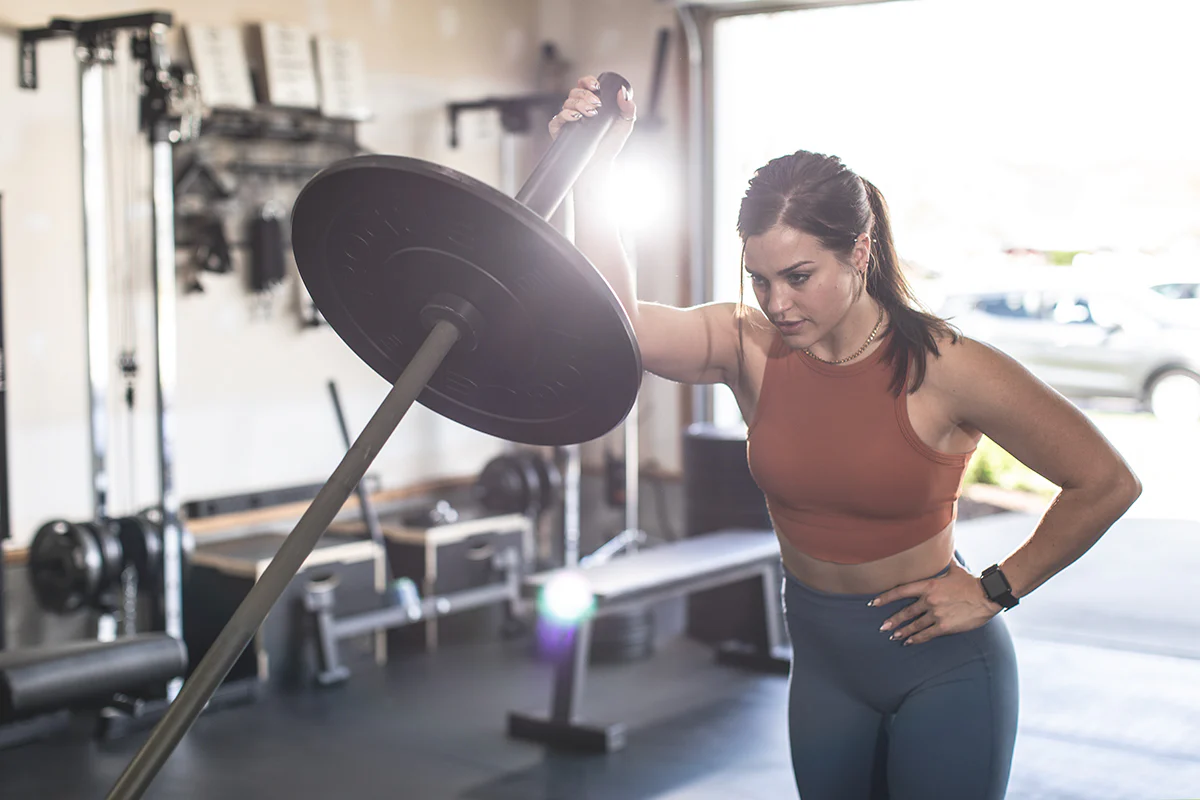
Most people building a home gym think in straight lines — squat rack, barbell, bench, done. But there’s one attachment that quietly multiplies the usefulness of every piece of equipment you already own, takes up almost no space, costs less than a single dumbbell set, and lets you train every major movement pattern with a single barbell. It’s called a landmine — and it might be the most underrated tool in the home gym world.
If you’re putting together a serious training space at home and you haven’t looked into landmine exercises for your home gym, this guide is going to change how you think about programming. We’re going to break down the setup, the mechanics, every major movement category, three ready-to-use workouts, and the practical tips that make the difference between a tool that gathers dust and one that becomes a cornerstone of your training.
What Is a Landmine Setup? (And What Do You Actually Need?)
A landmine is deceptively simple: you take one end of a barbell and anchor it to a fixed pivot point, then load the other end with weight. That pivot creates a fixed arc of motion — meaning the bar can swing up and down, rotate left and right, but always returns to the same path. That constraint is exactly what makes it so useful.
Types of landmine attachments:
- Corner mount: The most basic option. You wedge the sleeve end of your barbell into a wall corner, usually protected with a towel or rubber mat. Zero cost. Slightly less stable than a dedicated attachment, but it works.
- Floor sleeve attachment: A standalone sleeve that sits on the floor and accepts the barbell end. Often plate-loaded to keep it anchored. Costs $30–$60. Works anywhere on your floor without wall contact
- Rack-mounted attachment: Bolts or clamps onto your power rack or squat stand. The most stable option. Prices range from $40–$120 depending on your rack brand.
What you need to get started:
- A standard or Olympic barbell (you almost certainly already have one)
- A landmine attachment (or a towel-padded corner)
- Weight plates
- About 6–8 feet of open floor space
Related Post: Essential Home Gym Equipment vs Optional: What to Buy First
Why Landmine Exercises Are Ideal for Home Gyms

Here’s what I tell clients who are skeptical: the landmine doesn’t add a new piece of equipment to your gym — it adds about fifteen new exercises to every piece of equipment you already have.
Joint-friendly mechanics. Because the bar follows an arc rather than a straight vertical path, your joints — especially your shoulders and knees — aren’t forced into rigid patterns. The bar meets your body where it is. For home gym athletes who train alone (meaning no form check, no spotter), that forgiveness matters.
Compact footprint. A rack and barbell already dominate most garage or basement gyms. The landmine attachment adds almost nothing to your spatial footprint, and every movement stays close to the anchor point.
Full movement pattern coverage. Push, pull, hinge, squat, rotate, carry — the landmine handles all of it. That’s not an exaggeration. You can build an entire training program around the landmine alone if you needed to.
Safer for solo training. Pressing heavy overhead without a spotter is genuinely risky. The landmine press eliminates that risk — if the weight gets too heavy, you redirect it down to the floor along the fixed arc. No crash, no injury.
Works with what you own. If you have a barbell and a $40 floor sleeve, you have a landmine setup. The barrier to entry is as low as it gets. [LINK: how to set up a home gym on a budget]
Landmine Push Exercises: Shoulders and Chest Without the Risk
Landmine Press (Standing Shoulder Press Variation)
Stand square to the anchor point, holding the sleeve end of the barbell at shoulder height with both hands or one hand. Press the bar up and away along its arc until your arm(s) are fully extended, then lower with control.
Muscles worked: Anterior and medial deltoid, triceps, upper chest, serratus anterior
Why it works for home gyms: The arc of motion naturally reduces impingement risk compared to a straight barbell overhead press. If you’ve had shoulder issues with conventional pressing, start here.
Cue: Press “up and out,” not straight up. The bar wants to travel along its arc — let it.
Single-Arm Landmine Press
Same setup, one hand. The anti-rotation demand on your core doubles immediately. This is a genuinely complete upper body exercise — your shoulder is pressing while your entire torso is resisting rotation.
Actionable start: Begin with your non-dominant arm. Whatever weight you can press cleanly for 8 reps on that side is your working weight. Match it on both sides.
Landmine Floor Press
Lie on the floor perpendicular to the anchor point, elbow bent, bar at chest height. Press up, lower with control. The floor acts as a natural range-of-motion limiter, protecting your shoulder from going into excessive extension.
Muscles worked: Chest, triceps, anterior delt
Best for: Anyone rebuilding pressing strength after a shoulder injury or surgery.
Pro Tip — Grip and Elbow Path: For all landmine pressing movements, wrap your hand around the sleeve with your thumb overlapping your fingers (like a cup). Keep your elbow at a 45-degree angle to your torso, not flared at 90 degrees. That elbow position alone reduces rotator cuff stress significantly.
Landmine Pull and Row Exercises: Build Your Back Without Cables
Landmine Row (T-Bar Style)
Stand over the bar, hinge at the hips to about 45 degrees, and grip the sleeve end with both hands. Pull the bar toward your lower chest, squeezing your shoulder blades together at the top.
Muscles worked: Lats, rhomboids, rear delts, biceps, erectors (isometric)
Why it’s underrated: This movement loads your back in a way that barbell rows often don’t — the arc keeps tension on your lats even at the top of the movement.
Single-Arm Landmine Row
Same hinge position, one hand. Your non-working arm can rest on your knee for support, or you can go unsupported for greater core demand. The anti-rotation challenge here is significant — your obliques and QL work hard to keep your hips square.
Actionable cue: Before you pull, set your shoulder blade first. Think “down and back” with your scapula before initiating the row. That pre-sets the lat and takes the bicep out of the driver’s seat.
Meadows Row
Named after the late bodybuilder John Meadows, this is a more advanced variation. Stand perpendicular to the bar, stagger your stance (front foot toward the anchor), and grip the sleeve with your outside hand. Row the bar up toward your hip rather than your chest.
Why it’s different: The angle loads your lat in a stretched position throughout the movement — exactly where you want mechanical tension for muscle development. This is one of the best single-arm back exercises you can do with a barbell.
Pro Tip — Keeping Hips Square: In any single-arm row, your hips will want to rotate toward the working side. Fight that. Think about driving your non-working hip toward the floor as a counterbalance. If you’re losing position, drop the weight.
Landmine Hinge and Lower Body Exercises: Hamstrings, Glutes, and Legs
Landmine Romanian Deadlift (RDL)
Stand facing the anchor, holding the sleeve with both hands. Hinge from your hips — pushing them back, keeping your spine neutral — and lower the bar along its arc until you feel a stretch in your hamstrings. Drive your hips forward to return to standing.
Muscles worked: Hamstrings, glutes, erector spinae
Why it’s different from barbell RDL: The arc of the bar creates a slight horizontal pull, which increases hamstring stretch at the bottom. For home gym athletes who do a lot of squatting, this posterior chain balance is essential.
Landmine Sumo Squat / Goblet Squat
Stand facing the anchor with a wide stance, toes turned out, holding the bar at chest height. Squat down, keeping your chest tall and knees tracking over your toes. This is one of the most beginner-friendly loaded squat variations you can do.
Why it’s ideal for home gyms: No rack position to learn, no bar path to master. The landmine guides the movement. If you’re new to barbell training or returning after time off, this is your starting squat. [LINK: beginner barbell training for home gym athletes]
Single-Leg Landmine RDL
Hold the bar with the hand opposite your working leg. Hinge forward while lifting the non-working leg behind you. The bar provides just enough counterbalance to help you maintain position without reducing the stability demand on your working side.
Pro Tip — Foot Position and Loading: For the sumo squat, toes out at about 30–45 degrees. For the RDL variations, a soft bend in the knee at all times — never locked. On the single-leg version, start with zero weight on the bar. The leverage alone is enough of a challenge.
Landmine Core and Rotation Exercises: The Anti-Rotation Advantage
Landmine Rotation (Rainbow)
Stand perpendicular to the anchor, feet shoulder-width, holding the bar with both hands extended. Rotate the bar from one side of your body to the other in a controlled arc — like drawing a rainbow. Control the descent; don’t let gravity do the work.
Muscles worked: Obliques, transverse abdominis, hip rotators, shoulders
Why it’s excellent: This is a true rotational power exercise. Athletes who play any sport involving throwing, swinging, or striking need this movement. For everyone else, it’s core integration in a way that crunches will never touch.
Pallof Press Variation with Landmine
Stand to the side of the anchor, grip the bar at chest height, and press it straight out from your sternum. Hold the extended position for 2–3 seconds, then return. Your core is resisting the rotational pull of the bar — that’s the workout.
Actionable tip: Start 2–3 feet from the anchor. The closer you stand, the less rotational force. Move farther away as you get stronger.
Half-Kneeling Rotation
Drop to one knee facing away from the anchor at a slight angle. Hold the bar at chest height and rotate it to the side of your front knee, then return. The half-kneeling position locks out your lower body and forces all the rotation through your thoracic spine and obliques.
Bonus: This movement also stretches the hip flexor of your back leg — something most home gym athletes desperately need after desk-heavy days.
Pro Tip — Control, Not Speed: Rotational landmine exercises are not about momentum. If the bar is swinging, you’re not training your core — you’re just moving weight. Slow everything down. A 3-second lowering phase on the rainbow will humble you immediately.
Full-Body and Compound Landmine Movements: More Bang Per Rep
Landmine Thruster
Hold the bar at shoulder height, perform a full squat, and as you drive up, press the bar overhead in one fluid movement. This is a squat and a press combined into a single rep.
Why it belongs in your home gym workouts: Conditioning, strength, and coordination all in one pattern. When you’re short on time, five sets of landmine thrusters will do more work in fifteen minutes than most people accomplish in an hour.
Landmine Clean
With the bar loaded on the floor end, hinge down and grip it. Explosively extend your hips, shrug, and “catch” the bar at shoulder height in a partial squat. This is your power development exercise — the kind of athletic movement that translates to everything from recreational sports to everyday strength.
Start light. Technique on this one matters. Master the catch position before adding weight.
Sample Landmine Home Gym Workouts
These workouts are designed for a home gym environment — minimal equipment, no spotter, efficient use of space.
1) Upper Body Push/Pull Focus
| Exercise | Sets | Reps | Rest |
| Single-Arm Landmine Press | 4 | 8 each side | 60 sec |
| Landmine Row (T-Bar) | 4 | 10 | 60 sec |
| Meadows Row | 3 | 10 each side | 60 sec |
| Landmine Floor Press | 3 | 12 | 45 sec |
| Pallof Press Hold | 3 | 8 each side (3-sec hold) | 45 sec |
2) Lower Body and Core Focus
| Exercise | Sets | Reps | Rest |
| Landmine Sumo Squat | 4 | 10 | 60 sec |
| Landmine RDL | 4 | 10 | 60 sec |
| Single-Leg Landmine RDL | 3 | 8 each side | 60 sec |
| Landmine Rotation (Rainbow) | 3 | 10 each side | 45 sec |
| Half-Kneeling Rotation | 3 | 10 each side | 45 sec |
3) Full-Body 30-Minute Circuit
Perform 4 rounds of the following with 90 seconds rest between rounds:
| Exercise | Reps |
| Landmine Thruster | 8 reps |
| Single-Arm Landmine Row | 8 reps each side |
| Landmine Rotation | 10 reps each side |
| Single-Arm Landmine Press | 8 reps each side |
A note on progressive overload with limited plates: You don’t need a full rack of iron. Add half-plates (2.5 lb or 1.25 kg) to extend your progression. When plate jumps feel too large, add reps (go from 8 to 10 to 12) before adding weight. The landmine’s leverage makes even small weight additions feel significant.
Related Post: Best Strength Training Programs for Beginners
Tips for Getting the Most Out of Landmine Training at Home
Loading and unloading solo: Always unload one plate at a time from the loaded end and keep one hand on the sleeve while you work. The unanchored end of the bar becomes a lever the moment it’s unbalanced.
Flooring and anchor considerations: If you’re using a floor sleeve on rubber matting, make sure it’s not sliding. A non-slip mat under the sleeve fixes this immediately. For rack-mounted attachments, confirm your rack is bolted down before loading heavy. [LINK: home gym flooring guide]
Pairing with bodyweight and dumbbells: The landmine handles your primary loaded movements well, but don’t abandon everything else. Pair landmine push/pull sessions with bodyweight pull-ups, dips, or dumbbell isolation work for a complete upper body program.
Warming up the shoulder for pressing: Before any landmine pressing movement, spend 3–5 minutes on shoulder prep: band pull-aparts, wall slides, and thoracic rotations. The landmine is forgiving, but your shoulder capsule still needs to be warm. That five minutes protects years of training.
Conclusion: Build the Right Environment, Then Build Yourself
The home gym isn’t a compromise — it’s a commitment. Every piece of equipment you add is a decision about the kind of training you want to do and the kind of person you’re building yourself into. The landmine fits that philosophy perfectly: low cost, high utility, and zero wasted space.
If you’ve been looking for a way to expand what’s possible in your training environment without expanding your budget or footprint, landmine exercises for your home gym are the answer. Start with two or three movements from this guide — the single-arm press, the T-bar row, and the sumo squat are a complete program on their own. Build from there as you get comfortable with the mechanics.
Leave a Reply